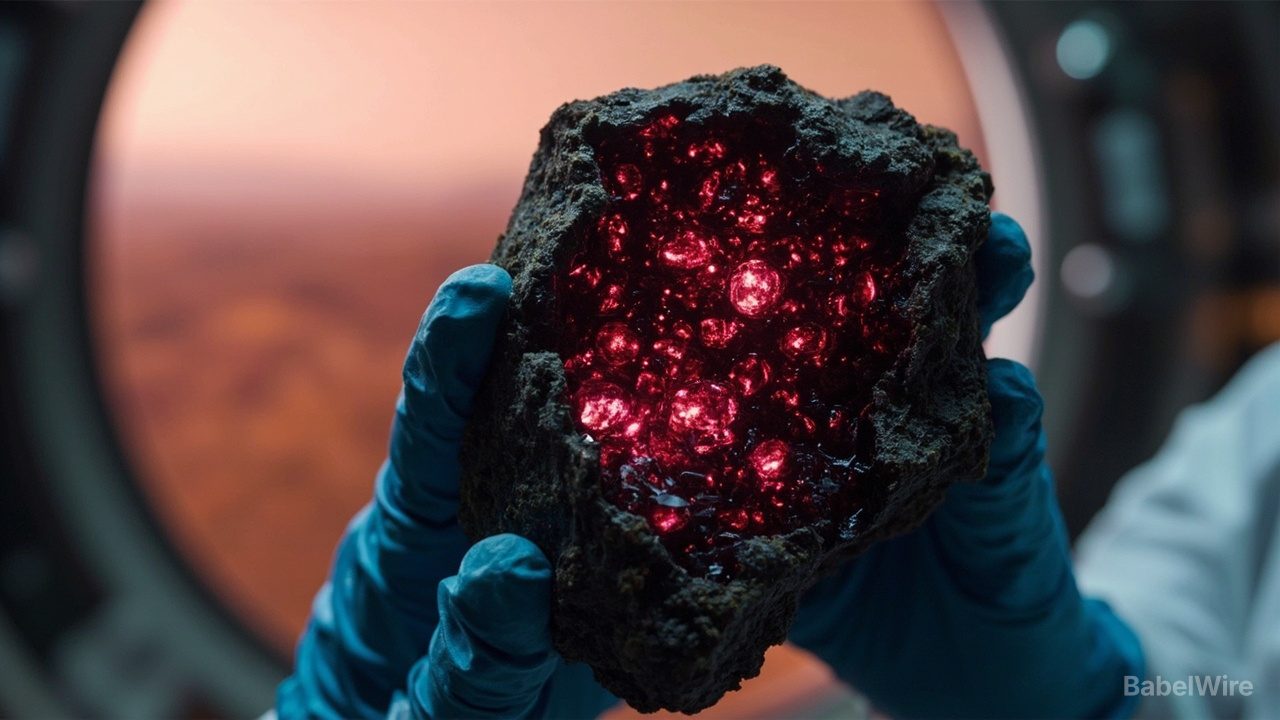
An international team of scientists has made a striking discovery: a Martian meteorite known as NWA 8171 contains garnet — a mineral never before identified in a sample from the Red Planet. The finding was published in the journal Geochemical Perspectives Letters.
Unlike Earth, where plate tectonics, volcanism, and erosion have constantly reshaped the surface over billions of years, Mars has preserved much of its ancient geological record. Every rare Martian rock is a time capsule — and this one contains an unexpected treasure.
A second look revealed garnet
The team, led by Tanya Kizovski of Brock University, detected the garnet while analyzing a fragment of the meteorite held at the Royal Ontario Museum. Initially, the fragment's chemistry seemed odd, but the researchers assumed it was pyroxene, a common mineral. A second, more careful analysis using electron microscopy and laser equipment revealed the presence of garnet.
"At first, we assumed it was a mineral called pyroxene, which is very common, but then we decided to take a second look," Kizovski said.
What garnet tells us about Mars
Garnet is one of geology's most informative minerals because it forms under very specific combinations of heat, pressure, and chemistry. On Earth, garnet is typically found in metamorphic rocks that have been subjected to extreme temperatures and pressures deep in the crust or at impact sites.
James Darling, Professor of Earth and Planetary Science at the University of Portsmouth, said: "The findings add a striking new dimension to our understanding of the geology of Mars and open an exciting new window into the evolution of our planetary neighbor."
The discovery suggests that parts of the Martian crust experienced metamorphic conditions — possibly from massive meteorite impacts, volcanic intrusions, or both — far more extreme than previously understood.
**Martian or extra-Martian?**
The researchers caution that it remains unclear whether the garnet formed on Mars itself or arrived via another meteorite impact. To settle the question, scientists would need to analyze the garnet's oxygen isotopes, but that would require destroying part of the rare sample — a step the team has so far avoided.
Measuring oxygen isotopes from the garnet-bearing rock would help confirm whether it is truly Martian in origin or came from an exotic meteorite impactor.
The discovery adds to the growing body of evidence that Mars was once a far more geologically active planet — with higher temperatures, greater internal pressure, and perhaps even hydrothermal systems — than the cold, dry world we see today.
Sources
- scitechdaily.comThis Strange Martian Rock Contains a Mineral Scientists Never Expected To Find - SciTechDaily
- sciencealert.comGarnet discovered on Mars for the first time - ScienceAlert
- doi.orgExpanding Mars' lithologic diversity: discovery of a garnet-bearing clast in NWA 8171 - Geochemical Perspectives Letters