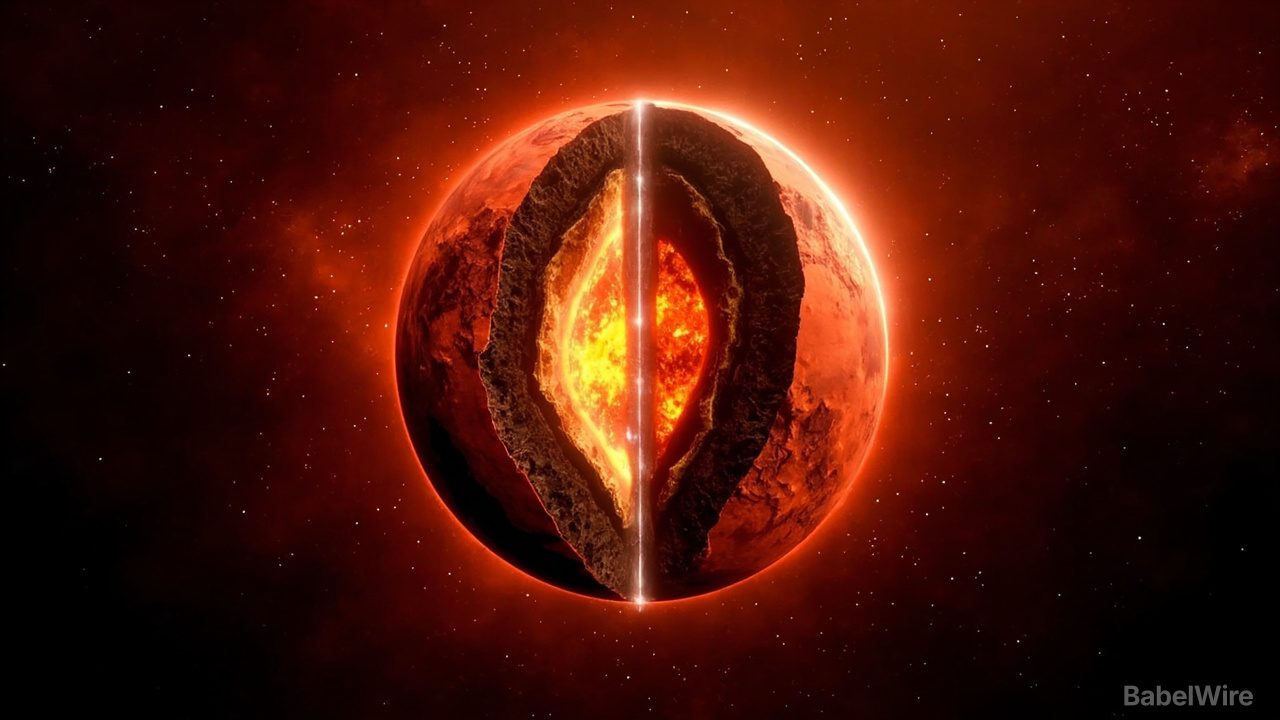
Researchers have uncovered a major temperature imbalance deep inside Mars. Gravity measurements suggest the interior beneath Mars's southern hemisphere is 200 to 400 degrees Celsius warmer than the north — and may be partially molten.
The study, published in Nature, was led by Caltech alumnus Alexander Berne (PhD '26), now at the University of Arizona. The team analyzed decades of observations from Mars Global Surveyor, Mars Odyssey, and Mars Reconnaissance Orbiter, tracking tiny velocity changes to reconstruct Mars's gravitational field.
Using a technique called tidal tomography — studying how the Sun's gravitational pull on Mars changes across seasons — the researchers built a three-dimensional model of the planet's interior. "Scientists usually assume that the interiors of planetary bodies are generally spherically symmetric, but this is not necessarily true," Berne said.
The finding could explain several long-standing Martian mysteries. The southern hemisphere shows unusual magnetic signatures in iron-rich minerals; a hotter southern mantle could indicate Mars once had a magnetic field strong enough to produce hemispheric magnetic differences. NASA's InSight mission previously found seismic waves lose energy more quickly in the south — higher temperatures could account for that.
The temperature divide may also illuminate Mars's watery past. The dichotomy between north and south gives information about processes that may have influenced the hydrology of Mars, including the formation of basins that may have held water, said co-author Amirhossein Bagheri.
What caused the anomaly remains unclear. Hypotheses include a giant impact releasing heat in the north, spontaneous convection in the southern mantle, or thick geological structures trapping heat beneath the surface.