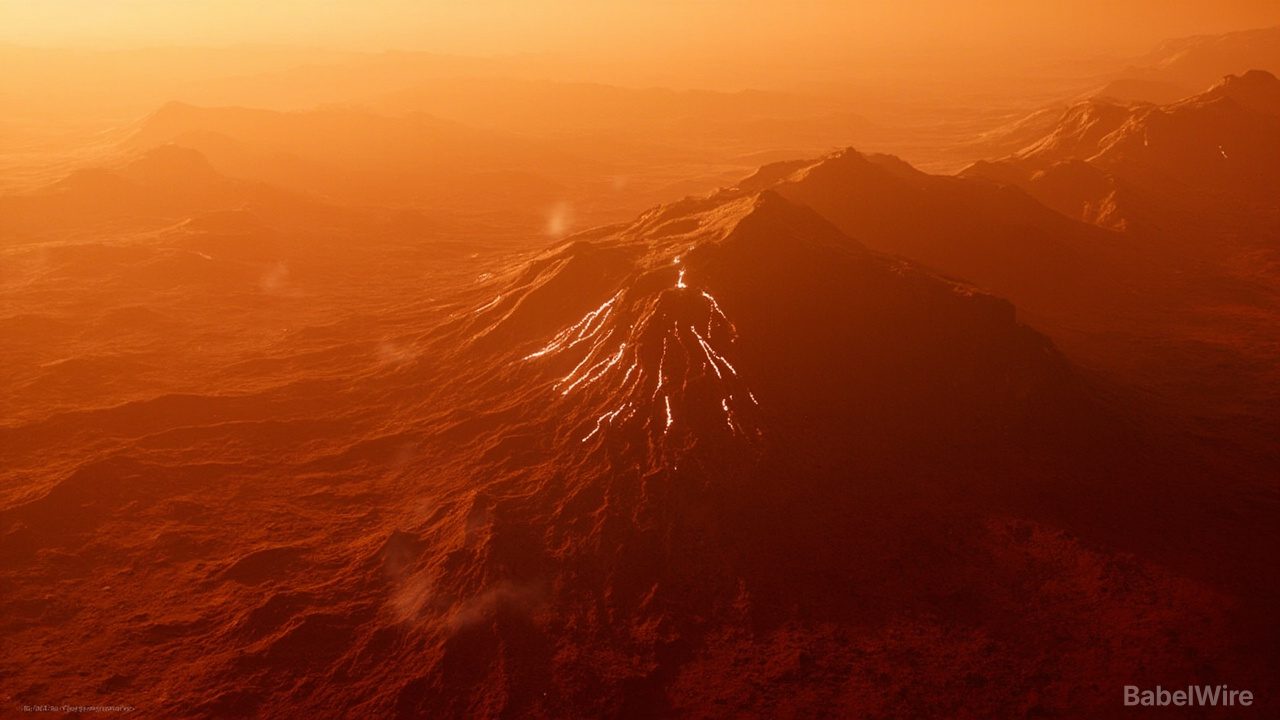
Mars is covered in the largest volcanoes in the solar system, and for decades the working assumption has been that they are monuments to a hotter past. A new analysis of atmospheric data from the European Space Agency's ExoMars Trace Gas Orbiter (TGO) argues that at least one of them may still be breathing.
The team, led by Alexander Trokhimovskiy with Daniel Mège of the Space Research Centre of the Polish Academy of Sciences as co-lead author, reports in Science Advances that hydrogen chloride (HCl) repeatedly concentrates over fractures on the slopes of Alba Mons during early northern summer. That timing is the interesting part: HCl on Mars normally peaks in northern winter and fades to near-nothing in summer, following the planet's dust and water cycles.
"Our findings suggest that Mars has retained enough internal heat to support volcanic activity until recently, and possibly still does," Mège said.
A smoking gun in a haystack
TGO's Atmospheric Chemistry Suite, a set of infrared spectrometers, spotted the gas in a small area shortly after winter frost disappeared. Turning the orbiter's CaSSIS camera on the same patch of ground revealed narrow fractures, some hundreds of metres long, that look fresh, with unusual colour changes around them.
"The Trace Gas Orbiter was able to find the smoking gun," Mège said. "It was like looking for a needle in a haystack."
The proposed mechanism is terrestrial, and mundane in the best way. On Earth, HCl escapes through openings connected to magma — fumaroles. On Mars, winters at -120°C could seal such fractures with ice, bottling the gas up; when early-summer warmth sublimates that ice, the pathways reopen and the gas escapes. The discoloured haloes around the cracks would then be mineral deposits left behind, exactly as they are around fumaroles on Earth.
What the team had to rule out
Scepticism is the right default here, and the authors say they applied it. A large part of the work was auditing every non-volcanic chemical route that could produce HCl in the Martian atmosphere before concluding that a deep source fits the spatial pattern best.
The result is a hypothesis with a specific shape: a dormant magma chamber beneath Alba Mons, part of a volcanic system that can leak gas without producing a visible eruption. Mars has never been caught erupting. Orbiters have seen lava flows only a few million years old, and InSight recorded marsquakes, but no fresh flow has ever been imaged.
Why it matters beyond geology
If magma is meeting groundwater somewhere below Alba Mons, the result would be a hydrothermal system — warm, wet, chemically charged, and shielded from the radiation and temperature swings of the surface. That is one of the more plausible habitats the solar system offers.
"Looking for Martian life in the seeping fissures of the Alba Mons region would make a lot of sense," Mège said.
None of this establishes present-day eruptions, and none of it establishes life. What it does is convert a diffuse question — is Mars geologically dead? — into a place on a map worth pointing instruments at. ESA's Colin Wilson called the findings potentially "TGO's greatest success yet."