**A team of physicists led by the University of Vienna has overcome a major obstacle in quantum computing by dramatically increasing the lifetime of magnons — tiny magnetic waves that can carry quantum information — by nearly 100 times. The breakthrough could eventually lead to quantum computers no larger than a coin.**
The researchers extended magnon lifespan from just a few hundred nanoseconds to as long as 18 microseconds, opening the door to ultra-compact quantum devices that could fit on a chip the size of a penny. Their findings were published in Science Advances.
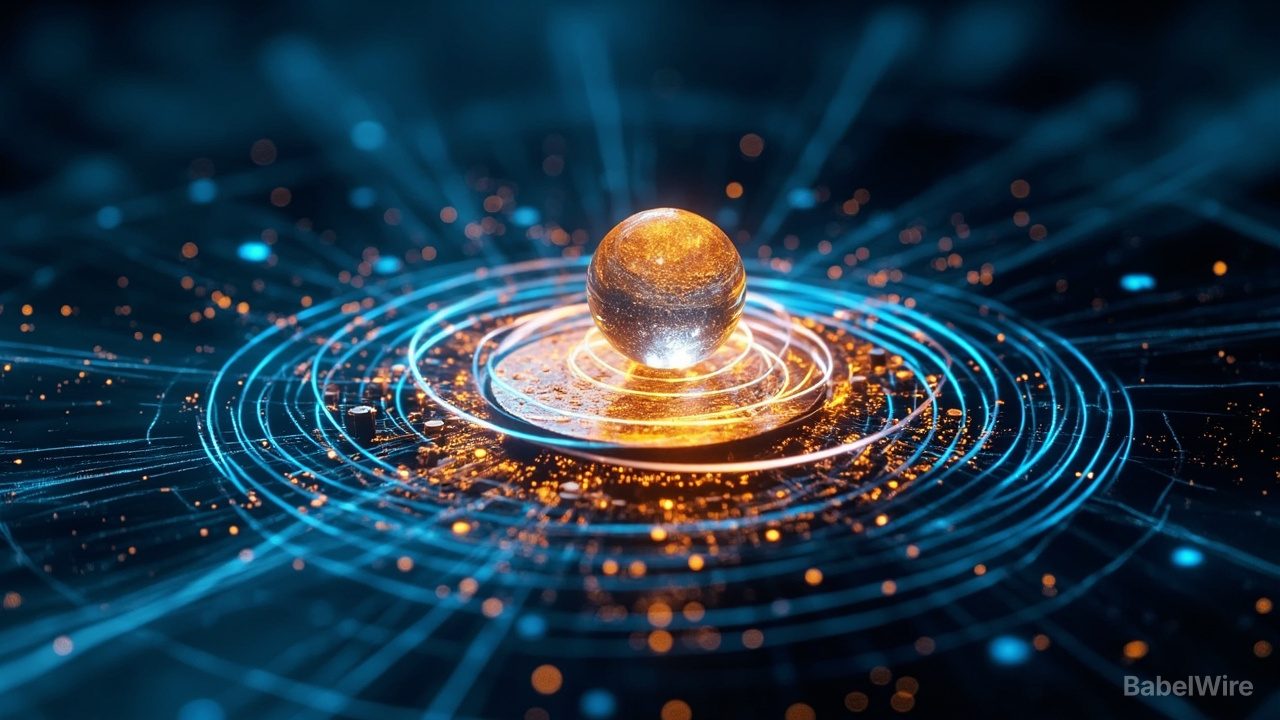
**What are magnons?** Magnons are tiny waves of magnetization that ripple through magnetic solids — like ripples spreading across a pond after a stone is dropped. Unlike photons, which travel through empty space, magnons remain inside magnetic materials. Because their wavelengths can shrink to just a few nanometers, magnon-based circuits could potentially fit onto chips no larger than those already found in smartphones.
For years, the biggest challenge facing magnon technology was their extremely short lifetime. They survived for only a few hundred nanoseconds — far too quickly to reliably store or transfer quantum information. The new study changes that entirely.
**The breakthrough came from combining two key techniques.** First, instead of conventional uniform magnons, the team generated short-wavelength magnons, which are naturally less sensitive to tiny crystal surface defects. Second, they cooled ultra-pure spheres of yttrium iron garnet (YIG) to just 30 millikelvin — a fraction of a degree above absolute zero — freezing out the thermal processes that normally destroy magnons.
Perhaps the most surprising discovery was identifying what now limits magnon lifetimes. By testing YIG spheres with different levels of purity, the researchers found a clear pattern: the purer the crystal, the longer the magnons survived. Even the least pure sample outperformed all previous records. The results suggest that future improvements depend primarily on advances in materials science rather than overcoming an unavoidable law of physics.
**With lifetimes reaching 18 microseconds, magnons become much more than temporary signals.** They could serve as reliable quantum memory devices and low-loss communication channels that move quantum information across a chip. The researchers say magnons could eventually connect hundreds of qubits through a shared pathway, creating a long-sought "quantum bus" that would help scale future quantum computers.
Because magnons naturally interact with many different quantum systems, they could also act as universal translators in hybrid quantum architectures, connecting technologies that otherwise cannot easily communicate with one another — a crucial step toward practical, large-scale quantum computing.