Scientists at Lawrence Livermore National Laboratory (LLNL) have resolved a stubborn 20-year-old discrepancy in how diamond behaves under extreme pressure — and the finding could have major implications for the quest for fusion energy.
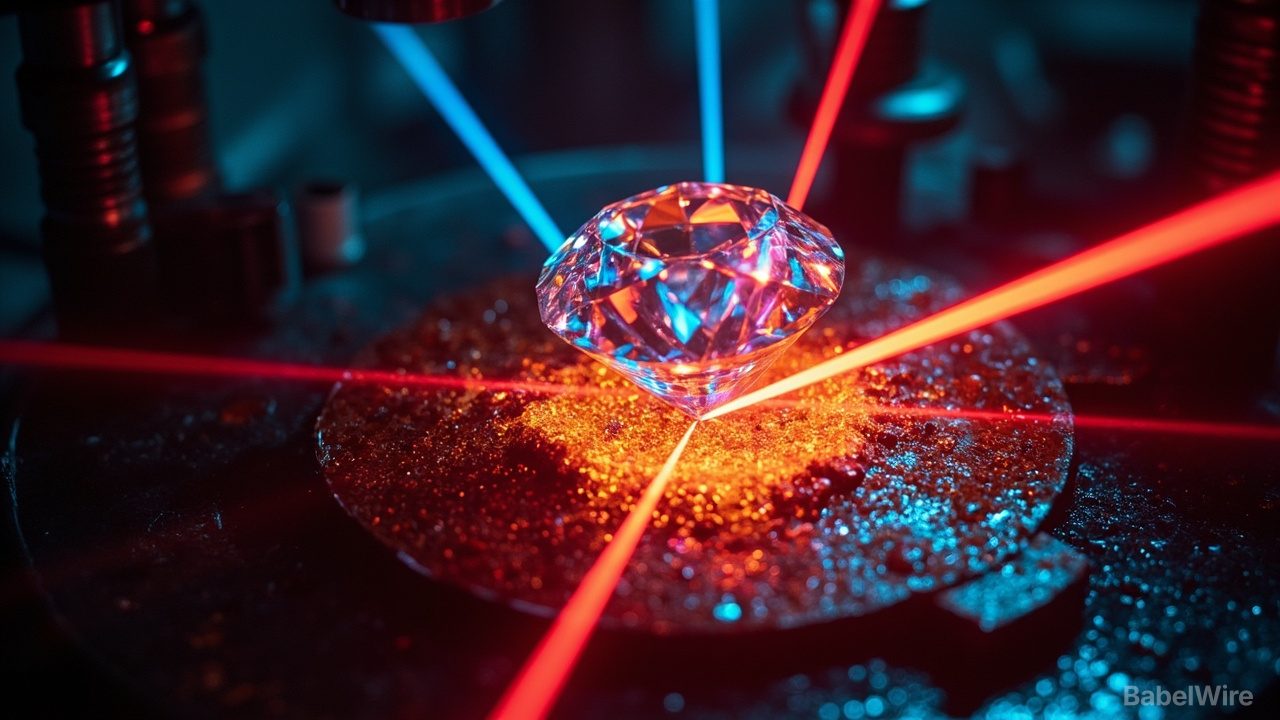
Using the Omega Laser Facility at the University of Rochester, LLNL researchers vaporized the outer layer of tiny diamond samples, sending powerful shockwaves through them at pressures exceeding 1 terapascal (10 million atmospheres). For the first time, they accurately measured the temperature at which diamond melts under these conditions.
The results, published in August 2026, confirmed a surprising prediction: diamond floats on its own melt. Unlike most materials, which become denser when they liquefy, diamond becomes less dense than the liquid carbon beneath it. This behavior had been predicted theoretically but never confirmed experimentally.
The practical implications are significant for inertial confinement fusion (ICF), the approach used at LLNL's National Ignition Facility, which has achieved fusion ignition 11 times. In ICF experiments, diamond capsules are used to contain fusion fuel. Understanding exactly how diamond melts under compression allows scientists to optimize these capsules, potentially tripling the energy gain from each laser shot.
Beyond fusion, the discovery also sheds light on the internal structure of ice giant planets like Neptune and Uranus, where carbon exists at similar extreme pressures and may exist in a liquid metallic state.