Physicists in Italy have entangled the motion of a levitating glass nanosphere with a beam of light — and, unusually, they did it without cooling the whole apparatus to cryogenic temperatures.
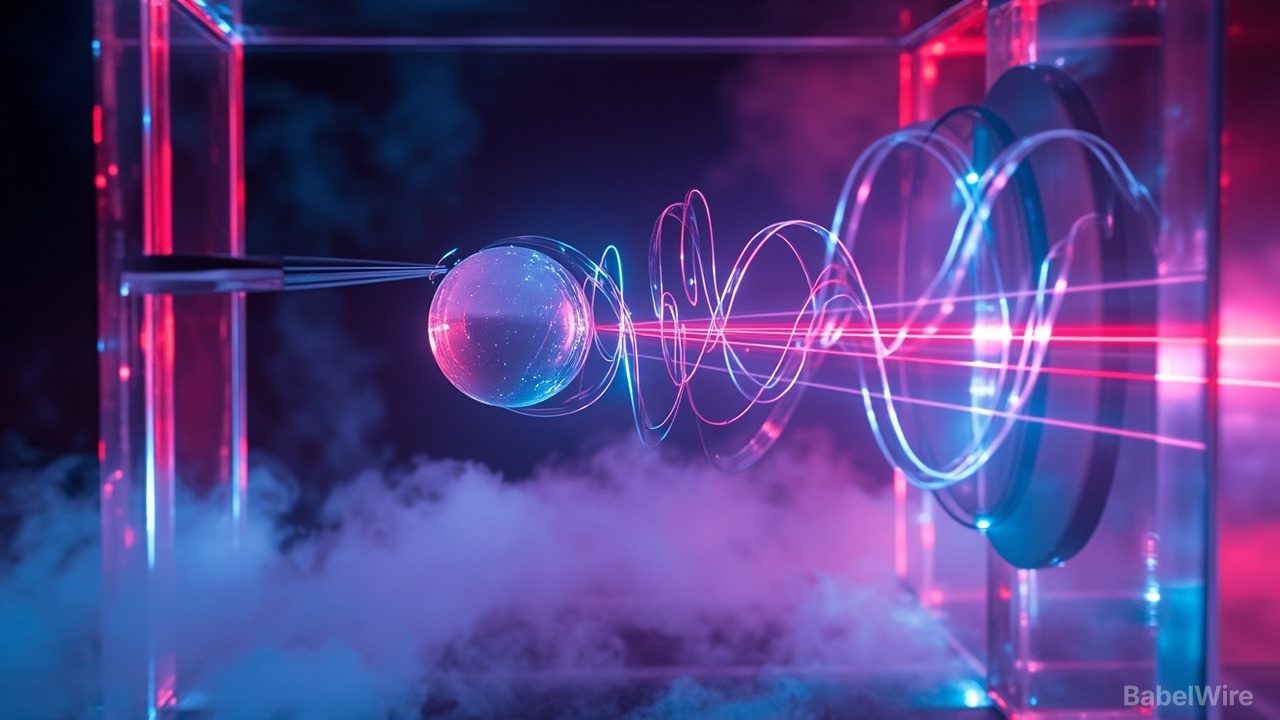
The object at the centre of the experiment, reported in the journal Science, is a sphere of glass just 100 nanometres across — roughly the size of a virus, but containing tens of millions of atoms. It was held aloft in a tightly focused laser beam, an optical tweezer, and confined between two mirrors forming an optical cavity inside a near-vacuum chamber. Nothing touched it.
'My next goal was to push the interaction between the light and the nanosphere's motion to the point of generating entanglement — arguably the most defining and counter-intuitive phenomenon in quantum mechanics,' Francesco Marin of the University of Florence, who led the work, told ScienceAlert.
The team's earlier work had used light to cool the sphere's oscillations toward their quantum ground state. But the light that generates entanglement also heats and destabilises the motion, so the researchers split the job between two laser colours: a red-detuned beam to cool and stabilise, and a blue-detuned beam to entangle the sphere's centre-of-mass motion with the light's amplitude-and-phase quadratures.
The entanglement was not confined to light trapped between the mirrors. It persisted in the light leaking out of the cavity, which carries information about the sphere's motion — making it, in principle, a travelling quantum system that could be sent through an optical network, measured elsewhere or coupled to another quantum device.
To prove the correlations were genuinely quantum rather than classical, the researchers reconstructed the full pattern of correlations from the escaping light and showed the measurements crossed the threshold that separates entangled states from separable ones, even after accounting for experimental uncertainty. The experiment ran for hours, with three laser systems kept stable while the chamber reached low pressure, and the entanglement emerged gradually with statistical significance.
Because the sphere is a fully artificial, mechanical system, it could serve as a local quantum memory or interface — the missing piece for connecting light-based quantum links. The next steps, Marin said, are to strengthen and dynamically control the entanglement, and eventually to link several nanospheres in different tweezers into a larger quantum system.