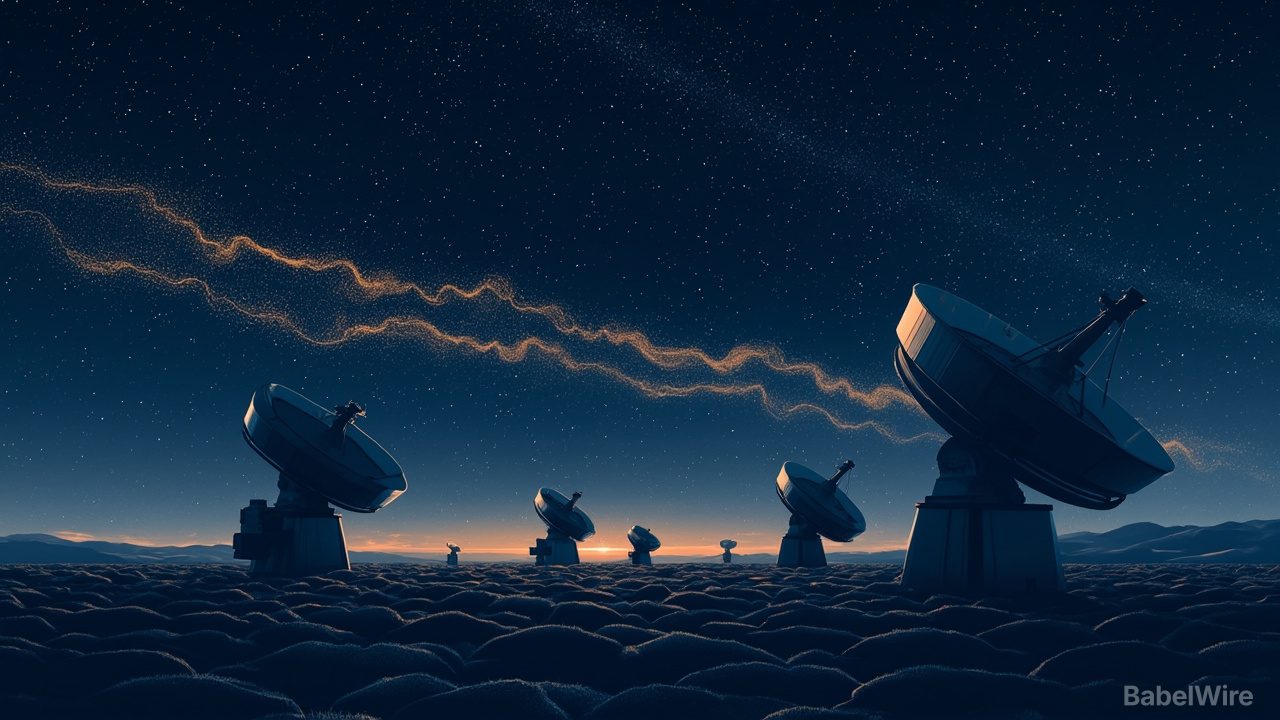
For the first time, Canada's CHIME radio telescope has shown that it can detect the faint radio glow of hydrogen from the distant universe using only its own observations, according to two studies published in The Astrophysical Journal.
The signal dates from when the universe was roughly five billion years old — light that has been travelling for about eight to nine billion years to reach us. The technique, known as 21-centimetre intensity mapping, measures the combined emission of neutral hydrogen rather than hunting for individual galaxies. Its strength and shape act like a fingerprint of how matter was distributed and clustered at that time. The team estimates that about two percent of hydrogen was in neutral atomic form then, broadly consistent with other measurements.
The result matters because hydrogen mapping had long been considered promising but unproven. Until now, CHIME researchers had to cross-check their radio data against galaxy surveys from other telescopes — surveys that cost millions more and can only see regions dense and hot enough to form stars. CHIME's approach covers far larger volumes of the cosmos and reaches further back in time.
Extracting the signal was painstaking. It had to be separated from radio noise coming from the sky, from human technology and from the telescope itself. After spotting a candidate signature in 94 nights of data collected in 2019, the team spent more than a year testing it before concluding that it was real. It is only the second measurement of its kind by any telescope, and the first of hydrogen clustering when the universe was less than half its current age.
The payoff could be significant. Dark energy — the unknown phenomenon apparently accelerating cosmic expansion — remains one of physics' biggest unsolved problems, and scientists have competing explanations for it. Data that a single instrument can produce independently gives researchers a way to test those ideas without depending on other surveys. CHIME still has nearly seven years of observations to analyse, and the team now aims to push the technique back to an era when the universe was only three billion years old.
Sources
- sciencedaily.comScienceDaily: A 9-billion-year-old signal could help explain dark energy
- news.asu.eduASU News: ASU researchers help unlock a new window into the universe
- nanodaily.comNanoDaily: CHIME detects hydrogen signal from five billion year old universe using its own data alone
- colombiaone.comColombiaOne: CHIME Detects Ancient Hydrogen Using Its Own Data