Strip a modern cell back and you find two things: chemistry, sealed inside a membrane. The chemistry is absurd — on the order of a billion reactions per second — and the membrane that contains it is built and repaired by machinery encoded in the chemistry it contains. Before any of that existed, something simpler had to do both jobs. The lipid-first hypothesis says the container came first, and that the container itself was the thing that evolved.
The case for it, laid out in a Quanta Magazine explainer opening the publication's Origins of Life Week, starts with what a membrane buys you. Bruce Damer, an astrobiologist at UC Santa Cruz, puts it bluntly: "You need a container before you can get the chemistry." Without a boundary, the molecules that might have reacted with each other simply diffuse away from each other, and the probability of assembling anything complex falls to nothing.
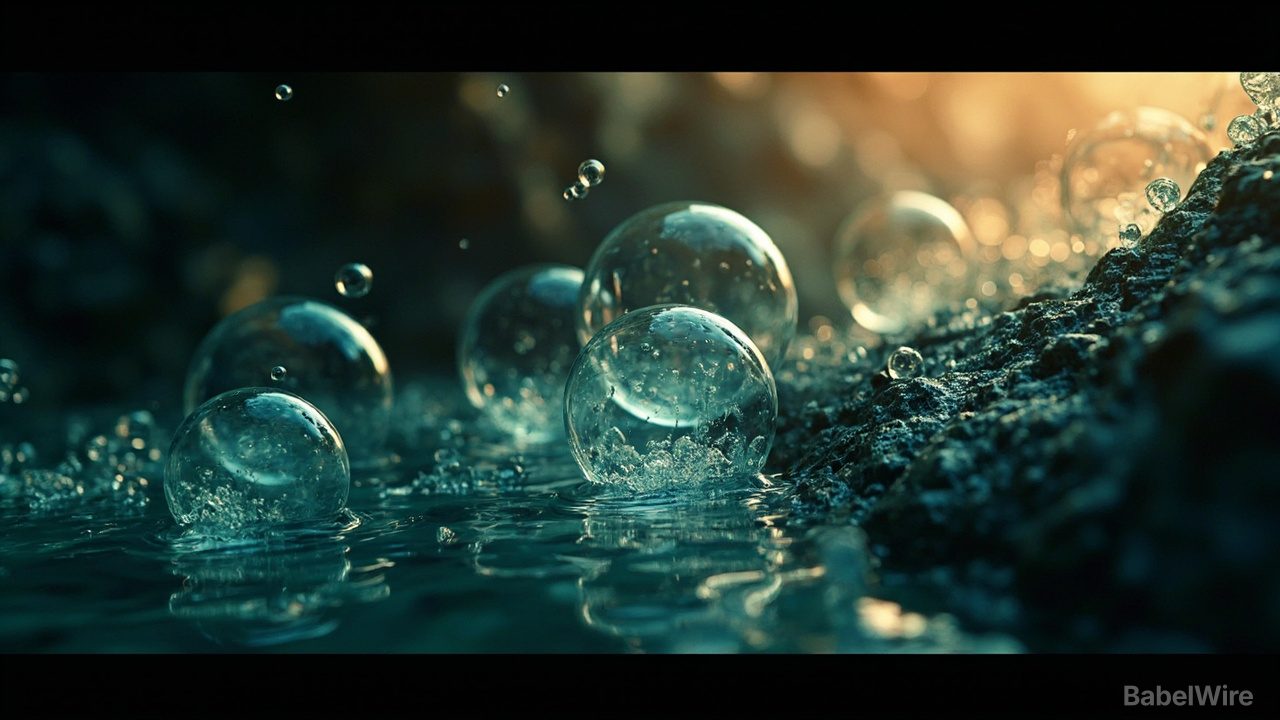
The radical part of the lipid world is not the container. It is the claim that heritable information can be carried by a mixture rather than a molecule. Picture a puddle stocked with amphiphiles — molecules with one water-loving end and one water-fearing end — which spontaneously close into hollow spheres. Inside a given sphere, molecule A catalyses production of B, and B catalyses production of A. The pair keeps itself topped up, and the sphere grows until it splits, dealing its contents out to daughters. What is inherited is not a sequence but a ratio: the recipe is the proportion of molecules.
Evolution needs variation on top of inheritance, and the model supplies it too. A stray molecule C can tip a bubble into a different loop, the way a mutation would. Bubbles that grow faster split more often and crowd out the slower ones. In 2000, Doron Lancet at the Weizmann Institute and Daniel Segrè, then at Boston University, published a computer model showing that these dynamics could produce something lifelike: bubbles passing compositions to daughters that vary and compete. In simulation, at least, the idea cleared its first hurdle.
Twenty-five years later the theory is in the strange position of having won the argument that mattered while losing the one it was built on. A 2010 analysis argued that copying compositional information from one generation to the next would simply be too inaccurate for natural selection to get traction. Jack Szostak, the Nobel-winning biochemist at Chicago who favours an RNA-based origin, is blunter still: "The idea of a lipid-only form of primitive life has never made sense to me." He points to the absence of experimental evidence that a lipid system can evolve at all, and to the awkward fact that nobody has a good account of how even simple lipids would have formed on the early Earth — "the least well-developed aspect of all of prebiotic chemistry".
Damer concedes the framing has shifted: "There really isn't a distinct lipid-world hypothesis anymore." Researchers now propose iron-sulfide mineral walls, or coacervates — droplets that concentrate molecules without any membrane at all. Damer and David Deamer have moved to hot-spring pools, where repeated drying and refilling could squeeze simple molecules between lipid layers; they present it as an extension of the lipid world rather than a replacement.
The surviving consensus is narrower and more useful than the fight. Every camp agrees that early life needed a compartment, and Szostak — the theory's most prominent critic — says plainly that without one "Darwinian evolution could not operate." Which leaves a tidy irony for the field: the mechanism that made lipid-first famous is the part under attack, and the bubble it argued for is now close to uncontested.
Quanta's Origins of Life Week continues through the week.