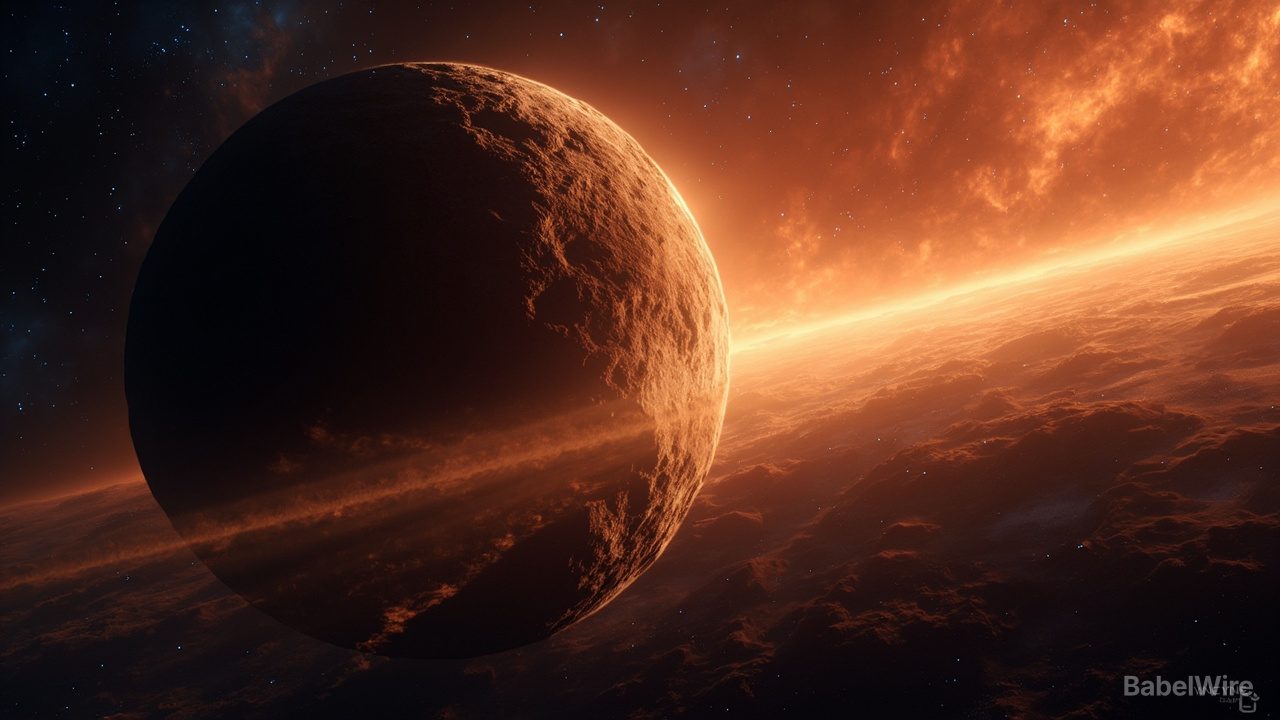
For the first time, astronomers have directly detected an atmosphere on a rocky, Earth-like planet orbiting within the habitable zone of its star — a historic milestone in the search for worlds that could support life.
The planet, called LHS 1140 b, is a super-Earth located 48 light-years away. Discovered in 2017, it orbits a cool red dwarf star every 24.7 days. With a mass 5.6 times Earth's and a radius 1.7 times larger, it receives 42% of the stellar radiation Earth does — placing it squarely in the "Goldilocks zone" where liquid water could exist on its surface.
Using the WINERED spectrograph on the Magellan Clay telescope at Carnegie Science's Las Campanas Observatory in Chile, researchers led by Harvard's Collin Cherubim detected helium escaping from the planet's upper atmosphere. The findings were published in the journal Science.
"We have actually detected directly the helium present in the atmosphere itself, and that's the first direct detection for any rocky exoplanet," said Cherubim. "And then there's this added bonus that it's in the habitable zone, which is super exciting for astrobiology."
The detection is remarkable because red dwarf stars typically emit intense radiation that strips atmospheres from orbiting planets. LHS 1140 b's star is roughly 6 billion years old — past its most volatile early phase — which may explain why the planet has retained its gaseous envelope.
Remarkably, 2024 observations showed helium escaping, while 2025 observations detected none — indicating the atmosphere is dynamic and changes on human timescales. The team's models suggest a layered atmosphere: helium-dominated in the upper reaches, with water vapor likely trapped at lower altitudes.
"This discovery is a big deal because it's showing that at least this rocky planet has retained an atmosphere over billions of years," Cherubim added. "It's a bona fide, robust way of saying yes, atmospheres can survive on rocky exoplanets."
A second planet in the same system, LHS 1140 c, showed no atmospheric signature — suggesting these two worlds may sit on opposite sides of the "cosmic shoreline," where some planets retain atmospheres while others lose them.
While the team stops short of claiming the planet hosts life, LHS 1140 b now checks more habitability boxes than any exoplanet ever observed: rocky composition, right temperature, and now — an atmosphere.



