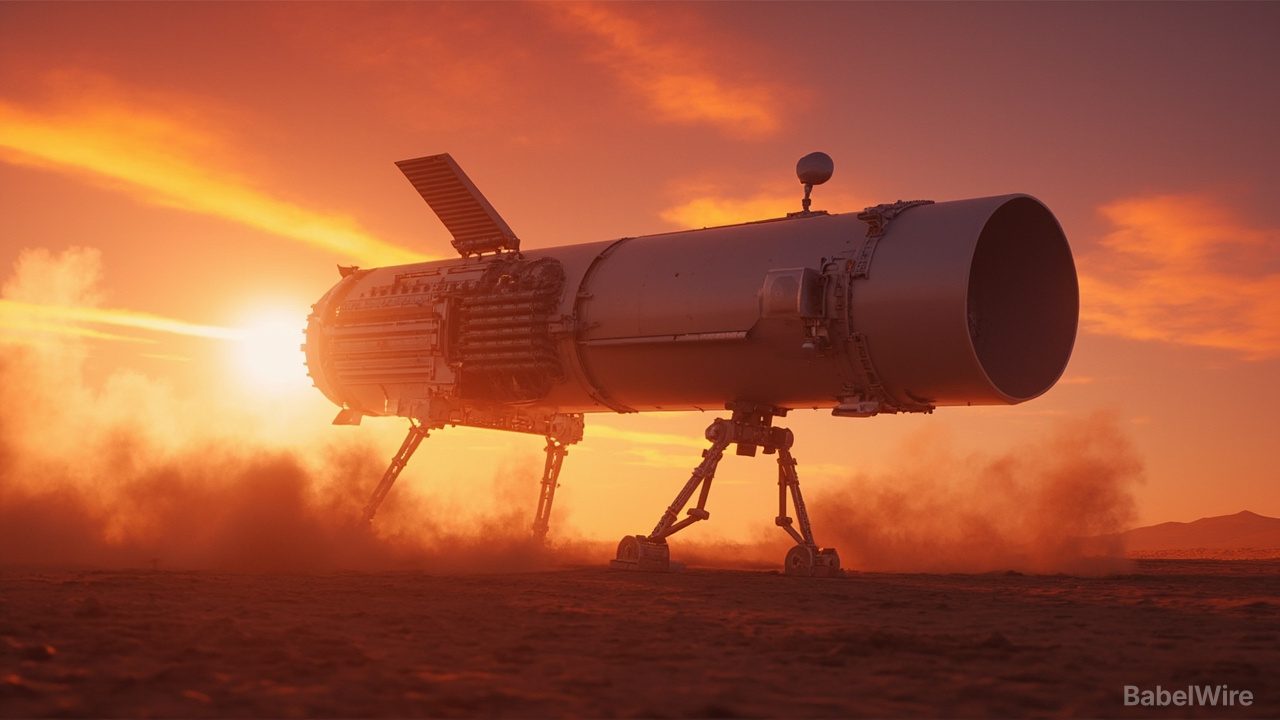
Beijing-based startup LandSpace has achieved a landmark moment in Chinese spaceflight. On August 18, 2026 (EDT), the company successfully landed the first stage of its Zhuque-3 rocket on solid ground using landing legs — becoming the first private Chinese company to recover an orbital-class booster on land.
The mission, launched from the Dongfeng Commercial Space Innovation Pilot Zone in northwest China at 7:35 p.m. EDT (23:35 GMT; 7:35 a.m. August 19 Beijing time), was only Zhuque-3's second-ever flight. The rocket's upper stage successfully delivered the Honghu 03 satellite to orbit, while the first stage performed a controlled descent and touchdown at the landing site in Minqin County, Gansu Province.
"This mission marks China's first-ever successful recovery attempt of the first stage of an orbital-class launch vehicle using landing legs, and China's first successful booster recovery on land," LandSpace announced on X (formerly Twitter).
The achievement is significant because it demonstrates that China's private space sector is rapidly closing the gap with SpaceX, which pioneered rocket reusability with its Falcon 9 rocket in 2015. Zhuque-3, which closely resembles the Falcon 9 in size and capability, uses methane and liquid oxygen (methalox) — the same propellant combination chosen by SpaceX for its next-generation Starship vehicle.
Zhuque-3 stands 66 meters tall and can carry approximately 18,300 kilograms to low Earth orbit, comparable to the Falcon 9's 22,800 kg capacity. The rocket's first flight in December 2025 was partially successful — the upper stage reached orbit but the booster landing attempt failed due to an abnormal combustion event.
This success is part of a broader Chinese push toward rocket reusability. State-owned China Aerospace Science and Technology Corporation (CASC) achieved China's first orbital rocket landing on July 10, 2026, using a Long March 10B rocket that was caught by a net on a ship at sea. Several other Chinese companies — including CAS Space, Deep Blue Aerospace, Galactic Energy, iSpace, Orienspace, and Space Pioneer — are also developing reusable launch vehicles.
The global reusable rocket race has intensified in 2026, with SpaceX continuing to dominate launch frequency (having completed its 100th mission of the year by August), while new players like India's Skyroot Aerospace (which successfully launched Vikram-1 in July) and Japan's RV-X prototype are also making strides in reusability.
Sources
- space.comTouchdown! Private Chinese rocket aces landing on 2nd-ever flight - Space.com
- reuters.comChina achieves first-ever land recovery of reusable rocket booster - Reuters
- en.wikipedia.orgZhuque-3 - Wikipedia
- facebook.comChina LandSpace Reusable Rocket Achieves First Stage Recovery - SpaceFlight.com