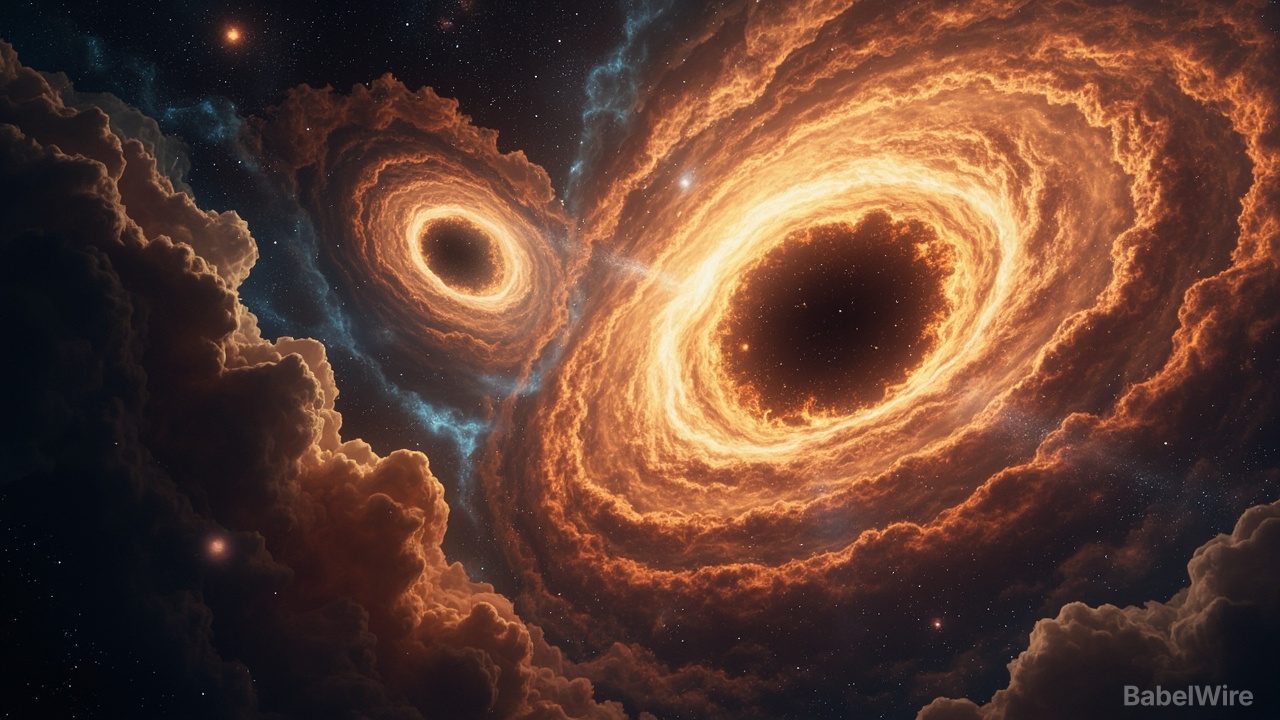
Astronomers have confirmed a close pair of actively feeding supermassive black holes — collectively named LID-1166 — seen just 1.3 billion years after the Big Bang. Separated by only about 4,900 light-years (1.5 kiloparsecs) inside a merging galaxy, the pair is the first close-separation dual black hole system confirmed this early in the universe's history.
The discovery team, led by Hyewon Suh of the International Gemini Observatory/NSF NOIRLab, combined observations from the James Webb Space Telescope's NIRSpec spectrograph with data from ALMA, the radio-telescope array in Chile. The study was posted to the arXiv preprint server in July and has been accepted for publication in Nature Astronomy. LID-1166 first showed up as a bright X-ray source in the Chandra COSMOS Legacy Survey, yet remained invisible in the deepest Hubble Space Telescope images — a hint that its power was being funneled through dense gas and dust.
Both black holes show the spectral signatures of gas swirling at high speeds, indicating they are actively feeding — active galactic nuclei powering the merging system. ALMA data also revealed a large pool of cold gas associated with each object, which study co-author Roberto Decarli of the Italian National Institute for Astrophysics says "points to the two AGN residing in the center of two galaxies on the verge of merging."
Astronomers have spotted other dual black hole candidates even earlier in cosmic history, but those pairs were separated by tens of thousands of light-years or more. Resolving two at just 4,900 light-years apart — with JWST — is what makes the discovery special, says Anna Trindade Falcão of NASA's Goddard Space Flight Center, who was not involved in the study: "What is striking here is resolving this process in an obscured pair that is only 1.5 kiloparsecs apart."
The find bears directly on one of astronomy's biggest puzzles: how some supermassive black holes grew so massive so quickly in the early universe. Merger-driven growth — galaxies cannibalizing each other and dragging their central black holes together — is exactly the process LID-1166 appears to catch in action, and the first step toward uncovering the hidden population of early black holes that theory predicts should exist. As Decarli puts it: "Cannibalizing other galaxies is part of this process. But what if these galaxies also host a massive black hole at their center?"