Apple's first foldable went on sale on Friday at $1,999 for the 256GB model, rising to $3,199 for 2TB, and the queues came back to Apple Stores. By Sunday the conversation had moved from the price to the hinge.
Owners began posting photographs of inner displays split by a bright vertical line within hours of unboxing. The pattern is consistent: the crack runs along the fold, and in most reports nothing has hit the screen. One owner in Australia said the phone had been opened fewer than 20 times in six hours of ownership before he felt something catch under the display, heard an audible crack, and watched the line appear. Some launch-day demo units in China showed the same fault.
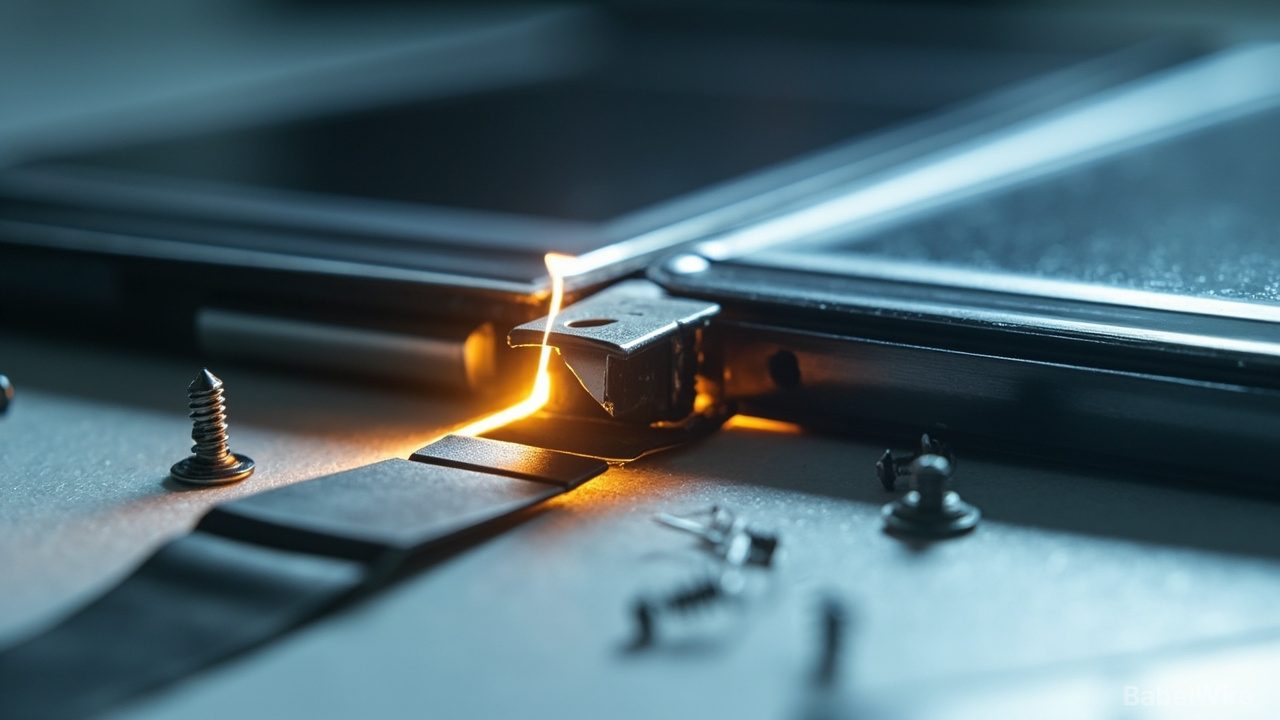
On Sunday the YouTuber CuriousHagi published the first mechanical explanation. He had already reproduced the failure during durability testing; then he took the phone apart. The Duo's hinge is not one part but an assembly: a gear-like central hinge plus two different types of linking hinges along its length. The link that broke sits in the middle of the phone and is thinner than the links above and below it. It snapped at a small notch — the point where it was already weakest. He also found marks where the hinge met the support plate, evidence that something caught before the link gave way.
JerryRigEverything added a second, independent trigger. Working sand into the hinge reproduced the same failure: vertical lines across the right half of the inner display. His scratch testing also separated the phone's two screens sharply. The outer panel, Ceramic Shield 2, resisted to level 7 on the Mohs scale. The inner folding display scratched at level 2 — soft enough that a fingernail is a threat, though the matte coating hides much of it.
Apple's response has been service rather than statement. Several owners who went to a store walked out with a replacement unit the same day; buyers who ordered through carriers have reported a harder time. The company published the official repair manual on Saturday, and the parts pricing is now public: the inner display assembly is a $999 repair at the low end and up to roughly $1,499 in the worst case. Apple has not said how many devices are affected, whether the thin link is a tolerance problem or a bad batch, or whether it will extend warranty coverage beyond the standard year.
Commercially, demand is not the difficulty. Reports put Apple's order book up 44 percent, supply is explicitly limited, and the launch brought back launch-day lines the company had not seen in years. The difficulty is that the most expensive iPhone ever shipped is failing at the least expensive component of its most complicated mechanism — a machined link a few millimetres thick, in a part that no owner can inspect and no reviewer can test without destroying the phone.
That is also why the story will not settle quickly. A teardown can show where a part failed; it cannot show how often. The useful number is the failure rate per thousand units after eight weeks of ordinary folding, and nobody outside Apple has it. Until then, the strongest evidence remains a handful of very similar photographs and two YouTubers who can break the phone at will.
Sources
- theverge.comA YouTuber dissected an iPhone Duo and thinks he found the cause of crackgate — The Verge
- macrumors.comCrackgate? iPhone Duo Owners Report Screens Breaking Along the Hinge — MacRumors
- itnerd.blogiPhone Duo "Crackgate" Gets Worse As The Phone Fails JerryRigEverything Durability Test — The IT Nerd
- reuters.comApple's foldable iPhone hits stores with $2,000 price tag and scarce supply — Reuters
- notebookcheck.netApple's $2,000 foldable iPhone reportedly cracks within hours as owners report display failures — Notebookcheck