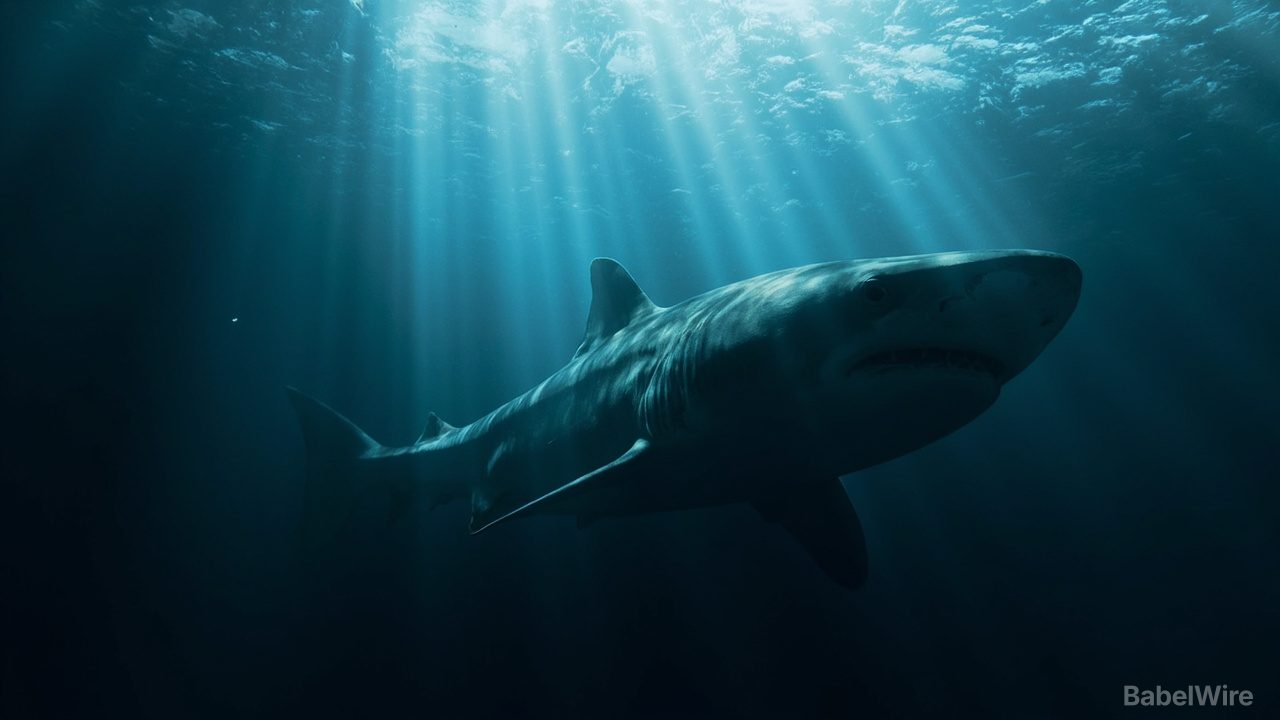
Greenland sharks are among the longest-lived vertebrates ever identified, with some individuals estimated to be over 300 years old. They inhabit some of the darkest waters on Earth, deep in the Arctic. Many carry a parasite attached to the surface of the eye, which helped fuel a long-held assumption that these sharks were essentially blind.
New research upends that view. A study published in Nature Communications finds that Greenland sharks retain functional vision even at extreme ages, with no signs of the retinal degeneration that normally plagues aging vertebrates.
Researchers examined preserved eyeballs from Greenland sharks caught near Disko Island off the coast of Greenland. Even in sharks estimated to be centuries old, the retina showed no widespread cell death or structural breakdown.
The retina is built almost entirely from rods, densely packed photoreceptors specialized for dim light. Cell membranes are rich in long-chain polyunsaturated fatty acids, helping rhodopsin function in cold, low-light conditions. Rhodopsin was tuned to blue wavelengths, the light that penetrates deepest in Arctic waters.
Aging is often framed as an unavoidable, uniform decline. The Greenland shark points to a different model, one in which certain organs resist breakdown entirely, even across centuries. By studying species that preserve sensory function over extraordinary timescales, researchers can begin to separate which aspects of aging are truly inevitable from those shaped by long-term repair.
Published in Nature Communications under the title The visual system of the longest-living vertebrate, the Greenland shark.