More than a century after Einstein rewrote gravity, two physicists have found a possibility hiding inside his equations that nobody had noticed: gravitational fields can have their internal structure break apart and reconnect, handing energy to matter in the process.
Luca Comisso of Columbia University and Felipe A. Asenjo of Universidad Adolfo Ibáñez in Chile call the process "gravitational reconnection". Their paper, titled "Reconnection of Gravitational Fields", was published on 28 October in Physical Review D, the American Physical Society's journal, and was circulated by Columbia this week.
The comparison that makes it legible is a phenomenon the Sun has been running for its entire life. In a plasma — a gas of charged particles — magnetic field lines can be pulled, twisted and stretched. Under certain conditions they suddenly change their connections and dump the stored magnetic energy into the surrounding particles. That is the mechanism behind solar flares and one of the most important energy-release processes in the universe.
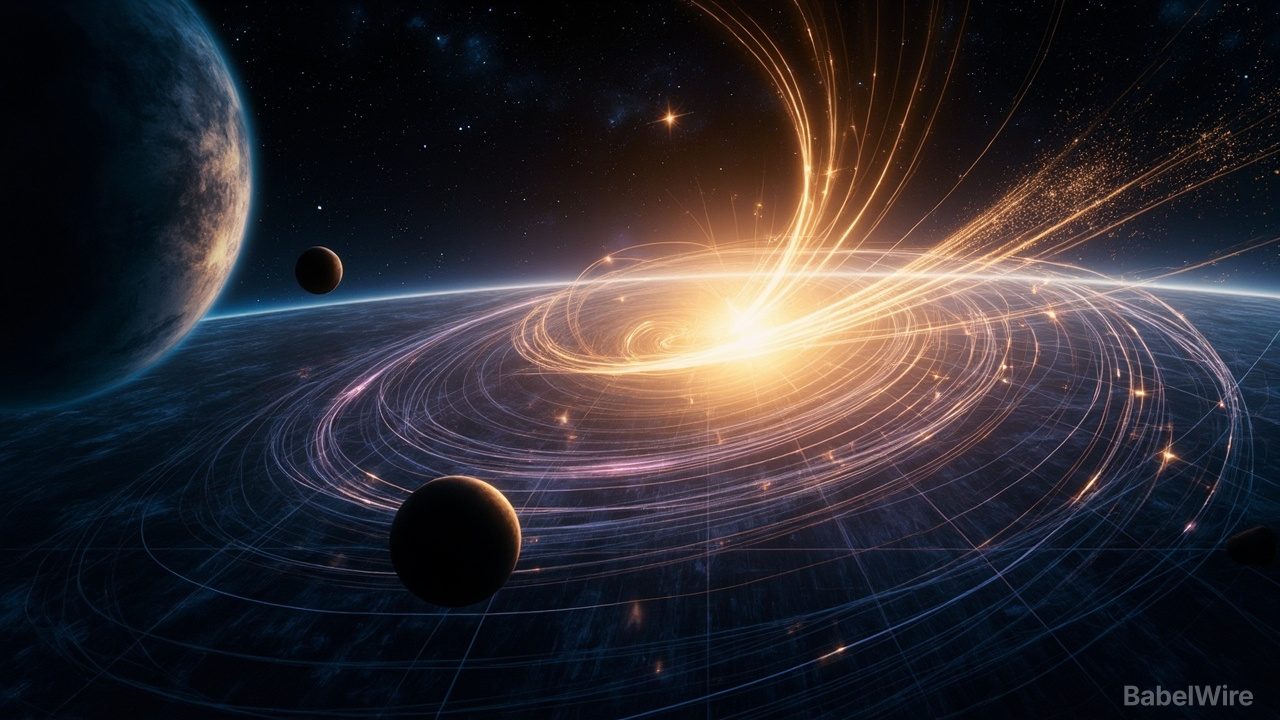
Gravity does not work with lines. "Because space-time is four-dimensional rather than three-dimensional, gravity involves something like field 'sheets' rather than field lines," Comisso said. "Adding one dimension to a line gives you a plane. You can think of it as putting many lines together to form a 'sheet'." Those sheets can rearrange their connections under the right conditions, much as magnetic field lines do.
What the sheets are not matters as much as what they are. They are mathematical descriptions, not physical membranes that literally tear. The reconnection describes a route by which the gravitational field transfers energy to matter — not a hole in space that something falls through.
The finding is not in a new theory. It is in a different way of reading the same one. Comisso and Asenjo lean on a reformulation of Einstein's field equations developed in recent years. It is mathematically equivalent to the original and describes the same physics, but it looks conspicuously like the equations used to study plasmas. Comisso has spent his career on plasma behaviour; when he and his colleagues registered the resemblance, applying one field's toolkit to the other became the obvious move.
The work builds on an earlier study by the same group, with Maricarmen A. Winkler, in Physical Review Letters. That paper identified constraints that determine which changes in the geometry of space-time are possible at all. "Einstein's equations contain constraints on how space-time can evolve that are not immediately apparent," Asenjo said. "By revealing these hidden new properties, we can begin to understand the fundamental rules governing how this gravitational reconnection process behaves."
The practical value sits where simulation runs out. When two black holes merge, their fields distort space-time so violently that even the largest supercomputers struggle to interpret the output. Knowing the underlying constraints lets researchers say which behaviours are physically permitted without computing every equation through. "It helps us predict some patterns of the space-time," Comisso said. "Even without doing the full calculation, we know that space-time needs to behave in a certain way."
The long-term target is gravitational-wave astronomy. LIGO and its partners measure the tiny distortions that merging black holes send through space. If gravitational reconnection operates in those events, it could leave signatures in the signals — and possibly account for some of the energy release currently left to the simulations.
What the paper does not provide is evidence. Gravitational reconnection is, so far, a theoretical finding. How the process operates in real astrophysical environments, whether it matters there at all, and whether its effects would be observable are all open. The next step is exactly that: work through concrete scenarios, black hole mergers above all, and see whether they yield recognisable predictions.
The research was supported by the US National Science Foundation and NASA. Both agencies funding foundational physics with no immediate application is part of the story: the value of an equation sometimes shows up only when someone writes it down differently from everyone before.
Why it matters: this is not a new law of nature and not an experiment — it is a hidden structure inside a theory everyone has known since 1915. Reformulations of exactly this kind have historically been how physics found new things to measure, and gravitational waves are now a measuring instrument.