A Self-Healing Quantum Machine
Google Quantum AI has achieved a significant milestone in the quest for practical quantum computing. In a study published this month in Nature, researchers led by Volodymyr Sivak demonstrated that reinforcement learning — a technique already used in robotics and LLM training — can enable quantum processors to learn from their own errors and make real-time adjustments without stopping their calculations.
The Problem: Fragile Qubits
Quantum computers rely on qubits, which are notoriously fragile. Environmental factors such as noise, temperature fluctuations, light, and even the activity of neighboring qubits cause them to decohere — essentially fall apart — introducing errors. Until now, these errors required periodic system shutdowns for recalibration, making it impractical to run the kind of long, complex calculations that would justify quantum computing's promise.
The Breakthrough
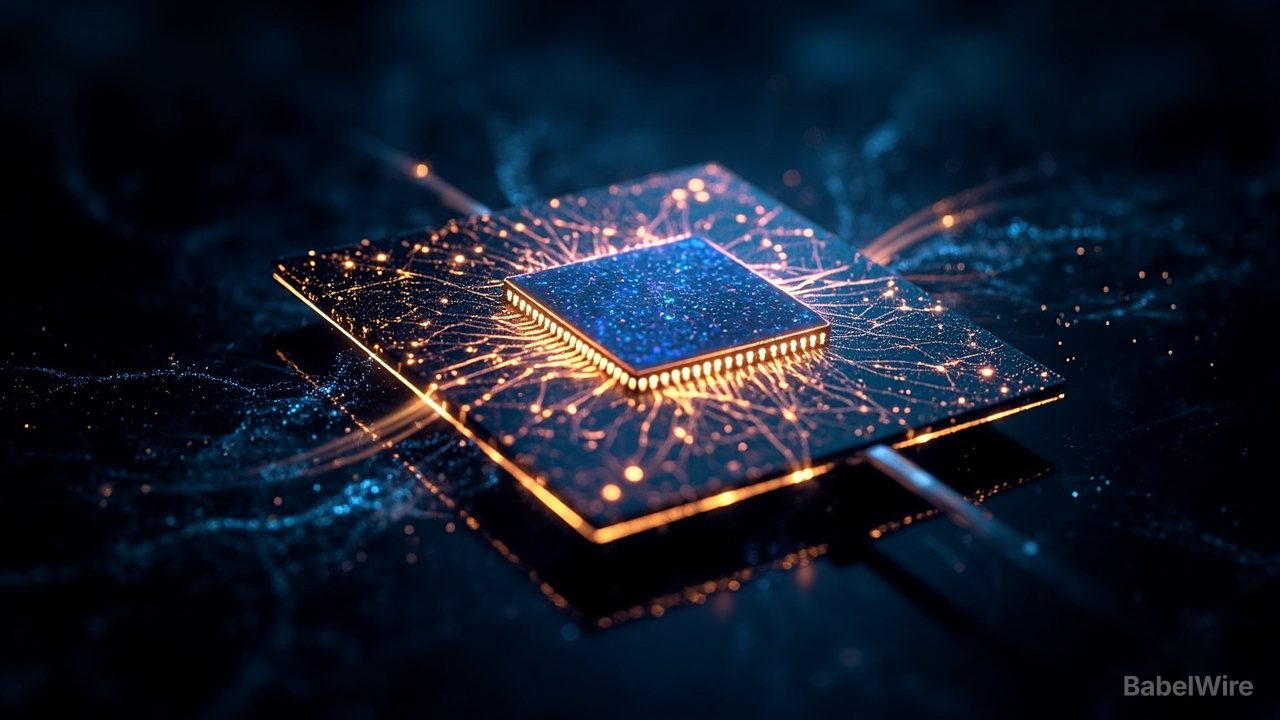
The Google team created a reinforcement learning framework for their Willow superconducting quantum chip (first announced in December 2024). The AI continuously monitors the encoded error data that quantum computers already collect during operation, learns from the patterns it detects, and adjusts the system's control settings and operating parameters in real time.
Testing the framework over multiple surface and color error-correcting codes, the researchers found:
- Logical error rates were reduced by approximately 20% compared to traditional recalibration methods - Stability improved by a factor of 3.5x — performance remained steady even as reinforcement learning was actively running - The agent achieved high performance even starting from randomized initial control parameters, suggesting potential to replace traditional calibration entirely - The framework successfully managed more than 1,000 control parameters on hardware, and numerical simulations showed it could scale to 40,000 parameters
The Future of Fault Tolerance
Crucially, the quantum processor was able to run continuously without interruption. The researchers introduced hardware drift — a gradual change in physical properties like qubit transition frequencies — and the AI adapted on the fly.
"By empowering the quantum computer to learn from its errors, we unlock a scalable pathway to optimize performance in real time, replacing disruptive calibration routines with uninterrupted computation," the researchers wrote. "Our work suggests that the path to fault tolerance will be built not only on better hardware but on more intelligent control."
Industry Context
The breakthrough is part of a broader convergence of AI and quantum computing. In recent months, Nvidia released its Ising family of AI models for quantum error correction decoding, IBM introduced an LLM-based framework for error correction code selection, and AWS researchers have used AI digital twins to advance quantum error correction simulation. Each approach tackles the same fundamental challenge from a different angle.
Google's reinforcement learning approach stands out by eliminating the human-in-the-loop entirely — the quantum computer becomes its own calibration engineer, learning and adapting around the clock.