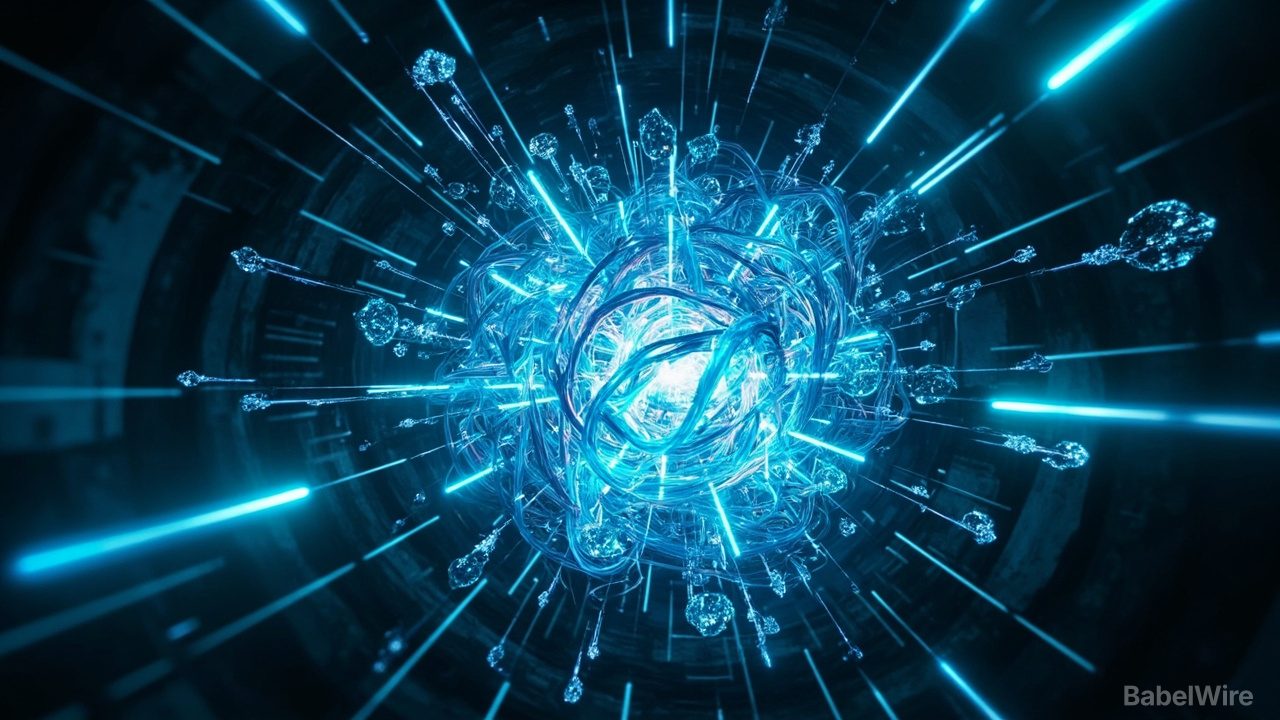
Physicists at Chinas BESIII experiment in Beijing have reported the strongest evidence to date that gluons, the fundamental carriers of the strong nuclear force, can bind together into a composite particle made entirely of themselves, with no quarks or leptons involved.
The particle, called X(2370), was first observed at BESIII in 2011 and has been studied over the course of 10 billion J/psi particle decays. In 2024, the team determined its spin-parity quantum numbers, a kind of fingerprint describing how the particle behaves under rotation and reflection, and found they matched the theoretical prediction for the lightest glueball.
Now the collaboration has gone further. They searched for a specific kaon-pair decay channel that should be strongly suppressed if X(2370) is a true glueball, because glueballs contain no quarks and therefore cannot favor one quark flavor over another. The decay was not found, with an upper limit of just 8 percent of the most common X(2370) decay pathway, far below what an ordinary quark-based particle would show.
The lightest glueball is essential for a natural and complete explanation of all these properties, said Yanping Huang of the Institute of High Energy Physics in Beijing, while all other interpretations can hardly explain them simultaneously.
Colin Morningstar of Carnegie Mellon University, whose 1990s supercomputer simulations predicted the properties of glueballs, called the results the strongest evidence yet that particles dominated by a glueball component can exist in nature.
Francesco Giacosa of Jan Kochanowski University in Poland described the particle as one that walks like a duck, quacks like a duck, and does not do something the duck we are searching for should not do. He emphasized that independent experimental confirmation remains extremely important.
The results have direct implications for quantum chromodynamics (QCD), the theory of the strong interaction. As Shan Jin of Nanjing University explained, the finding represents direct proof of self-coupling among gluons predicted by QCD about 50 years ago. It also illuminates the origin of mass, since the glueballs mass comes entirely from the strong interaction acting on gluons that are themselves massless.
BESIII collected its 10 billion J/psi events over more than a decade, and the collaborations wish list includes an upgrade to the BEPCII accelerator to gather ten times more data.