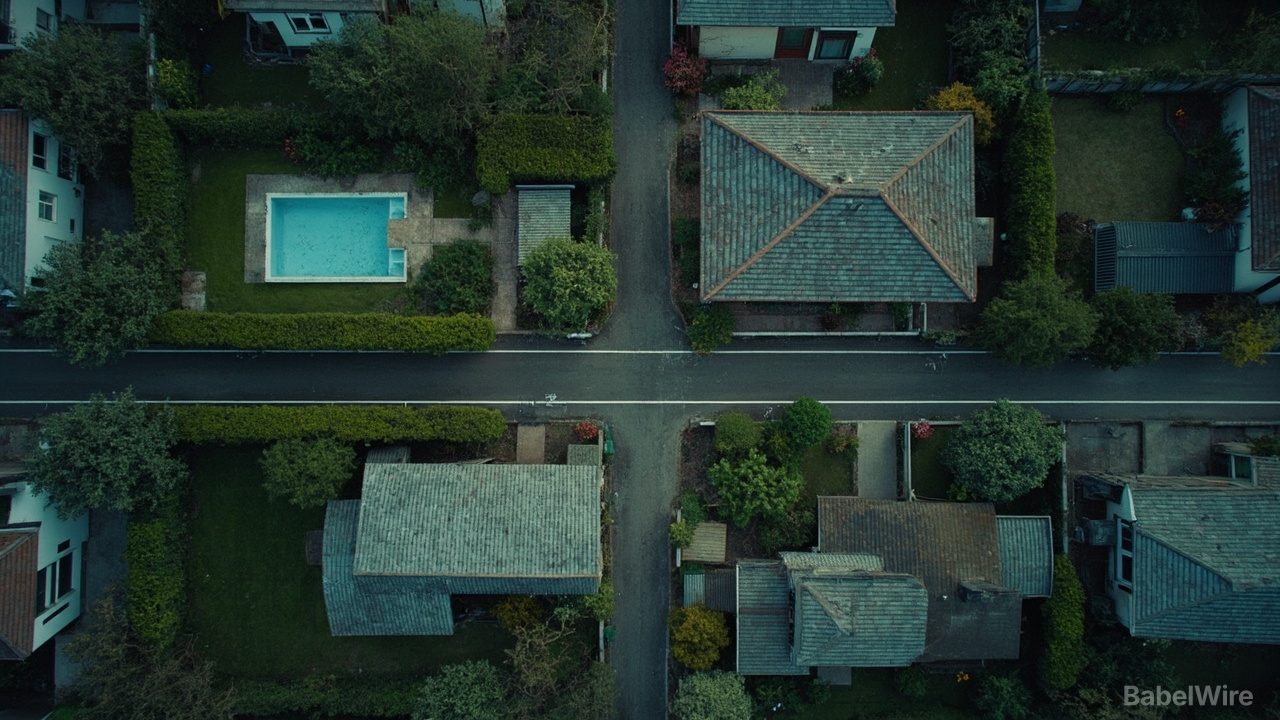
Google has been ordered by a German court to pixelate aerial photographs of private property, according to a report by Golem. The decision pushes a long-running German argument about privacy and mapping imagery from the street into the sky: an aerial photograph looks over the hedge, the fence and the wall where street-level imagery stops.
Germany is the hardest market in Europe for map imagery, and not by accident. When Street View arrived in 2010, hundreds of thousands of households used an opt-out Google had offered under political pressure, and the country is still covered in blurred islands as a result. Courts have spent the years since working out how far that objection reaches: who may photograph a house, from what altitude, and what the owner can demand afterwards. Property law gives owners a claim against interference with their land (BGB § 903 and § 1004); the general right of personality covers the image itself. Aerial photography sits awkwardly across both.
What the ruling establishes is less a map than a principle: a roof, a garden, a terrace or a pool photographed from above falls inside the protected zone, and pixelation is an acceptable remedy. That is the expensive part for Google. Pixelation on request does not industrialise. Imagery is refreshed on cycles, every blur is a permanent artifact in the dataset, and to know which parcels are protected an operator would need a register that does not exist.
The precedent does not stop at Google. Under the GDPR, an aerial photograph of an identifiable home can be personal data, and data protection authorities in other member states have repeatedly looked to German case law on exactly this question. Apple, Microsoft's Bing, Here and the national survey agencies all serve the same kind of imagery. A German ruling turns blurring-on-request from a favour into a requirement of the product.
Google's appetite for imagery risk has visibly shrunk. In August the company pulled AI image generation from Google Earth a day after launch, after the feature rendered views of real places that should not have existed. That was self-inflicted. This pressure arrives from a courtroom.
What remains open is which court decided, who brought the case, and whether the decision is final or still appealable. If Google appeals, the principle may narrow again. But the direction of German privacy case law has been consistent for fifteen years: the burden sits with the company that publishes the picture.
For every mapping service in Europe, the question is therefore no longer whether pixelation on request is possible. It is whether it can be done at the speed of the next imagery refresh.