Geodesy has long carried an unanswered question: when do spherical harmonic expansions accurately represent a planet's gravity field? Such models are essential for satellite navigation, Earth observation and the exploration of planets, moons and asteroids.
It has been known for decades that spherical harmonics work reliably far from a body. The classical boundary of guaranteed convergence is the Brillouin sphere — the smallest sphere centred on a planet's centre of mass that encloses the whole body. Outside it, adding more harmonic terms improves accuracy. What happens inside the Brillouin sphere but outside the planet itself, however, had remained unclear.
Researchers had observed that for smooth, idealised planetary shapes, the expansions could stay valid well inside the Brillouin sphere, while for rough, realistic planets with complex topography they often failed much closer to the surface. The reason for the difference was not understood.
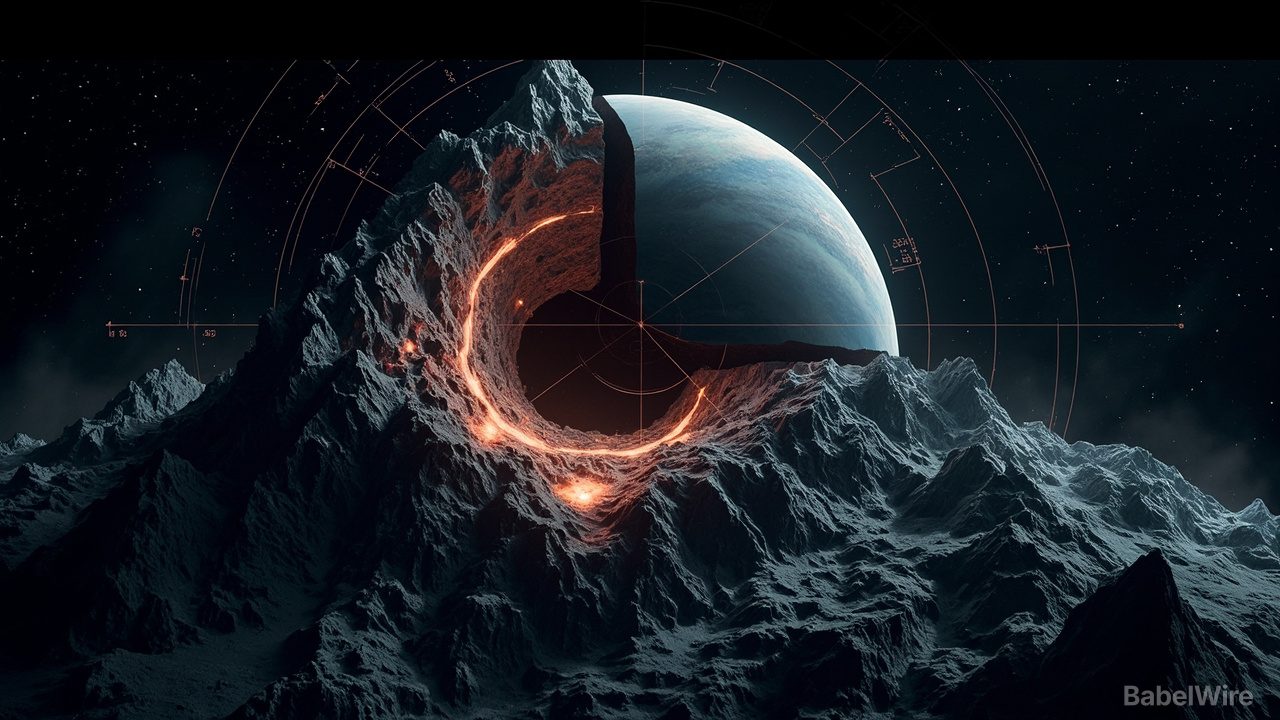
A new study now offers a simple geometric explanation. Whether spherical harmonic gravity models succeed or fail is controlled by hidden mathematical features known as singularities, whose locations are determined by the body's physical properties, such as shape and mass density. Smooth bodies can have singularities buried deep within the planet, keeping calculations accurate inside the Brillouin sphere. Rougher bodies with mountains, edges or irregular topography push those singularities closer to the surface, causing the calculations to break down much sooner.
The finding resolves a longstanding puzzle in geodesy and provides a framework for predicting the reliability of gravity models used in satellite navigation, planetary exploration and the study of planets, moons and asteroids.
Professor Gerald Dunne of the University of Connecticut said: "The precision of geodetic measurement and analysis is technologically important and scientifically fascinating. In recent work we have shown that it is advantageous to recast the discussion about the accuracy of spherical harmonic expansions as an analysis of the singularities of the gravitational potential of the planetary body. This demystifies the problem and opens the door to significantly higher precision."