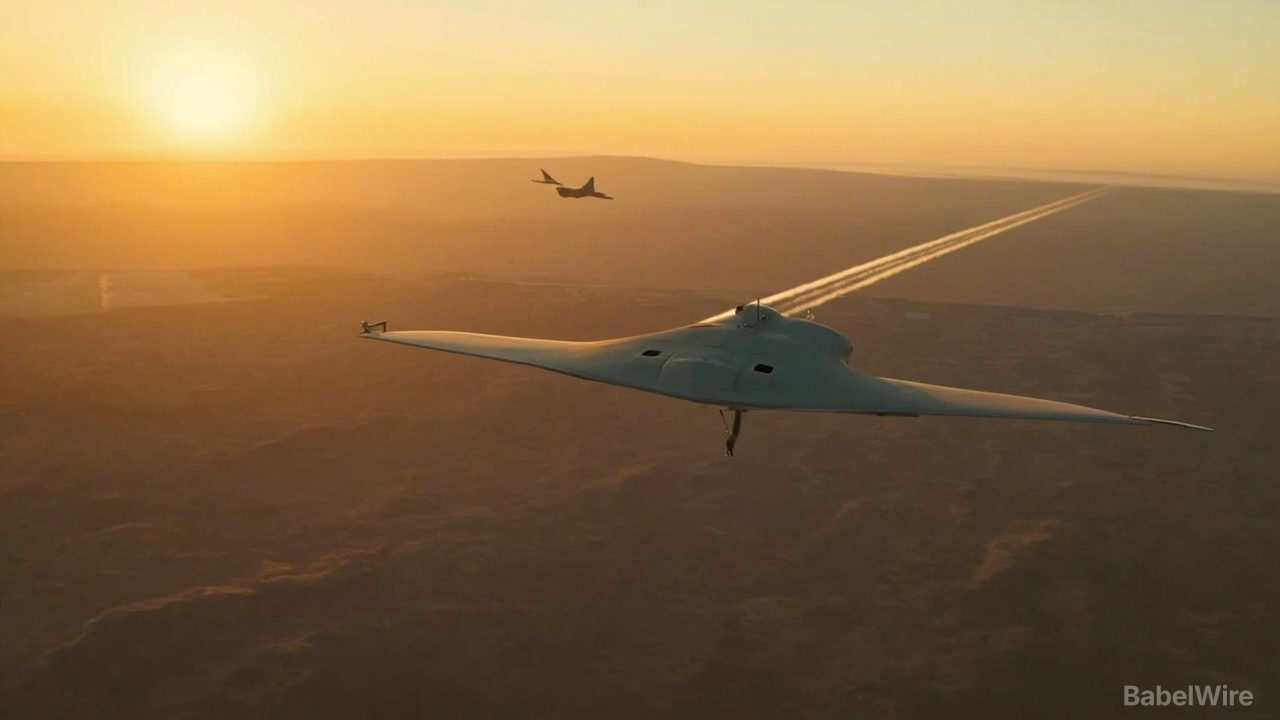
The most striking number in General Atomics' latest update on its Gambit drone family appears almost in passing, inside a quote. The company is working on a flying wing called NextGen, larger than the Gambit 4 design, with "novel hybrid-electric propulsion" and — according to a spokesperson — an engine team that has promised "60+ hours unrefueled."
Sixty hours is not an increment. It is a different kind of aircraft. The MQ-9 Reaper, the workhorse that made General Atomics famous, stays up for well under half of that depending on payload and altitude; even the Global Hawk line sits in the region of a bit over a day. An armed, stealthy wing that loiters for two and a half days changes what "presence" means: fewer launches, fewer ground crew per flight hour, fewer tankers.
C. Mark Brinkley, a General Atomics spokesperson, described NextGen to The War Zone as a fully armed, fully outfitted ISR/strike wing — and explicitly not a CCA, meaning not part of the collaborative combat aircraft programme through which the Air Force wants to pair crewed jets with uncrewed escorts. Work on NextGen is meant to feed into Gambit 4, the stealthy flying wing in the Gambit line announced in 2022, so that the company is not starting from scratch when a customer appears.
The context is a family growing faster than planned. In 2022 there were four concepts — Gambit 1 for intelligence and reconnaissance, 2 for air-to-air combat, 3 as a 'red air' aggressor, 4 as the flying wing. There are now six. Gambit 1 flies as the XQ-67A under the OBSS programme with the Air Force Research Laboratory; on Tuesday AFRL announced that advanced mission systems, sensors, mission computers and power and thermal management, plus beyond-line-of-sight datalinks and live, virtual and constructive simulations, had been exercised on the aircraft over the Nevada Test and Training Range. Gambit 2 flies as the FQ-42A Vengeance, one of two designs the Air Force has put into production under the first CCA increment — Anduril's FQ-44A Fury is the other. In September the Air Force set a goal of at least 500 of those aircraft in inventory by 2032.
The next hard date is earthbound. For early 2027 General Atomics plans a company-funded live-fire demonstration of an air-to-ground munition released from a company-owned Gambit 6. Brinkley used the occasion for a jab at competitors hanging weapons under wings: if a drone is not low-observable, does not have a working internal weapons bay and was not designed for affordable high-rate production from the start, "then it's just a little jet."
What is missing from the 60-hour claim is everything but the number. No timeline, no customer, no engine model, no fuel-fraction figure. Hybrid-electric propulsion promises better loiter economy and reduced infrared and acoustic signatures, and General Atomics has been chasing it for years — in 2021 with the MQ-Next concept and the same 60-hour target, in 2025 with an AFRL contract for a programme called GHOST. The same figure reappearing is continuity, not proof.
The point is still structurally interesting. A modular core — landing gear, baseline avionics, common hardware — lets reconnaissance, air combat, shipboard operation and ground attack be derived from one chassis family. That is how a drone fleet stops being a set of programmes and becomes a product line.