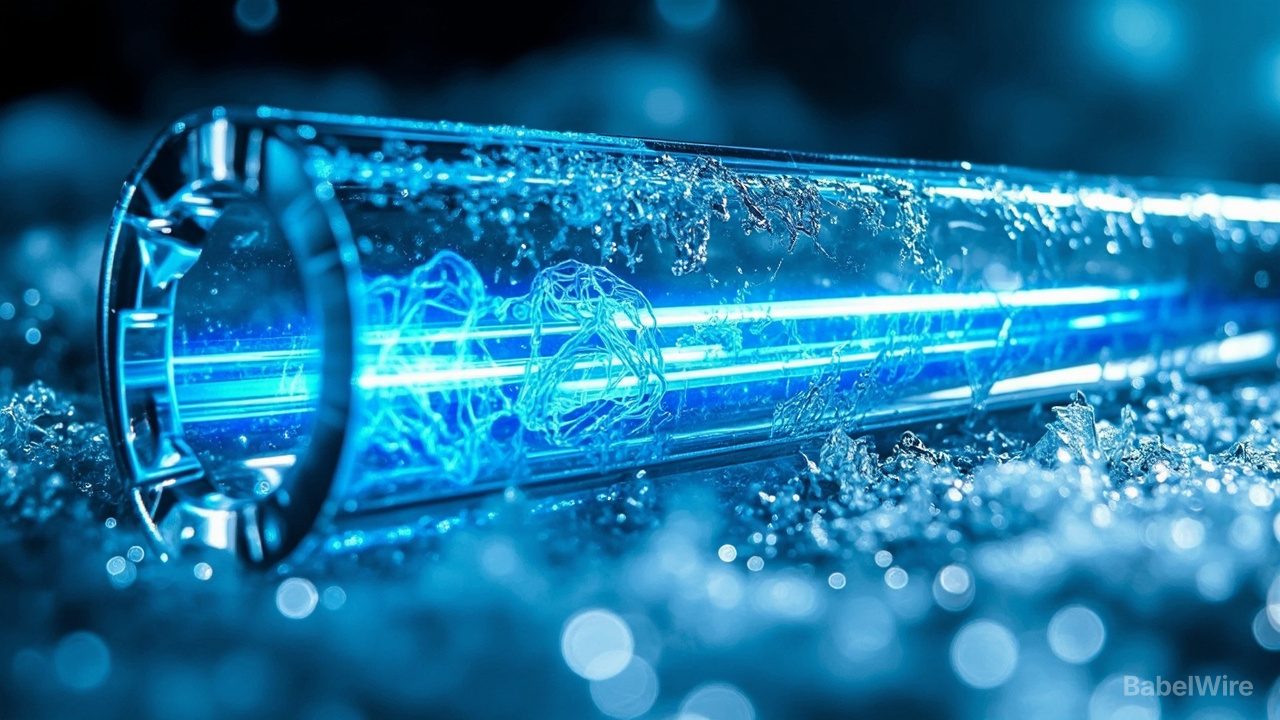
An Unusual State of Matter
When a lake freezes in winter, water molecules rearrange themselves into a new structure, changing the material's physical properties. Scientists have now applied this same principle to create a revolutionary new type of optical fiber—by freezing it.
A team of researchers from the Max Planck Institute for the Physics of Light (MPL) in Erlangen, Leibniz University Hannover (LUH), and the Leibniz Institute for Photonic Technologies (IPHT) in Jena has developed an optical fiber that simultaneously transmits light and sound waves with extraordinary efficiency.
The secret? Freezing a glass capillary filled with carbon disulfide (CS₂) to -196°C in liquid nitrogen.
How It Works
The new fiber, called a Liquid Core Optical Fiber (LiCOF), starts as a liquid-filled capillary that guides light like a conventional optical fiber. When selectively frozen to cryogenic temperatures, the liquid core solidifies but—remarkably—retains its ability to guide light.
"The key point is that the frozen section of the LiCOF retains its ability to guide light. Not only that: both the liquid and the frozen sections of the fiber guide hypersonic waves," explains Simon Seiderer, lead author of the study published in Optica.
This creates an entirely new platform for optoacoustics—the combination of light and sound waves.
1,000 Times Stronger Coupling
The researchers exploit an effect known as Brillouin-Mandelstam scattering, where light and sound interact within a material. This occurs in conventional fibers but only weakly. The frozen core creates an extremely confined and dense environment, amplifying the optoacoustic coupling by more than 1,000 times compared to standard optical fibers.
This dramatic enhancement enabled the team to demonstrate an optoacoustic memory—a key building block for photonic neuromorphic computing.
Why It Matters
Today's computer chips generate enormous amounts of heat, limiting their performance. Photonic computing—using light instead of electricity—promises vastly higher speeds with dramatically lower energy consumption. However, storing and delaying light signals has been a major challenge.
The frozen-core fiber solves this elegantly. By converting fast light signals into slow sound waves and back, it creates a memory buffer that could enable entirely new architectures for computing.
"By freezing the liquid core, we have created an entirely new physical platform that offers extreme nonlinearities while remaining easy to handle," says Prof. Birgit Stiller, who leads the Quantum Optoacoustics research group.
Applications Beyond Computing
The unusually strong light-sound coupling could prove relevant for:
- Quantum information processing: Manipulating quantum states using sound waves - Microwave photonics: Converting between microwave and optical signals - High-precision sensing: Creating extraordinarily sensitive sensors - Neuromorphic computing: Building computing systems that mimic the brain's neural architecture
The research was published in the journal Optica (Vol. 13, pp. 1415–1422, 2026).
Sources
- computer-automation.deComputer&Auto - New Fiber-Optic Technology with 1,000 Times Stronger Light-Sound Coupling
- mpl.mpg.deMax Planck Institute for the Physics of Light - Press Release
- modernmechanics24.comModern Mechanics - Frozen Optical Fibers Merge Light and Sound
- opg.optica.orgOptica - Giant Brillouin gain in frozen CS₂ capillaries (Vol. 13, 1415-1422, 2026)