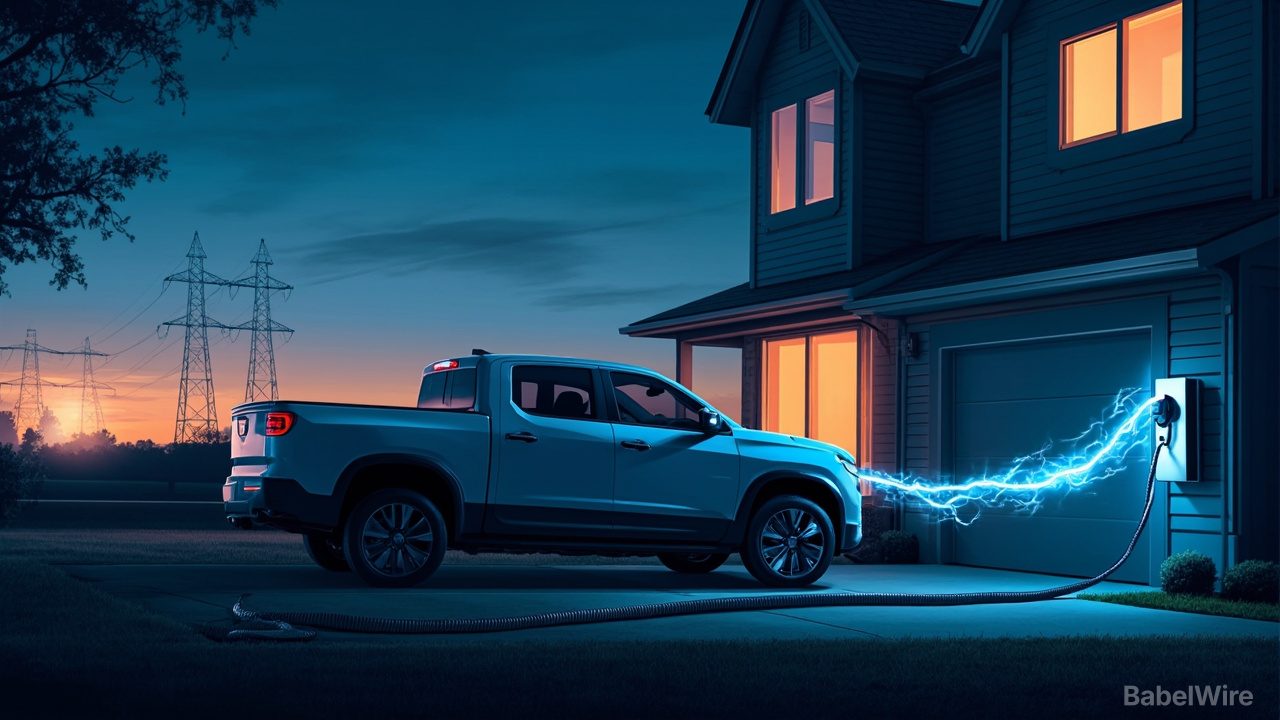
Ford announced two home chargers on Tuesday that turn its forthcoming Fathom pickup into a backup battery, and priced them at roughly half what its first-generation bidirectional hardware cost. The Fathom itself starts at $28,350; TechCrunch calls it the cheapest American EV capable of powering a house.
The cheaper device, the Home Power Station, costs around $650 — about 50 percent less than Ford's first bidirectional charger. It lets the truck charge when electricity prices are low and push power back into the home when they are high, trimming a utility bill without any outage involved. The second option, Home Backup Power, bundles that unit with a Home Backup Panel for around $2,100, about 60 percent less than the previous generation, and adds the ability to keep part or all of a house running during an outage.
Ford says the Fathom can deliver "over 10 kW" to a home. That is roughly the output of a small standby generator: enough for a refrigerator and an air conditioner for about half a day in a typical US house, not enough to run everything. Which circuits actually stay live depends on the household and the installation — compressors and fridges draw a large surge at startup, and soft-start devices that tame it add cost.
None of the prices include installation, which is the number that decides whether vehicle-to-home is a mass-market feature or a demo. For existing V2X chargers, installation can run up to $10,000 depending on how much electrical work a house needs. Ford has not announced installer partnerships; a spokesperson said details would come later.
Both chargers also enroll the truck in virtual power plants — software that aggregates distributed batteries, including EVs, and pays owners to let a utility draw on them. Ford did not say what Fathom owners could earn, but payouts in such programs can exceed $1,000 a year depending on grid need. The pitch is timely: utilities are hunting for flexible capacity at the edge of the grid as AI data centers strain it, and a parked pickup with a large battery is exactly the kind of asset that can absorb a peak without a new power plant.
The strategic logic goes beyond selling chargers. Ford has been pushing deeper into energy storage as demand for such services grows, and a vehicle that earns money while parked is a stronger argument for buying it than a specification sheet. The catch is the same one that has limited V2X for years: the hardware got cheaper, but the electrician, the panel and the permit have not.