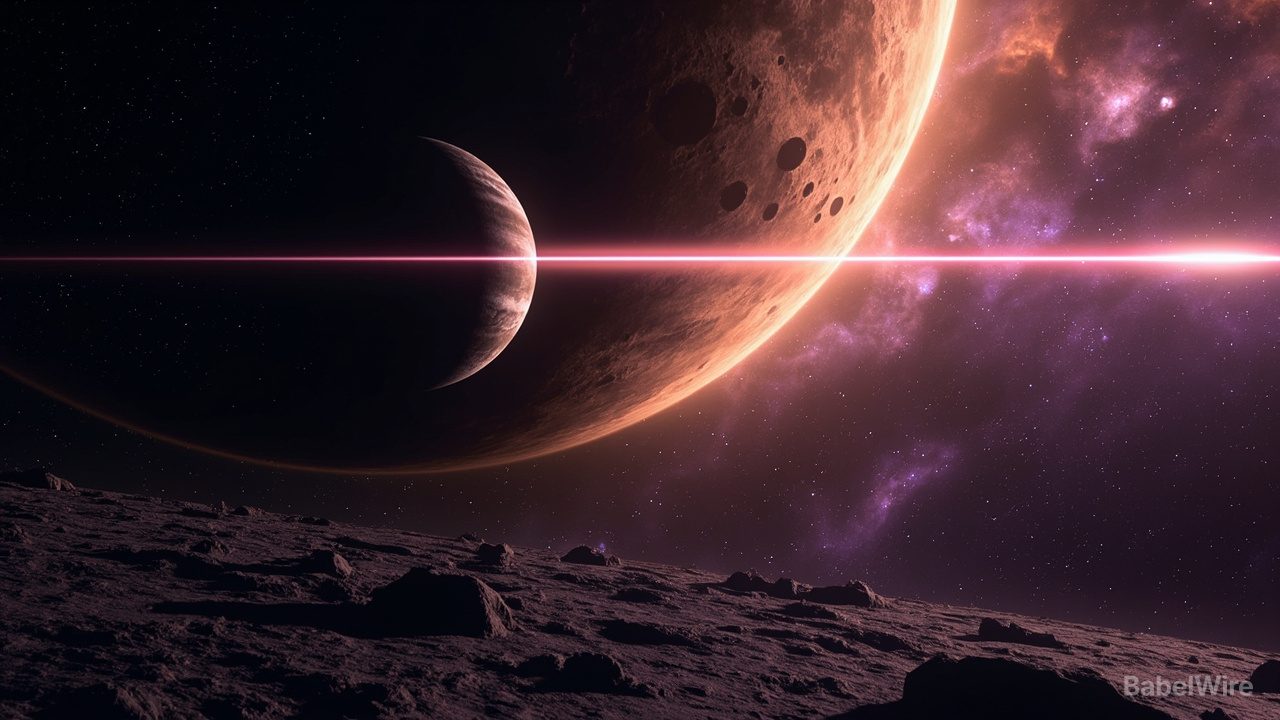
Astronomers using the European Southern Observatory's Very Large Telescope (VLT) in Chile have detected what may be the first exomoon ever discovered — a Jupiter-mass celestial object orbiting a brown dwarf approximately 200 light-years from Earth.
The findings, published in Nature, detail observations of a giant moon-like body circling a failed star in the constellation of Scorpius. If confirmed, it would mark the first unambiguous detection of a moon outside our solar system, a prize astronomers have chased for decades.
**A Moon or a Planet?** The object, roughly the mass of Jupiter, orbits its brown dwarf host at a distance that would place it well within the habitable zone if the system had the right conditions. The discovery blurs the line between moons and planets, raising fundamental questions about how these bodies form.
"This detection opens a new frontier in exoplanetary science," said the research team. "If moons can form at this scale around brown dwarfs, our models of planet and moon formation need significant revision."
The detection was made possible by direct imaging with the VLT's adaptive optics system, which corrects for atmospheric distortion to achieve extraordinarily sharp observations. The team observed the system over multiple epochs, confirming that the companion is gravitationally bound to the brown dwarf rather than a background object.
Why It Matters Finding exomoons has been an astronomical holy grail. While thousands of exoplanets have been confirmed, their moons have remained frustratingly elusive due to their smaller size and the limitations of detection methods. The Kepler and TESS missions yielded several candidates, but none were definitively confirmed.
A Jupiter-mass moon challenges conventional formation theories. In our solar system, even the largest moons — Ganymede and Titan — are only about 0.025 Earth masses. A moon as massive as Jupiter suggests either a radically different formation mechanism or that our definition of "moon" may need updating.
The discovery comes as NASA's James Webb Space Telescope continues to search for exomoons around other targets, and the Nancy Grace Roman Space Telescope, set to launch later this decade, will have the ability to detect smaller exomoons in large numbers.