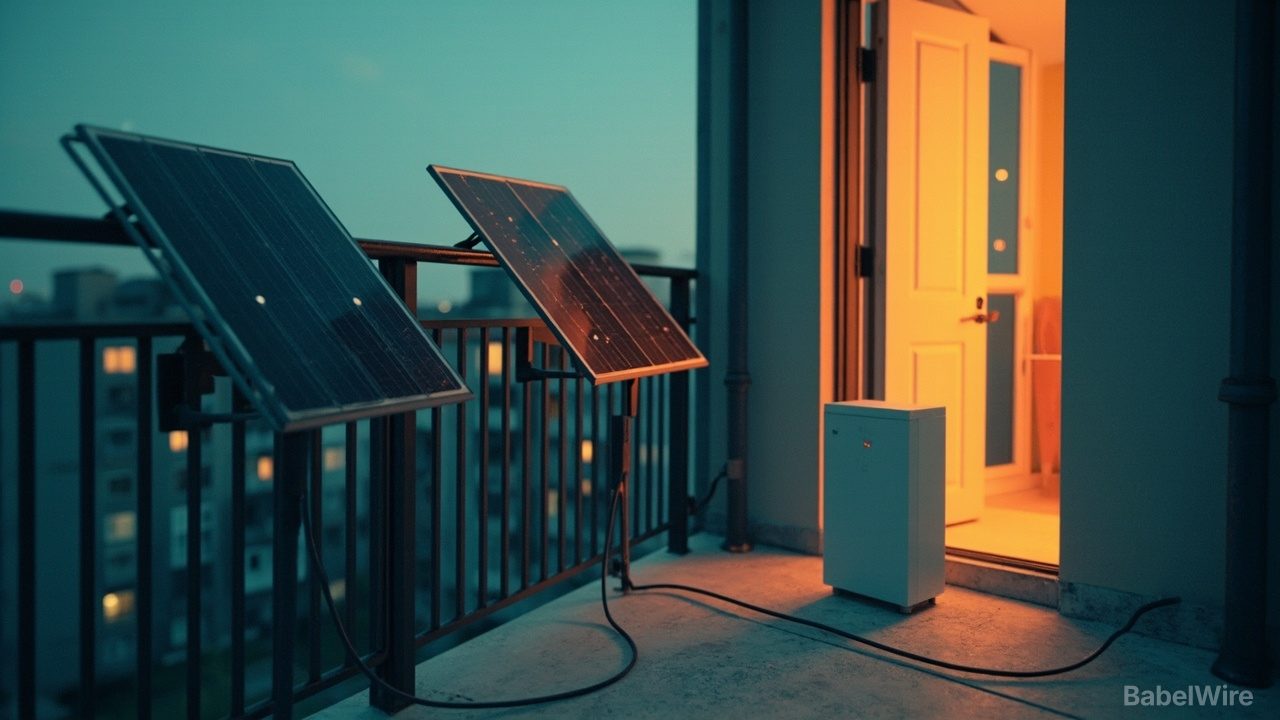
Sunlight on Demand
The Federal Communications Commission (FCC) has approved the first test launch of Reflect Orbital's Eärendil-1 satellite — a spacecraft designed to deploy an 18-by-18-meter (59-foot) thin-film reflector in low Earth orbit that will beam sunlight back to specific locations on Earth after dark.
The launch could come as early as late 2026, likely from Vandenberg Space Force Base via SpaceX. The satellite will fly in a near-polar orbit at 625 km altitude and test the ability to project a patch of light equivalent to a Full Moon's brightness over a 3-mile area.
50,000 Mirrors by 2035
Reflect Orbital CEO Ben Nowack envisions a constellation of more than 50,000 orbital reflectors girdling the Earth by 2035. The company's business model is to sell "on-demand solar" for extending working hours, disaster relief, and agriculture. The US Department of Defense could also be a prime customer.
Three test reflectors will launch in sequence, each three months apart, starting with Eärendil-1 (named after the Lord of the Rings character who carried the light of the morning star). The first three will also generate revenue for the company.
An Old Idea, New Scale
The concept dates back decades: Russia deployed the 20-meter Znamya-2 reflector from the Mir space station in 1992, creating a 5 km light patch as bright as the Full Moon that traversed Europe. Reflect Orbital's plan is orders of magnitude larger in scale.
Astronomers Sound the Alarm
The American Astronomical Society has voiced strong concerns. While Starlink and other satellite megaconstellations are incidental reflectors that photo-bomb astronomical observations, Reflect Orbital's mirrors are explicitly designed to brighten the night sky.
The company says it will work with astronomers to create exclusion zones for dark sky preserves and major observatories, and that the mirrors are "specular" (non-diffuse), focusing light only where needed. But critics argue that with 50,000 mirrors, the cumulative impact is impossible to contain.
Safety concerns extend beyond astronomy: the bright beams could interfere with aviation, confuse satellite star-trackers, and disrupt nocturnal wildlife.
The Precedent Problem
Unlike Starlink, which received FCC spectrum approval years before light pollution concerns were fully debated, Reflect Orbital's approval opens a new frontier: purpose-built orbital light sources. There is currently no international authority capable of assessing the environmental impact of orbital reflectors at scale.
"Maybe we need something equivalent to the FCC, in terms of an authoritative international agency able to analyze missions and their night sky impact," wrote Universe Today's David Dickinson.
With the first launch imminent and 50,000 more planned, the debate over who controls the night sky is only just beginning.
Sources
- universetoday.comUniverse Today — FCC Approves First Launch for Space Reflector Constellation
- phys.orgPhys.org — FCC approves first launch for space reflector constellation
- thehill.comThe Hill — FCC approves Reflect Orbital's satellite for Earth lighting
- spacenews.comSpaceNews — FCC approves first Reflect Orbital satellite