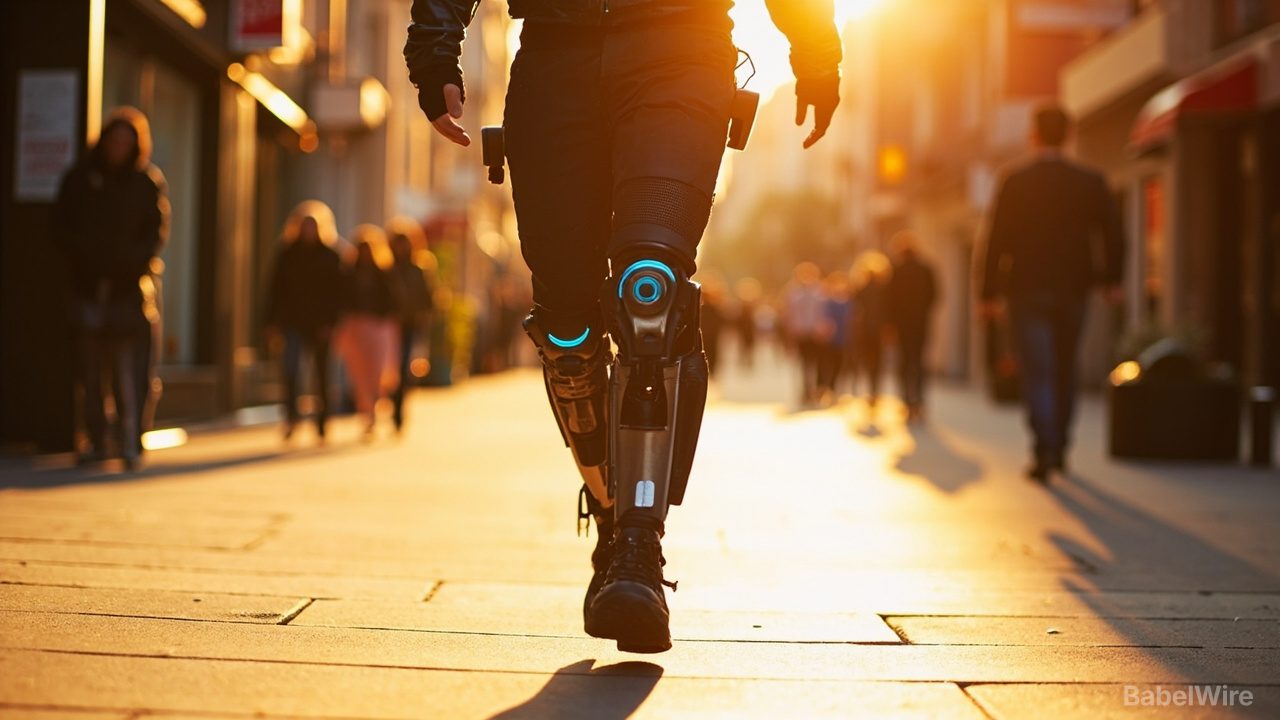
For decades, robotic exoskeletons existed primarily in science fiction and hospital rehabilitation wards. That era is ending. A convergence of advances in artificial intelligence, lightweight materials, and miniaturized motors is transforming exoskeletons from cumbersome medical devices into something closer to wearable e-bikes — and researchers say the technology could be as common as today's fitness trackers within a decade.
The shift is driven by a fundamental change in philosophy. Older exoskeletons were designed to replace lost function: help a paralyzed person walk, stabilize a stroke survivor's gait. The new generation aims to augment existing capability. A powered brace might take 25–30% of the load off an arthritic knee. Robotic shorts could make an elderly person's daily walk less exhausting. And for younger, healthier users, the promise is simply going farther with less effort.
Nike has entered the arena with Project Amplify, a prototype powered footwear system developed with robotics company Dephy. The system uses a motor, drive belt, and rechargeable battery worn around the lower leg and foot to assist ankle movement. While still in testing, Nike says it eventually intends to sell the product to everyday athletes who want to walk or run farther.
The technical breakthrough enabling this transition is what researchers call "task-agnostic control." Previous exoskeletons replayed preset movement patterns timed to specific body motions. The new systems use AI to estimate the forces a wearer's joints are producing in real time, then supply a proportional assist. This preserves the wearer's control, reduces power consumption, and makes the device less awkward when switched off.
Researchers at the Georgia Institute of Technology have developed an AI system that estimates hip movement across a wide range of walking speeds, inclines, and stair heights. At the University of Michigan, roboticist Robert Gregg is leading a $2 million project to adapt motorized braces for knees, with pilot study participants reporting reduced pain during activities like standing from chairs and climbing stairs.
Soft materials are also reshaping the field. The University of Heidelberg's WalkON system uses shoulder straps, a belt, and thigh bands that fit over regular clothes, weighing under 3 kilograms. In tests, it reduced the metabolic cost of walking on level ground by 10% for older adults and by 18% for younger users walking uphill. Compare that to earlier clinical exoskeletons weighing 23 kilograms or more — devices that took 20 minutes to fit and were impractical outside a laboratory.
The market potential is enormous. The global wearable robotic exoskeleton market is projected to grow from $3.5 billion in 2026 to $64 billion by 2034, driven by rapidly aging populations in Japan, China, Italy, and elsewhere. The World Health Organization projects that the global population aged 60 and older will reach 2.1 billion by 2050.
But significant challenges remain. Cost is still the largest barrier. Usability is another: devices must be easy to put on, adjust, and wear without specialist help. And there is an open question about whether making movement easier will lead people to exercise more — or whether their bodies will become dependent on the assistance, potentially causing muscle atrophy.
Researchers are also grappling with the stigma problem. In Japan, roboticist Tomohiro Shibata notes that the size and weight of exoskeletons can discourage use, much the way stigma discourages some older people from using canes or hearing aids. The goal, he says, is to make exoskeletons feel like "part of the body" — invisible, intuitive, and unremarkable.