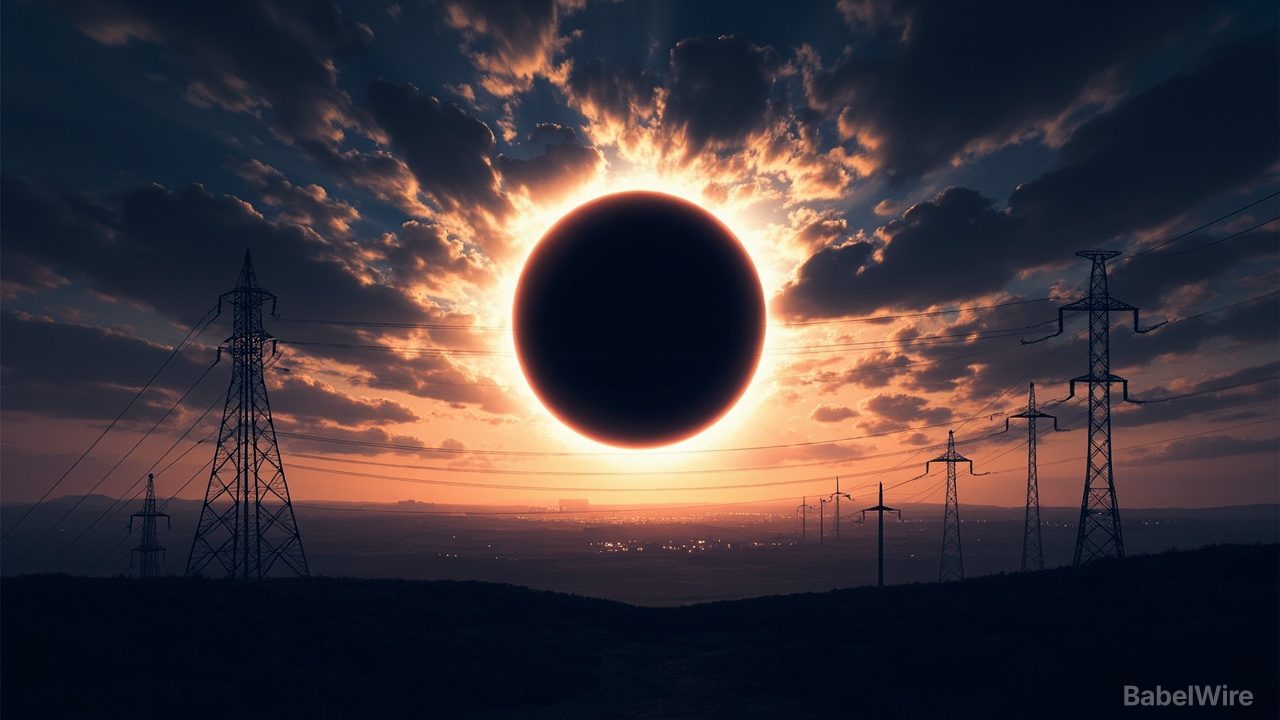
On the evening of August 12, the moon's shadow will race across eastern Greenland, western Iceland and northern Spain — the first total solar eclipse to sweep this part of Europe in more than a century. For astronomers it is a spectacle. For Europe's electricity grid operators, it is a full-scale drill in managing a solar-powered system.
The European Network of Transmission System Operators (ENTSO-E) has activated a specialized task force to coordinate the response. Under clear-sky conditions, photovoltaic output across Europe could decrease by up to 9.7 gigawatts during the event, which is expected to unfold between roughly 19:15 and 21:30 CEST — a rapid but predictable change that arrives just as the continent's evening demand begins to climb.
France's grid operator RTE puts the potential loss at about 9.7 GW between 19:30 and 21:30 local time, with Spain expected to feel the sharpest effect: the path of totality crosses the north of the country as the sun nears the horizon, when solar plants are already winding down for the day. The European Commission said the impact should be manageable precisely because the eclipse happens late in the day.
The Financial Times framed the event as a stress test for a region navigating a delicate electricity squeeze, and the numbers explain why: a synchronized multi-gigawatt swing on a network where renewables now supply a large share of power is exactly the kind of shock that planners must rehearse. Storage, hydro reserves and interconnector flows — the toolkit of a flexible grid — have been lined up in advance.
Grid operators stress that the drop is steep but highly predictable, which is what makes it manageable. The partial eclipse of March 2015 offered a rehearsal; Tuesday's event is the real thing — the first full test of whether a solar-heavy European grid can absorb a synchronized 9.7 GW dip in stride, and keep the lights on while millions look up at the sky.
Sources
- reuters.comReuters: EU's electricity grid operators prepare for solar eclipse effect
- ft.comFinancial Times: Solar eclipse threatens to tighten Europe's electricity squeeze
- taipeitimes.comTaipei Times: Europe readies for solar eclipse's effect on power
- rte.ieRTE: Europe readies for solar eclipse dip in power generation
- linkedin.comENTSO-E on LinkedIn: When the Moon passes in front of the Sun, Europe's solar output dips