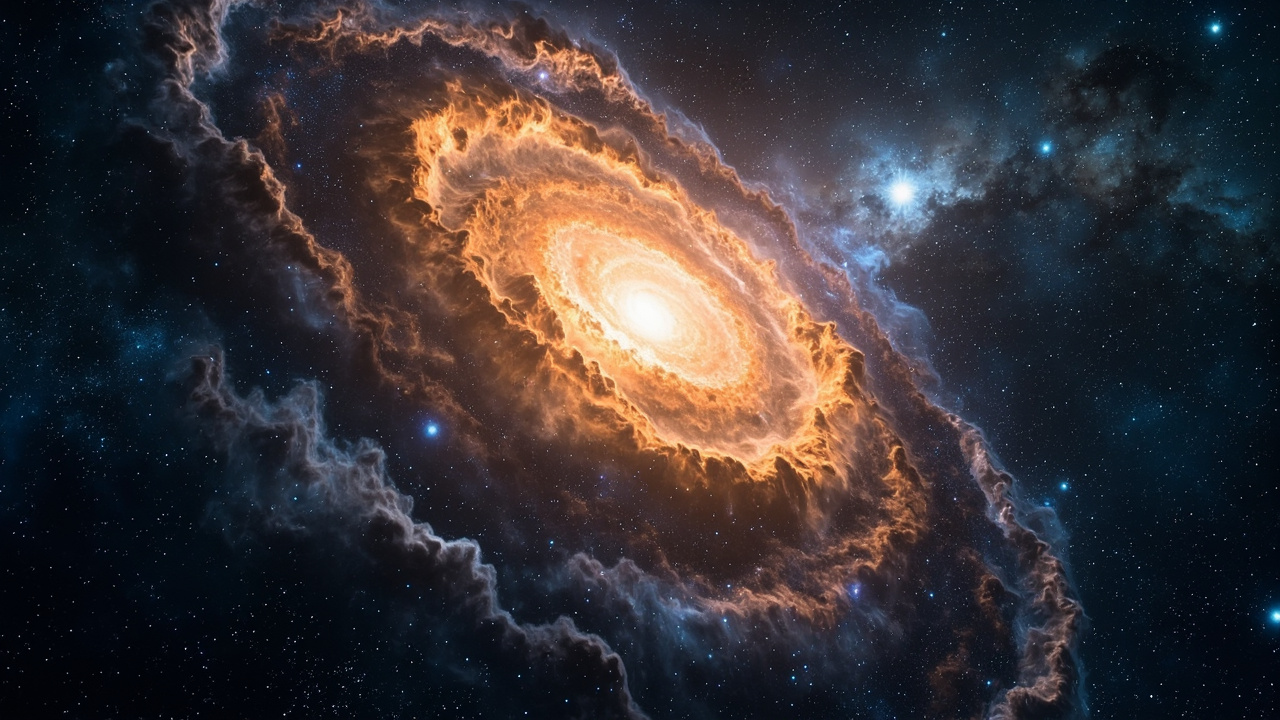
The European Space Agency's Euclid space telescope has produced the largest, most detailed visible-light portrait ever taken of the Milky Way's crowded heart, mapping more than 60 million stars in our galaxy's central bulge.
The enormous 6-gigapixel mosaic was captured in just 26 hours across March 23 and 24, 2025, and is composed of nine pointings from Euclid's visible light camera. Each pointing covers an area of the sky larger than the full Moon.
"Designed to observe billions of faraway galaxies, the space telescope's visible light camera is sensitive enough to tell apart individual stars in our super-crowded galactic bulge, without being blinded," Euclid team members said in a statement.
The telescope's sharpness and sensitivity in visible light is comparable to the NASA/ESA Hubble Space Telescope's wide field camera. But crucially, each Euclid pointing spans an area 270 times larger than Hubble's field of view. To observe the same region from the ground, the Keck Observatory would need approximately 2,000 hours of telescope time.
This image encompasses the entire region that NASA's upcoming Roman Space Telescope will monitor for planet hunting using a technique called gravitational microlensing — where a foreground star's gravity bends and magnifies the light of a more distant star, revealing planets otherwise too faint to detect.
"Adding Euclid's snapshot to Roman's future survey will help us map our Galaxy better and identify hard-to-find cosmic treasures like isolated black holes and rogue planets more easily," said Dr. Jason Rhodes, an astronomer at NASA's Jet Propulsion Laboratory.
Dr. Matthew Penny, an astronomer at Louisiana State University and co-lead of Euclid's exoplanet science working group, added: "One of the most exciting aspects of the Euclid observations is that they give us the chance to test and improve Milky Way models."
The image also captures nebulae and star clusters embedded within the galactic bulge, providing astronomers with an unprecedented census of the stellar population in this dense region. This rare pause in Euclid's primary survey — which is mainly geared toward cosmology and dark energy studies — was deemed worthwhile for its high scientific impact.
"This is the only time Euclid has paused its normal sky survey, which is mainly geared toward cosmology," Dr. Rhodes noted. "This takes a lot of work and planning, so it really has to be something with a high impact for science."