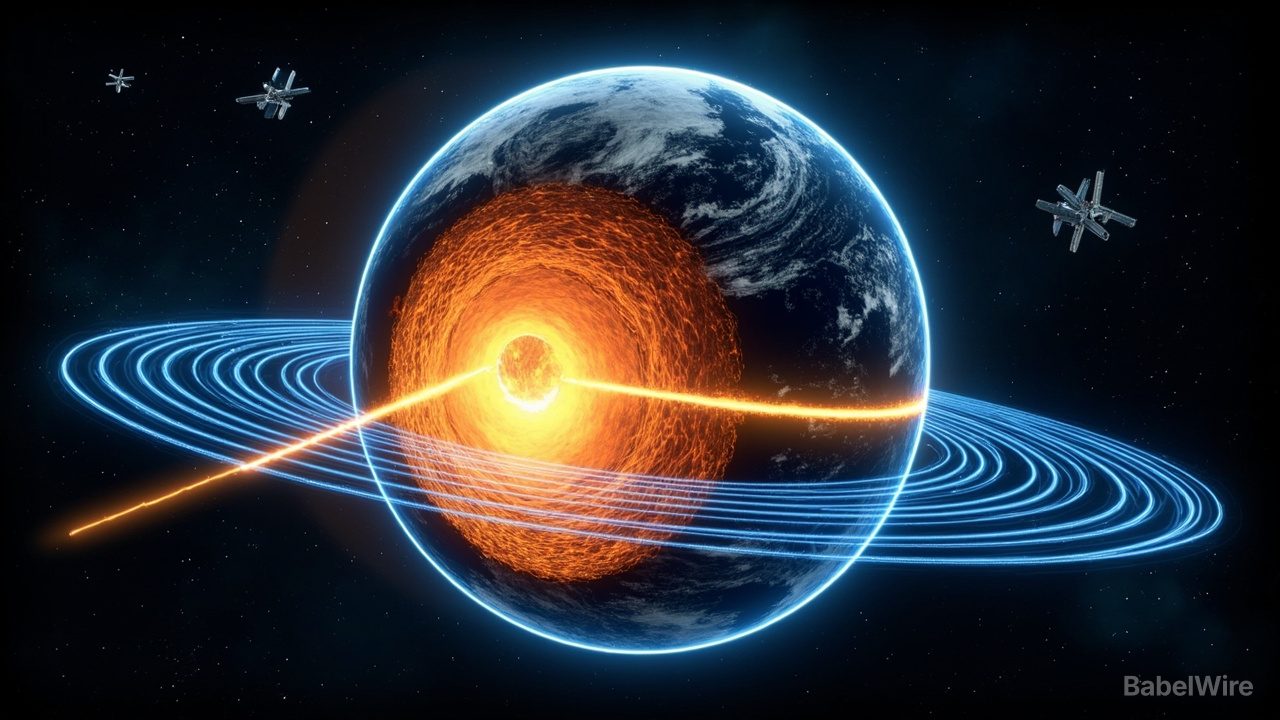
Deep beneath the Pacific Ocean, something strange is happening inside Earth. A massive flow of liquid iron that had been moving in one direction for years suddenly reversed course in 2010 — switching from a weak westward drift to a strong eastward current. Scientists did not expect it, and they only discovered the full scale of the shift thanks to satellites orbiting hundreds of miles above Earth.
The outer core sits roughly 1,370 miles beneath the surface, a sphere of molten iron and nickel at temperatures rivaling the surface of the Sun. As this superheated metal churns, it generates the geomagnetic field that shields the planet from solar radiation and makes modern navigation possible.
For decades, scientists believed the large-scale flows in the outer core drifted steadily westward. Then, the data showed otherwise.
A new study led by Frederik Dahl Madsen of the University of Edinburgh's School of Geosciences analyzed magnetic field measurements from 1997 to 2025, drawing on data from ESA's Swarm and CryoSat missions, Germany's CHAMP mission, and Denmark's Ørsted satellite.
"The large-scale flow reversal beneath the Pacific raises new questions about the behavior of Earth's deep interior," said Madsen. "Scientists now want to understand whether the reversal represents a short-lived fluctuation, part of a repeating oscillation, or a new stable equilibrium for core circulation."
The reversal coincided with a geomagnetic event known as the 2017 geomagnetic jerk — a sudden acceleration in Earth's magnetic field. Researchers also linked it to changes detected by seismologists in the solid inner core, suggesting the entire deep interior may be more dynamically coupled than previously understood.
"The rise of the strong eastward flow in the Pacific is contemporary with a change in behavior in the inner core," Madsen explained. "We hypothesize that these changes in the deep interior are associated with the changes in flow beneath the Pacific."
The European Space Agency's Swarm trio of satellites, launched in 2013, were instrumental. Each carries highly sensitive magnetometers that measure tiny variations in the magnetic field, allowing scientists to separate signals from the core from interference by the crust, oceans, atmosphere, and space weather.
ESA Swarm Mission Scientist Elisabetta Iorfida noted that "regional changes can emerge rapidly within just a decade." The latest data suggest the eastward flow has weakened since 2020 after reaching a peak, raising the possibility the flow could reverse again.
While these deep movements pose no direct danger — they are not linked to earthquakes or climate change — changes in Earth's magnetic field can affect satellite communications, airline navigation, and space weather forecasting. Understanding the dynamo at Earth's heart isn't just an academic question: it powers the invisible shield that makes modern technology possible.