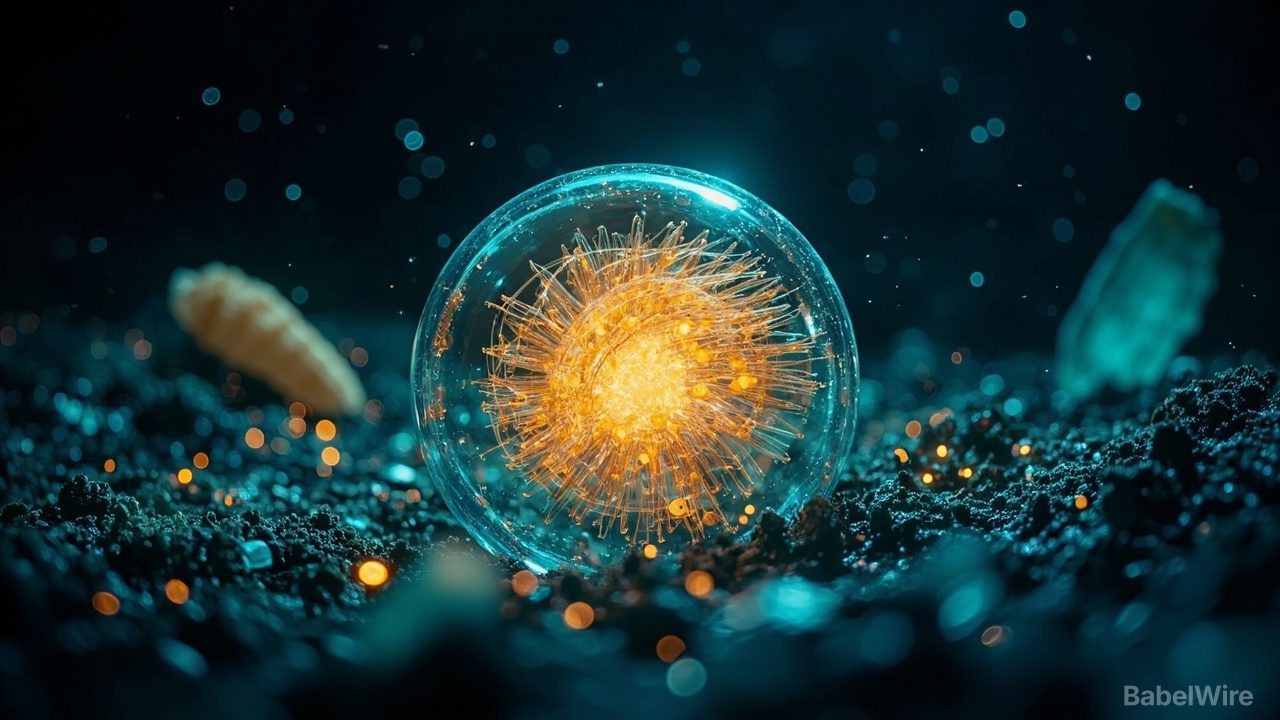
Deep in the sediment around methane seeps in the South China Sea lives a rare, worm-like mollusc called Chaetoderma shenloong — the 'divine dragon glistenworm'. When it was first described in 2024, marine taxonomists ranked it among the ten most remarkable new species of the year. It has now produced something odder still.
Writing in Nature Communications, researchers in China and Japan report that the glistenworm's digestive gland is packed with microscopic spheres they have named dracosphera — 'dragonballs', after the manga series. Each one is bounded by more than 20 membrane layers and contains hundreds of bacteria of a single sulfur-oxidising species. The team argues the dracosphera is the first organelle known to be dedicated to chemosynthesis: a cellular structure that exists specifically to farm bacteria that live on chemical energy instead of sunlight.
Chemosynthetic symbiosis itself is not new. Since the discovery of hydrothermal vents on the Galápagos Rift in 1977, biologists have known that animals at vents and cold seeps 'feed' on symbiotic bacteria held in specialised cells called bacteriocytes. What is new here is a structure within those cells — one not seen in other molluscs, nor in the tubeworms that are the textbook example of the lifestyle.
The researchers' best guess is that it is a rationing system. Glistenworms spend most of their lives buried in sediment where oxygen is scarce, and pinning the bacteria inside a multi-layered sphere may stop them from consuming oxygen the host needs. To eat, the worm may break down some of the membranes and digest the released bacteria — the scientists found no lysosomes, the cell's normal digestive sacs, inside the dragonballs themselves. That hypothesis, the authors concede, rests on correlative evidence: living specimens are almost impossible to obtain, and one of the molluscs in the study was collected by chance at a mud volcano off Japan, extending the species' known range.
A single new organelle, in one poorly understood animal, is a reminder of how thin the map of deep-sea biology still is.