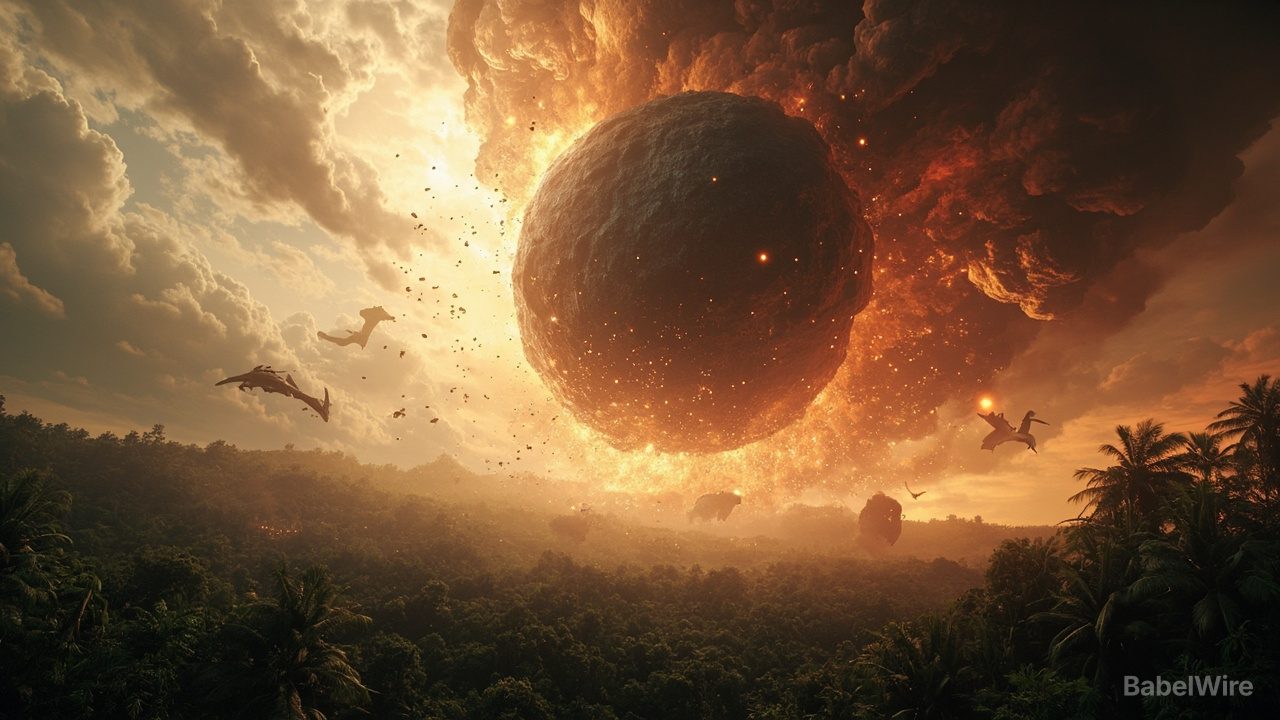
For decades, the object that ended the reign of the dinosaurs has been known only in outline — a city-sized projectile that carved the Chicxulub crater and triggered the fifth mass extinction. Now researchers have identified exactly what it was.
A team led by the University of British Columbia, in collaboration with scientists from Paris, Brussels and Vienna, has determined that the Cretaceous-Paleogene impactor was a rare class of meteorite called a CO chondrite — a carbonaceous chondrite of the Ornans class.
A Fingerprint in the Clay
The discovery, published July 19 in Science Advances, was made by measuring nickel isotopes preserved in a thin layer of clay deposited around the world after the impact. Only minute traces of the original projectile remain — the meteorite vaporized on impact — but its isotopic signature survived.
"CO chondrites are definitely not like the typical meteors you find in museum collections," said Dr. Philippe Claeys, a visiting professor at UBC from Vrije Universiteit Brussel. "A CO contains much less volatile elements — like carbon, zinc, water and particularly sulfur — than other classes."
Dust, Not Sulfur, Delivered the Blow
The finding reshapes scientists' understanding of the extinction mechanism. Because CO chondrites contain so little sulfur, the new evidence suggests that sulfur from the meteorite itself may not have been the main driver of the catastrophe. Instead, enormous quantities of fine debris blasted into the atmosphere — blocking sunlight and cooling the planet — played the dominant role.
**Where Did It Come From?**
The meteorite's origin remains uncertain. It may have come from a distant region of the outer Solar System or from the outer asteroid belt near Jupiter. Carbonaceous chondrites account for only about five percent of meteorites sampled on Earth, and CO chondrites represent a tiny fraction of that group.
"Being impacted by such a rare, distant projectile really underscores how unlucky the dinosaurs were," said Dr. Claeys.
The Chicxulub impactor measured 10 to 15 kilometers across and struck Earth at roughly 64,000 km/h, creating the 180-kilometer-wide crater now buried beneath Mexico's Yucatán Peninsula.