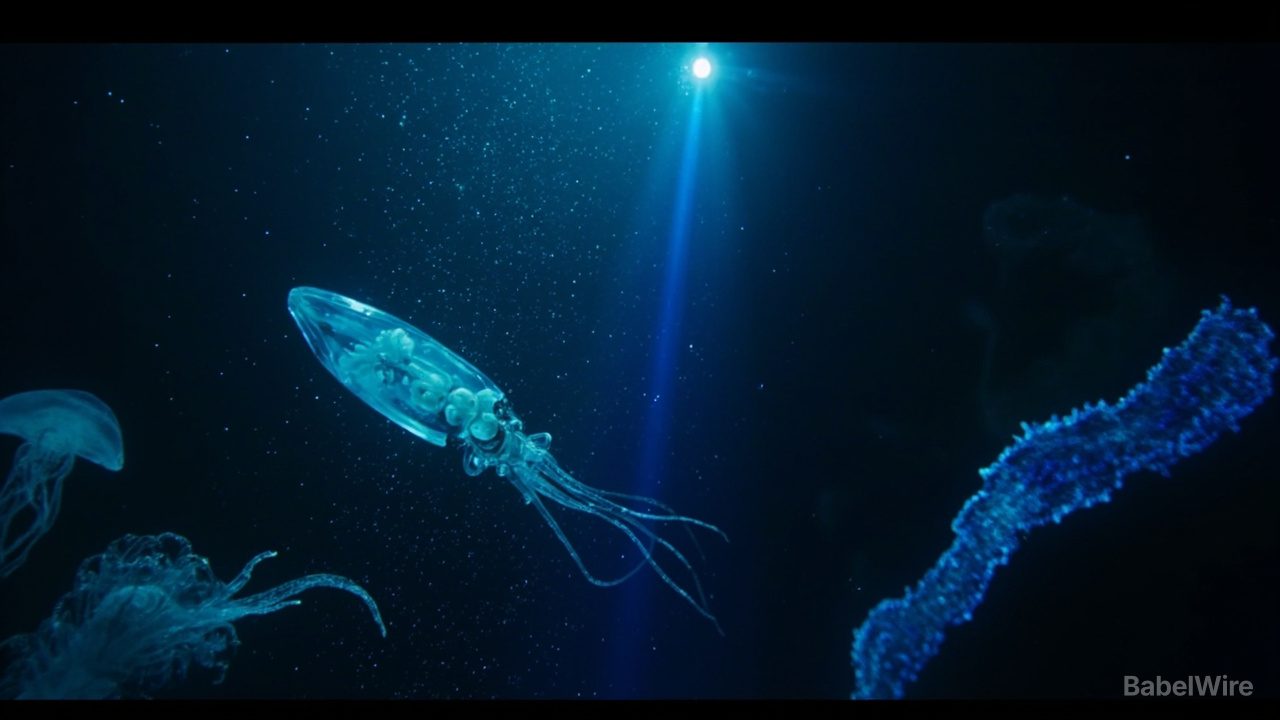
In just two weeks, an international team of researchers aboard the Schmidt Ocean Institute's research vessel R/V Falkor (too) identified 31 new marine species in the deep midwater off the coast of Brazil — a region so poorly understood that scientists call it "the least understood ecosystem on Earth."
The expedition focused on the ocean's midwater zone, between 600 and 3,300 feet (180–1,000 meters) below the surface. This vast, lightless realm is the largest habitat on the planet yet remains almost entirely unexplored due to crushing water pressure and the fragility of its gelatinous inhabitants.
Among the discoveries were a juvenile glass squid with transparent tissue, a fast-moving gossamer worm (Tomopteris) that glows with brilliant yellow bioluminescence, a new species of lobed comb jelly, and a rarely-seen female Haliphron atlanticus octopus — which can grow to four meters and 75 kilograms — preying on a jellyfish at 800 meters depth.
The team deployed an array of cutting-edge technologies. The remotely operated vehicle (ROV) SuBastian captured high-definition footage, while a laser-based imaging system called Deep Particle Image Velocimetry (DeepPIV) — developed by MBARI's Bioinspiration Lab — scanned transparent animals in 3D. A spinning-wheel confocal microscope nicknamed "the Squid" imaged living cellular structures inside organisms for the first time, while shipboard DNA sequencing allowed rapid on-site species identification.
"The largest habitat on Earth, the midwater, is filled with incredible animals we are only just starting to understand," said Karen Osborn, the expedition's chief scientist. "I continue to be fascinated by the fantastic variety of solutions they have evolved to survive in this formidable environment."
"This opens a new door for researching deep-sea physiology, linking cellular architectures to organism function," added Manu Prakash, a bioengineer at Stanford University. "We can now witness live internal processes within these extreme organisms adapted to withstand immense pressure and darkness."
One of the most remarkable finds was a siphonophore — a colonial organism related to the Portuguese Man-o-War — belonging to what scientists believe is an entirely undescribed genus, possibly even a new family. The 3D renderings created on board will allow taxonomists to formally name the species after further comparison with specimens from other regions.
The expedition was part of Schmidt Ocean Institute's ongoing mission to advance marine science through open-access technology and exploration.
Sources
- popsci.comPopular Science - 31 alien-like marine species discovered off the coast of Brazil
- discovermagazine.comDiscover Magazine - 31 New Species Found off Brazil Reveal a Fragile World in the Ocean's Midwater
- theguardian.comThe Guardian - Marine expedition uncovers 31 new species in two weeks
- sevenseasmedia.orgSeven Seas Media - 31 New Species Discovered in Two Weeks of Deep-Sea Exploration