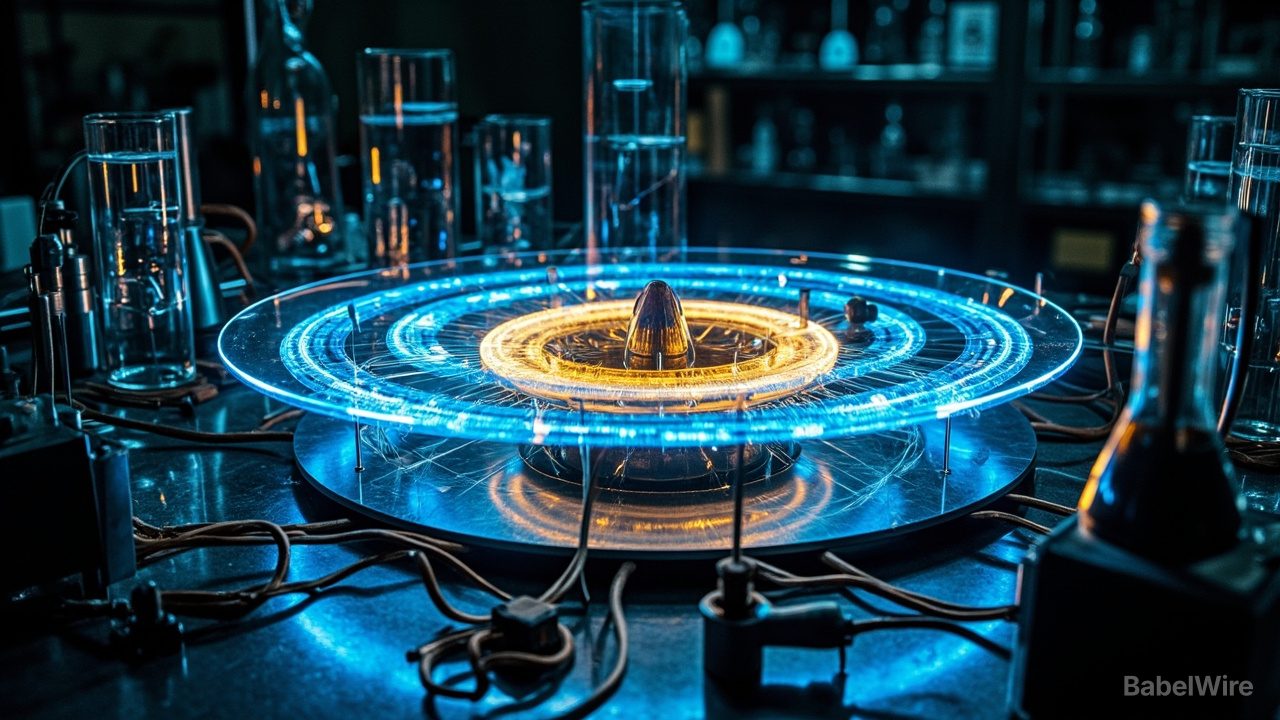
More than 50 years after Sir Roger Penrose first proposed that energy could theoretically be extracted from a spinning black hole, physicists at the CUNY Graduate Center's Advanced Science Research Center (ASRC) have finally demonstrated the effect in a laboratory experiment.
The breakthrough, published in the journal Nature, experimentally confirms the Penrose-Zel'dovich process — the idea that waves interacting with a rapidly rotating object can gain energy and become amplified.
Rather than mechanically spinning anything at extreme speeds, the CUNY team built a radio frequency device whose electrical properties are rapidly modulated across both space and time. This creates "synthetic rotation," achieving effective rotational speeds far beyond what any physical motor could produce.
"Our approach facilitates a new method of wave-matter interaction in which waves with selected rotational properties extract energy from synthetic time-engineered rotation," said Andrea Alù, principal investigator.
The team constructed a ring of electronic resonators whose properties were adjusted in a synchronized sequence. Though the hardware never moved, the timed changes generated a traveling pattern around the ring. Electromagnetic waves with the right rotational characteristics experienced the system as though it were spinning at extraordinary speed — and drew energy from it.
Lead author Hadiseh Nasari called the work "a versatile experimental platform for exploring phenomena at the intersection of astrophysics, wave physics, and quantum science."
Because synthetic rotation can imitate motion beyond the speed of light, the platform opens new avenues for studying extreme physical regimes in the lab. Researchers believe the same principles could advance wireless communications, optics, photonics, and quantum technologies.