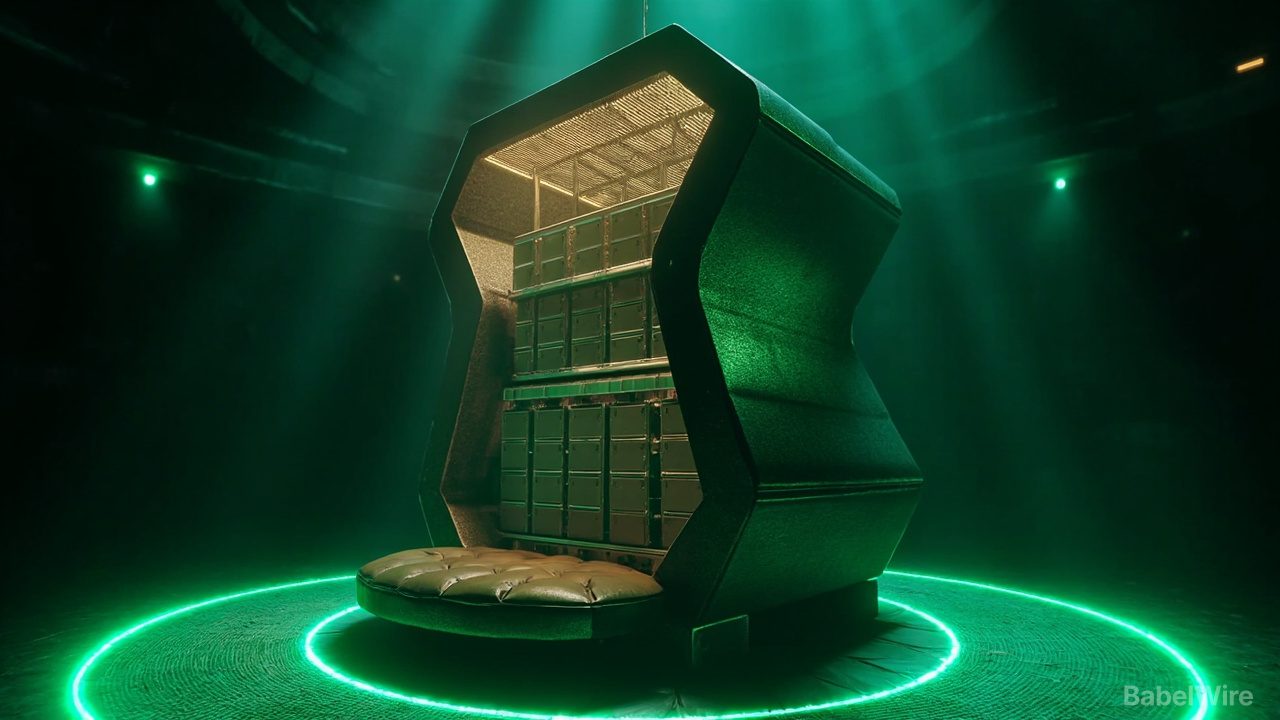
Spain's Museo de Historia de la Computación has unveiled a full-scale visual replica of the Cray-1, the 1976 supercomputer whose C-shaped tower and padded bench are among the most recognisable silhouettes in computing history. It is powered by 30 Mac Minis from 2012.
The project took 18 months and is framed by the museum as a joint 50th-anniversary tribute to the Cray-1 and to Apple's founding. Twenty-five of the machines are dual-core i5 models and five are quad-core i7s; apart from two 2014 units, the entire array dates from 2012. In recent tests the networked cluster orchestrated 64 active cores into 1.3 teraflops; the museum says it previously reached 1.5 teraflops using all 70 available cores before one node went offline. The numbers come from a custom matrix-multiplication script written in Python.
For scale, the original Cray-1's peak theoretical throughput was about 160 megaflops. The comparison also illustrates how the architecture changed: Seymour Cray's machine used vector processing, applying one instruction to many data elements at once, while the replica divides work across independent processors — in effect a small cluster inside a retro shell.
The team chose macOS Mojave (10.14) rather than a Linux distribution, because the older macOS shipped built-in support for MPI, the message-passing layer that lets cluster nodes hand tasks to one another. Cooling is entirely passive: the Macs are mounted vertically on aluminium trays inside a steel chassis, so the tower works as a thermal chimney and hot air rises out through grilles at the top. The museum says the loudest components are two gigabit Ethernet switches at the base, measured at 30–33 dB, with plans to swap them for silent models; individual machines are quoted at 12–15 dBA at idle.
The control terminal borrows design cues from the DEC VT05 and the Processor Technology Sol-20, including an analogue control panel, and a single master Mac Mini inside it directs the rest of the cluster. Future additions include 3.5- and 5.25-inch floppy drives under the desk and a 3D-printed shell over a PowerMac G4 keyboard to mimic the classic HP 250. The museum is crowdfunding 70–80 additional M4 Mac Minis with the stated goal of building a cluster that could rank on the TOP500 list.
The replica is on permanent display alongside two unused authentic Cray CX1 systems.