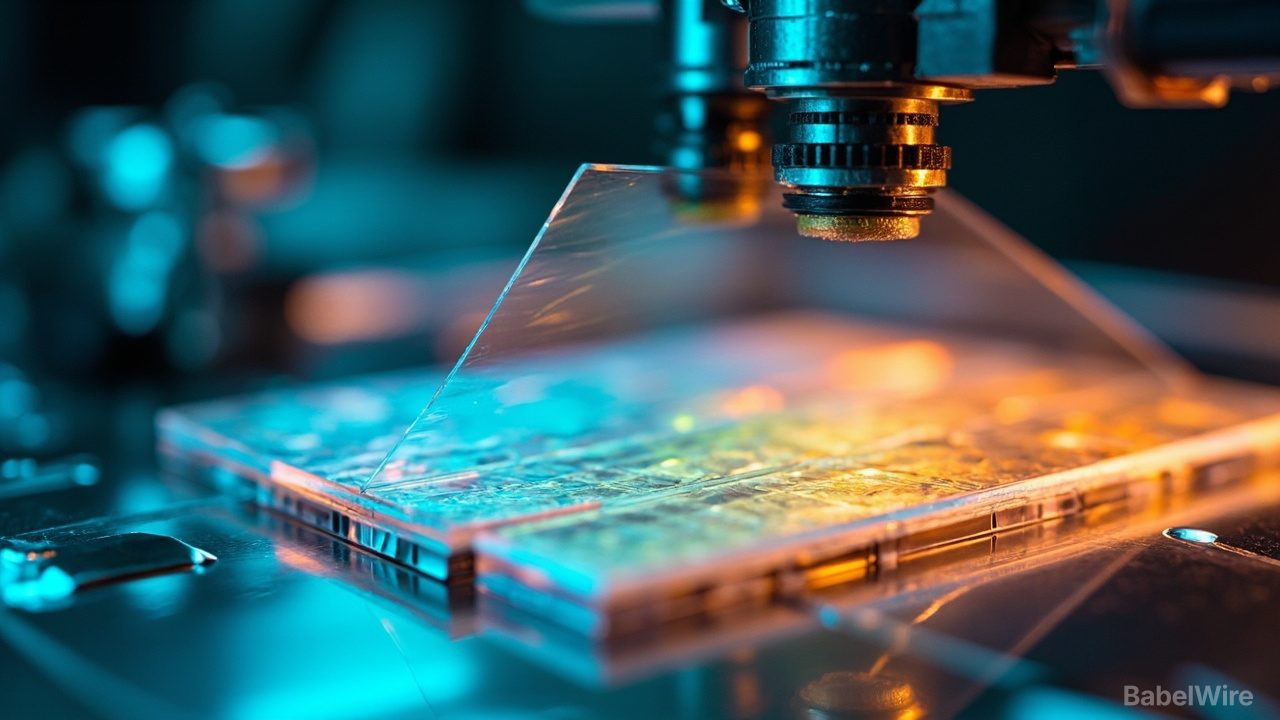
A team of researchers in Amsterdam has cracked one of the most persistent challenges in two-dimensional (2D) materials science: how to move fragile, atom-thin sheets onto patterned surfaces without cracking them.
The technique, published today in ACS Nano by researchers from the UvA Institute of Physics, ARCNL and AMOLF, uses low-density polyethylene (LDPE) — ordinary kitchen cling film — as the transfer medium. It achieves near-unity yield on transfers of large-area monolayers of tungsten disulphide and hexagonal boron nitride onto substrates ranging from flat glass to high-aspect-ratio patterned interfaces.
2D materials like graphene and transition-metal dichalcogenides have extraordinary electronic, optical and mechanical properties. But exploiting them in real devices requires transferring them from growth substrates onto target surfaces — often patterned with electrical contacts, optical coatings or photonic structures. Previous transfer methods were either limited to flat surfaces, probabilistic in outcome, or introduced significant cracking.
The Amsterdam team fabricated a stamp using a heat-resistant hemisphere covered in LDPE cling film, mounted on a micron-precision stage. The stamp contacts the monolayer at 70°C, then heats to 140°C to melt the LDPE for strong adhesion. After cooling and lifting, polymer residue is cleaned away.
Before transfer, cracks covered 8% of the material; after, 14% — a modest increase. Critically, the material retains its photoluminescence properties.
Being able to do this is crucial since it enables the integration of 2D materials with structures like larger electronic devices and photonic coatings, said Jorik van de Groep of UvA's 2D Nanophotonics group. Most importantly, the transfer is no longer probabilistic but has a near-unity yield.
The method opens the door to fabricating atomically thin optical elements, optical modulators, single-photon emitters and complex quantum material heterostructures. The team is now optimizing the process with humidity-controlled environments.