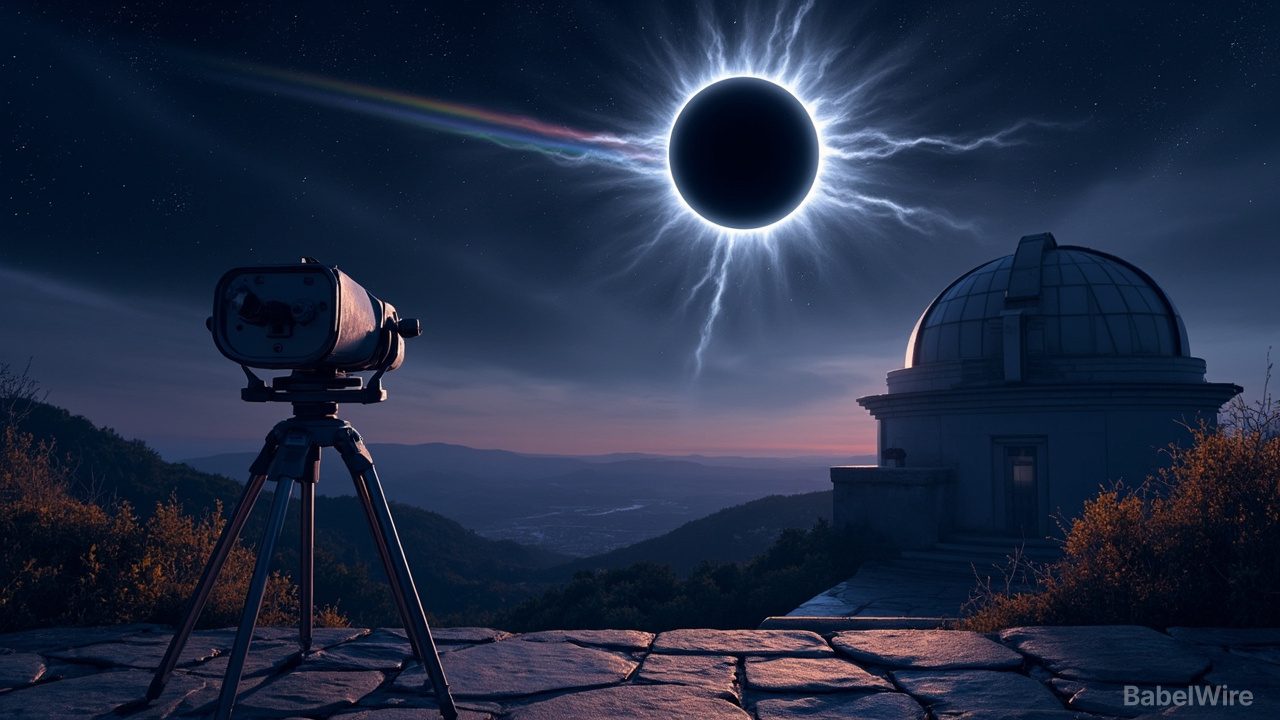
With totality only days away, a team of Italian researchers has finished building an instrument they believe could transform how astronomers study the solar corona. The Circular Slit Spectrometer (CISS) will face its decisive test on August 12, when a total solar eclipse crosses Spain, at the Javalambre Astrophysical Observatory — the culmination of two and a half years of work.
Conventional spectrometers scan the corona line by line, a process that can take hours while the corona itself changes on timescales of minutes. CISS uses a circular slit, enabling it to capture the spectrum of the entire corona at a given distance from the Sun's center in a single photograph. 'There is neither space nor time for the unexpected,' said Paola Zuppella of the Institute for Photonics and Nanotechnologies in Padua, summing up the pressure of a brief totality window.
The eclipse creates rare conditions in which the corona becomes clearly visible — a region whose behavior can disrupt communications networks and power grids on Earth. If the new optical principle proves out, the team says the design could fly on a future space mission; the last major ultraviolet spectrometer, SOHO's UVCS, operated from 1996 to 2013 but needed many hours to map the corona. To protect their work, the team drove the instrument to Spain by van rather than flying. Principal investigator Federico Landini of the Astrophysical Observatory of Turin noted the goal was simply 'to make sure we actually get there.'