Reading the Universe Through AI
An international team led by the University of Barcelona's Institute of Cosmos Sciences (ICCUB) has developed a groundbreaking AI framework that could revolutionize how astronomers measure the expansion of the universe. Published in Nature Astronomy, the framework — called CIGaRS (Combined Inference from Galaxy, supernova, and Redshift Surveys) — uses machine learning to extract far more information from Type Ia supernovae than previously possible.
Why Type Ia Supernovae?
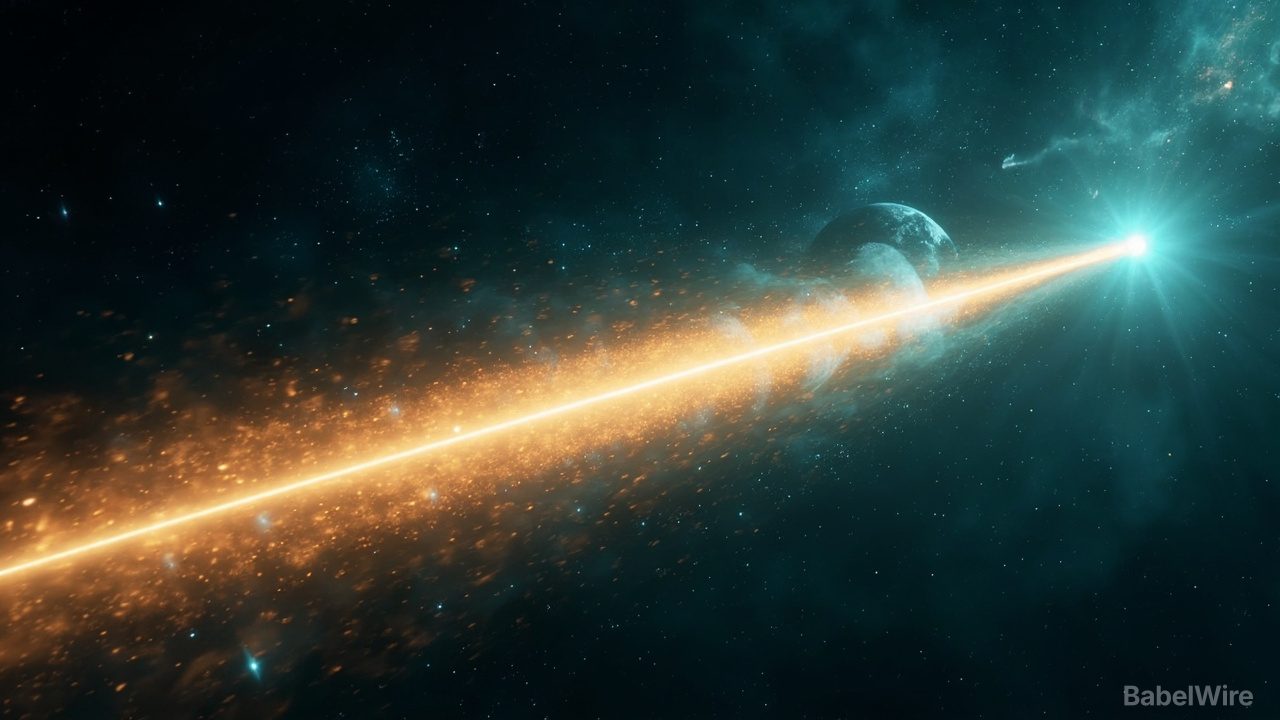
Type Ia supernovae are the "standard candles" of cosmology. Because these white dwarf explosions reach nearly identical intrinsic brightness, astronomers compare their actual brightness to their observed brightness to calculate cosmic distances. This technique led to the Nobel Prize-winning discovery that the universe's expansion is accelerating — driven by the mysterious force called dark energy.
But there's a complication: a supernova's brightness is subtly affected by its host galaxy. Older, more massive galaxies produce different-looking supernovae than younger ones. Traditional correction methods are imprecise.
The CIGaRS Breakthrough
CIGaRS solves this by building a single, unified model that simultaneously accounts for the supernova itself, its host galaxy, interstellar dust, supernova rates across cosmic history, and the expansion of the universe — all connected within one Bayesian inference framework.
"A powerful way of modelling the Universe is to simulate it ab initio in the computer using Bayesian inference," said co-author Raúl Jiménez (ICREA-ICCUB). "This provides a way to vary all possible parameters at the same time."
A neural network learns how simulated observations relate to physical parameters. Once trained, it can analyze tens of thousands of real supernovae simultaneously — a task impossible with traditional techniques.
Key Results
- Redshift from images alone: The framework determines galaxy distances (redshifts) with precision comparable to spectroscopy, but using only imaging data. - 4x improvement: CIGaRS could improve cosmological constraints by up to a factor of four over traditional methods. - Rubin Observatory ready: The Vera C. Rubin Observatory in Chile will discover millions of supernovae, 99% of which will only have photometric (imaging) data. CIGaRS was built for this data deluge.
Lead author Konstantin Karchev (ICCUB-SISSA Trieste) emphasized: "Our no-compromise end-to-end simulation-based inference approach is uniquely capable of extracting the full cosmological information from the Rubin Observatory's hard-earned data."
What's Next
The framework also sheds light on how Type Ia supernovae form by reconstructing how their occurrence rates vary with stellar ages. As Rubin Observatory begins its decade-long survey, CIGaRS could be key to finally understanding the nature of dark energy.
Sources
- sciencedaily.comMillions of exploding stars could soon reveal dark energy's secrets — ScienceDaily
- nature.comCIGaRS I: combined simulation-based inference from type Ia supernova data — Nature Astronomy
- icc.ub.eduA new way to read the Universe — ICCUB / University of Barcelona
- imperial.ac.ukNew AI method sharpens view of the Universe from supernova light — Imperial College London