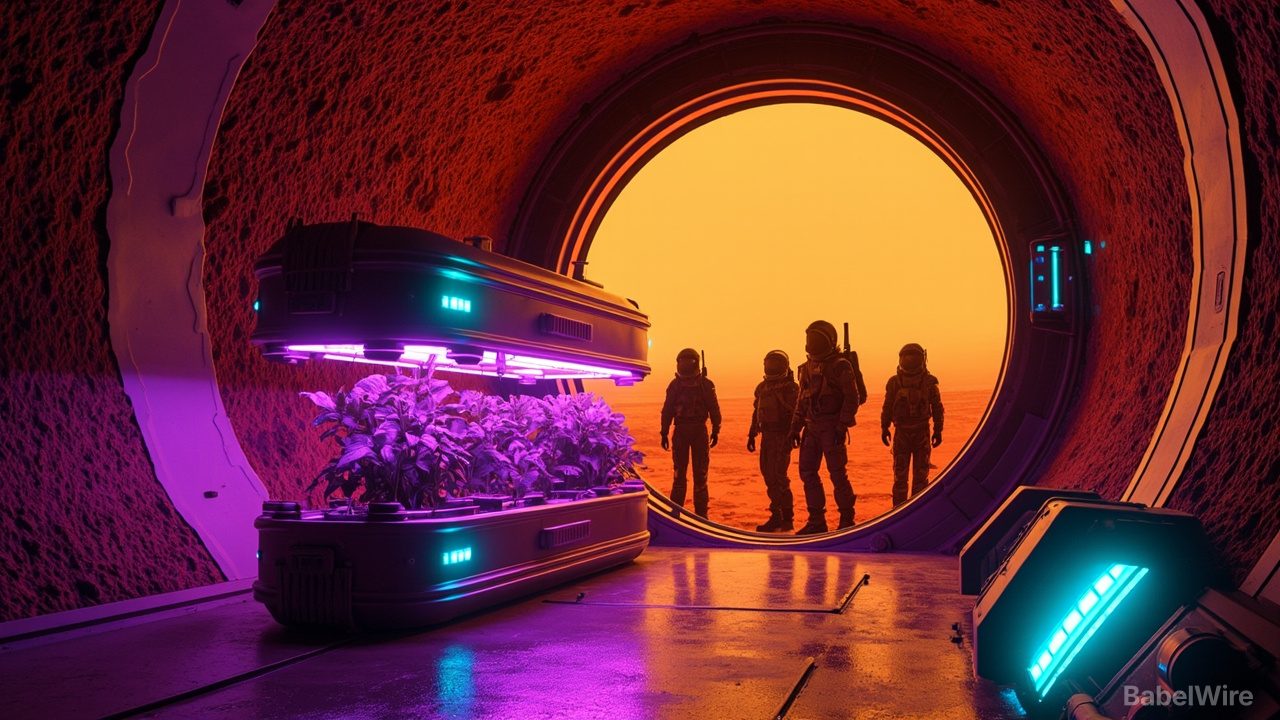
Four volunteers spent 378 days inside a windowless habitat on simulated Martian ground in Texas — not on Mars, but at Houston's Johnson Space Center, where NASA's second yearlong Mars surface simulation ended on October 31.
Ross Elder, Ellen Ellis, James Spicer and Matthew Montgomery entered Mars Dune Alpha on October 19, 2025. The habitat, roughly 1,700 square feet, is 3D-printed and windowless. Throughout the mission, communication with the outside world ran with delays of up to 22 minutes each way — the cost of pretending to be far from Earth.
The schedule included simulated Marswalks, robotic operations, habitat maintenance, exercise, crop cultivation and 3D printing. From inside, crew members remotely operated a drone and a rover to survey terrain and identify or collect rock samples. Montgomery, the science officer, set up the habitat's 3D-printing capability and ran a seed-germination experiment comparing a control soil with simulated Martian soil.
Spicer, the flight engineer, compared the year to living aboard a submarine: limited supplies, limited space, and decisions shaped by both. The crew tracked consumables from dish soap to respirator filters and managed food and water carefully. He was surprised by how little he missed the constant stream of news and social media updates.
Ellis, the medical officer — a US Space Force officer with National Reconnaissance Office experience — described the other side of the isolation. "It would be difficult to convince someone who has never lived in isolation that most days, I don't feel isolated. I have three teammates that I rely on every day," she said. Her headline lesson: a future Mars crew requires a highly integrated ground team.
Commander Elder, an Air Force experimental test pilot, found the simulated Marswalks "uncannily similar" to flight operations. Preparing suits, running airlock procedures and making long traverses took time and stamina, which put nutrition, exercise and rest at the centre of his account.
NASA astronaut Jack Hathaway supplied the scale of it. While the four were sealed in, he completed a 237-day station mission and returned to Earth; the Artemis II astronauts flew around the Moon and set the record for the farthest humans have travelled from Earth.
Two weeks of post-mission evaluations and debriefs now follow. The data builds on the first CHAPEA mission, which ended on July 6, 2024. CHAPEA project scientist Sara Whiting says it arrives at the right moment: NASA is planning how astronauts will live and work at the Moon Base near the lunar south pole, and much of what constrains a crew there — time, water, food systems, communication capacity — is what the habitat was built to squeeze. Principal investigator Grace Douglas notes that many of those resource problems mirror challenges on Earth.