Physicists at CERN's Large Hadron Collider have discovered the final missing member of a particle family first predicted more than half a century ago, marking a landmark moment in the history of particle physics.
The LHCb Collaboration announced the detection of the Ωcc⁺ (Omega_cc_plus) baryon, a particle containing two charm quarks and one strange quark, completing the family of doubly charmed baryons. These exotic particles are approximately four times heavier than a proton and exist for only about 170 femtoseconds before decaying via the weak force.
"Quarks are basic building blocks of matter," explained Dr. Paula Collins, incoming deputy spokesperson of the LHCb Collaboration. "There are six types — up, down, charm, strange, top and bottom — which bond into pairs or triplets, known as mesons and baryons respectively."
The story of this discovery begins in 1964, when the discovery of a particle consisting of three strange quarks at Brookhaven National Laboratory confirmed theoretical predictions about how quarks combine. A decade later in 1974, the discovery of the charm quark forced theorists to extend their models, leading to predictions of doubly charmed baryons — particles with two charm quarks paired with a third quark of another type.
The first member of this family, the Ξcc⁺⁺ (up quark + two charm quarks), was discovered in 2017. The second, the Ξcc⁺ (down quark + two charm quarks), was found earlier in 2026. Now, the third and final member — the Ωcc⁺ with its strange quark — has been observed.
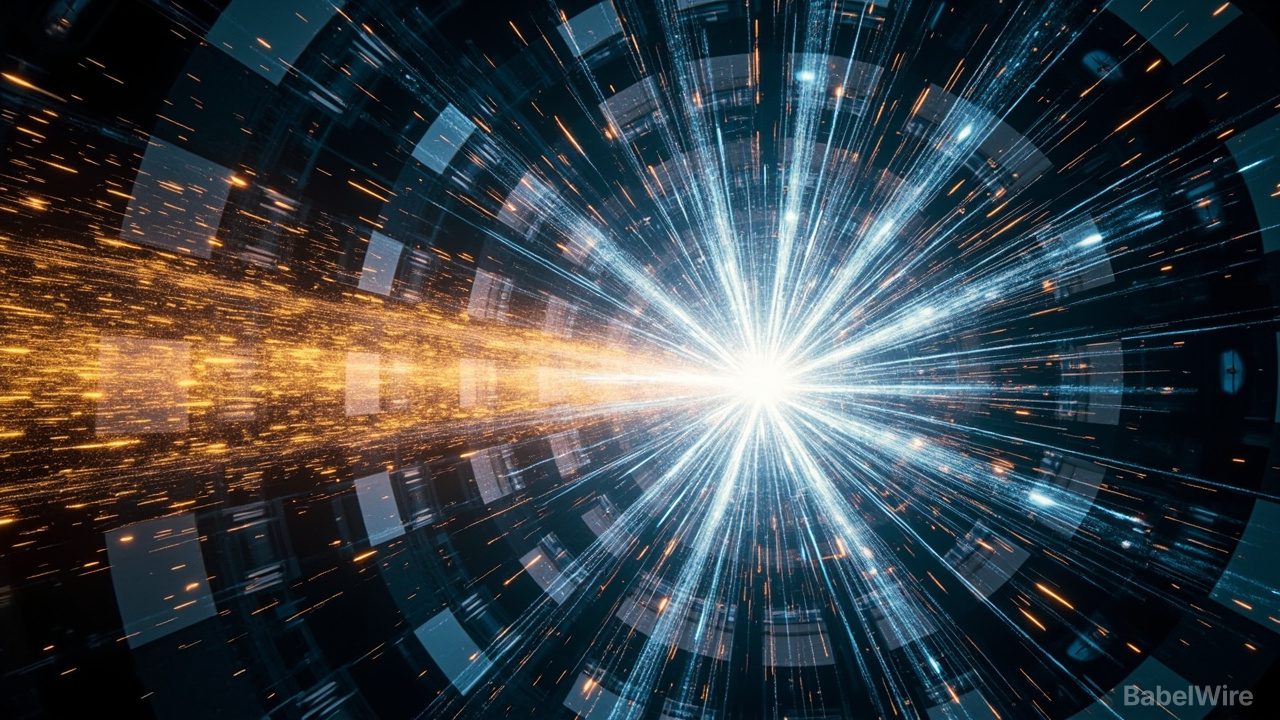
The discovery is based on data from high-energy proton-proton collisions collected in 2024 using LHCb's upgraded detector, which features an all-software trigger system and enhanced readout capabilities operating at 40 MHz. These upgrades allowed physicists to reconstruct the characteristic signatures of the short-lived particles as they traveled a fraction of a millimeter before disintegrating.
"This is a moment of beautiful historical significance," Dr. Collins said. "Out of the 85 composite particles discovered so far at the LHC, these three doubly charmed baryons are unique. They decay by the weak force and live long enough to give measurable flight distances in our experiment."
Scientists are particularly interested in this family because the large mass differences between the constituent quarks could provide valuable insights into the strong force — the fundamental interaction that binds quarks together into protons, neutrons, and all visible matter.
The finding culminates a theoretical and experimental quest spanning over six decades, from the earliest quark models of the 1960s to the upgraded detectors of the 2020s. It demonstrates not only the predictive power of the Standard Model but also the relentless advancement of experimental techniques needed to catch a glimpse of nature's rarest combinations.