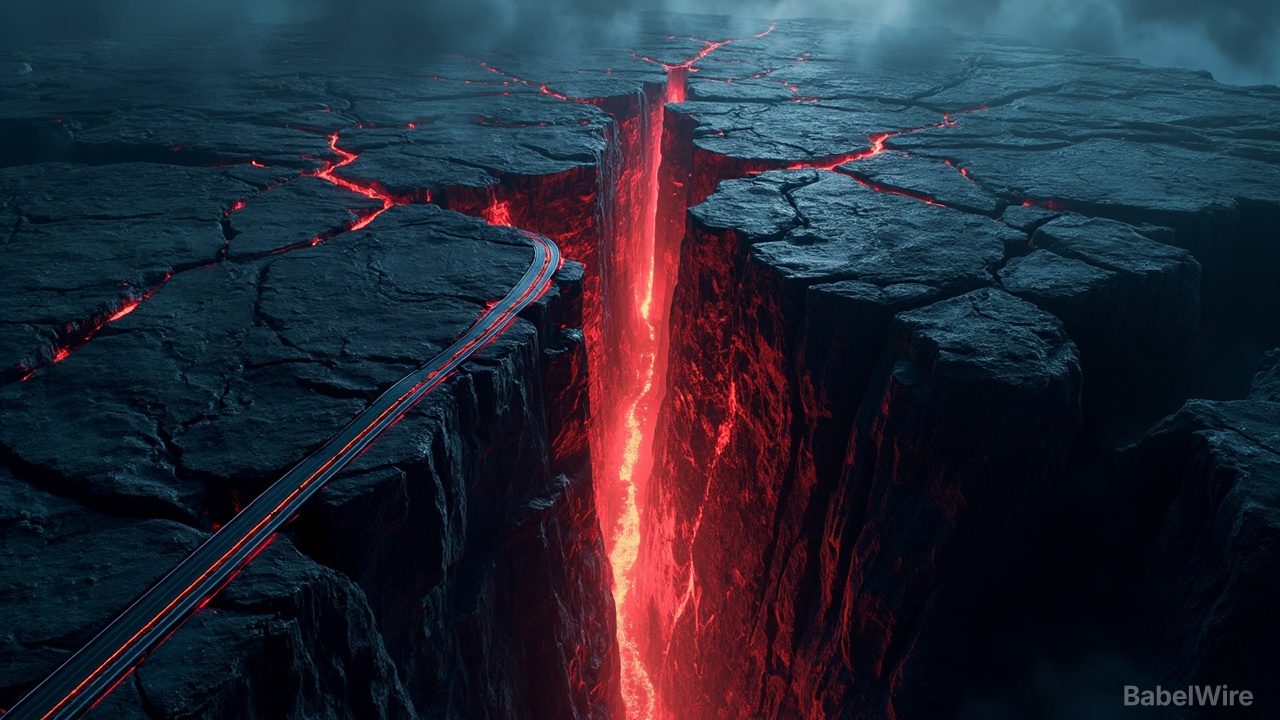
Southern California's two most important fault systems may be more loaded than at any point in the last thousand years — and they are loaded at the same time.
The study
An international team led by Dr. Liliane Burkhard of the University of Bern built a physics-based, four-dimensional earthquake-cycle model of the southern San Andreas and San Jacinto faults, then fed it a 1,000-year record of past ruptures assembled from radiocarbon dating, tree-ring patterns and historical accounts. The work, with collaborators at the University of Hawaiʻi at Mānoa, the USGS Earthquake Science Center in Pasadena and the Scripps Institution of Oceanography, is published in Journal of Geophysical Research: Solid Earth.
The model's conclusion: tectonic stress across parts of the system has reached, and in places surpassed, the highest values anywhere in its 1,000-year history.
Two numbers to watch
- The San Jacinto–Bernardino section carries a modelled stress of 3.6 MPa — higher than any value reached anywhere else in the simulation. - The Mojave South section of the San Andreas sits at 2.8 MPa.
Individually, high stress is not new. The concerning part is that the two faults are heavily stressed at the same time and at relatively similar levels — a configuration the model associates with ruptures that cross from one fault onto the other.
Cajon Pass, the 'earthquake gate'
Northeast of Los Angeles, the two systems almost touch at Cajon Pass. Past earthquakes show both behaviours: the magnitude 7.9 Fort Tejon quake of 1857 stopped there; the Wrightwood earthquake of 1812 passed straight through and ruptured both systems.
Burkhard describes the junction as an "earthquake gate" whose behaviour depends on how loaded the surrounding faults are. If both are highly stressed together, conditions favour a through-going rupture — one that could involve greater Los Angeles, San Bernardino, Riverside and the Coachella Valley, and the highways, rail lines and energy corridors that thread through Cajon Pass itself.
What the study does not say
It is not a forecast. High stress does not tell scientists when a rupture will happen. As Burkhard puts it: "The study is not a prediction of when an earthquake will occur. What we can say is that the system is critically stressed." The value is in hazard assessment, infrastructure planning and emergency preparedness — and in a modelling framework the team says can be applied to complex fault junctions worldwide.
Sources
- mediarelations.unibe.chEarthquake model reveals: Stress in California at record level — University of Bern, Media Relations
- sciencedaily.comScientists find an "earthquake gate" as California fault stress hits a 1,000-year high — ScienceDaily
- temblor.netIs Southern California's Cajon Pass an 'earthquake gate' ready to open? — Temblor