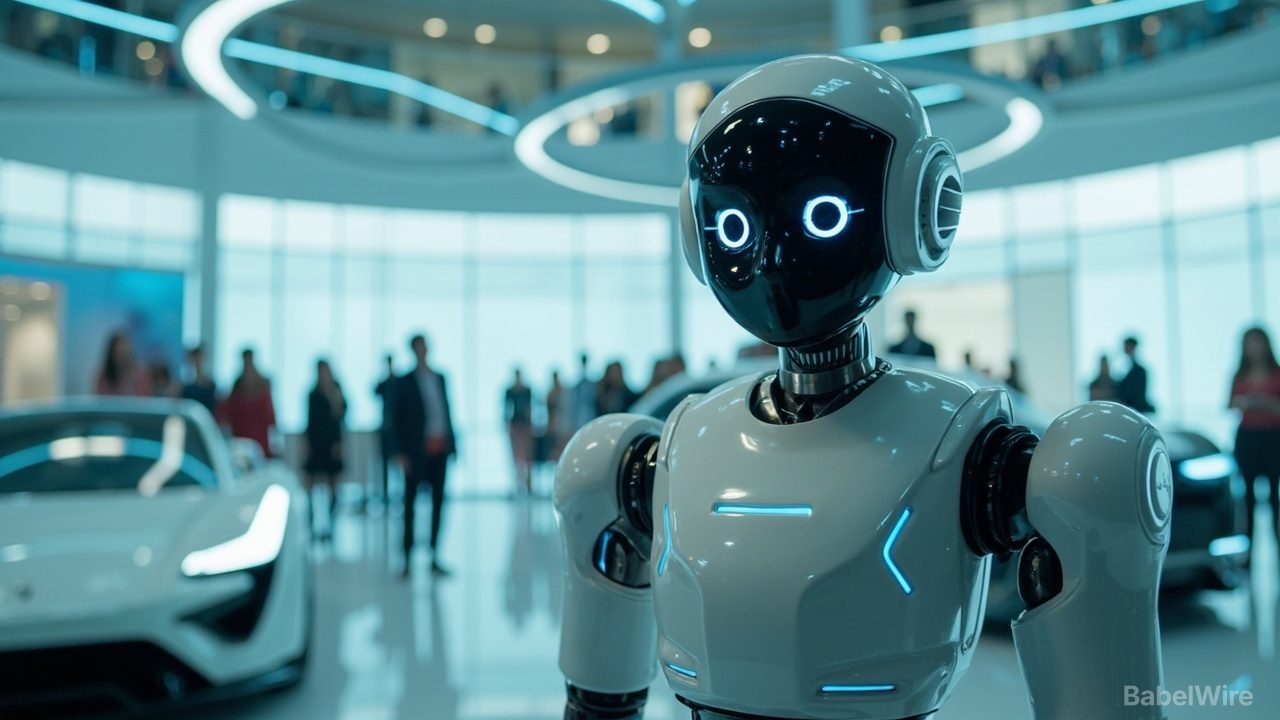
BYD, China's largest electric vehicle manufacturer, has officially entered the humanoid robotics race with the deployment of its first service robot, 'Xiao Di,' at its Di Space experience centers.
The robot, which stands 1.61 meters tall and weighs 58.5 kilograms, features 31 degrees of freedom across its body and seven dexterous degrees of freedom in each hand. It supports multimodal interaction, including real-time two-way translation across six Chinese dialects and six foreign languages, 360-degree vision, facial recognition, lip reading, and gesture recognition.
Xiao Di's initial deployment is at BYD's Di Space venues in Zhengzhou and Tianjin—immersive public education spaces for新能源 vehicles located in prime commercial districts. The robot is expected to greet visitors, explain vehicle models, demonstrate in-car systems, and attract customer traffic through interactive engagement.
"The short-term goal is for robots to provide in-store sales assistance, with two to three units deployed at each store," said Stella Li, BYD's executive vice president. Over the medium term, BYD plans to introduce the robots into supermarkets, shopping malls, and warehouses. In the longer term, the company hopes the robots can enter homes to handle cleaning, cooking, and companionship.
BYD established its embodied intelligence team as early as 2022, exploring how capabilities from its automotive supply chain—batteries, electric motors, electronic control systems, and manufacturing expertise—could transfer to robotics. The company aims to leverage these overlapping technologies to lower hardware costs and enable scalable production.
The move comes as BYD's car sales fell 15.7% year-on-year in the first half of 2026 to 1.81 million vehicles, amid intense price competition in China's domestic EV market. The robotics push offers a fresh growth narrative.
BYD joins Tesla, Xpeng, Li Auto, and GAC Group in the humanoid robotics space. Tesla's Optimus is expected to enter production this year, while Xpeng has introduced its Iron humanoid robot and is advancing small-batch trial production.
China's Ministry of Industry and Information Technology reported that the country produced about 20,000 humanoid robots in 2025. Production exceeded 40,000 units in the first half of 2026 and is expected to surpass 100,000 for the full year, with government policy calling for 10,000-unit deployment capacity by year-end.