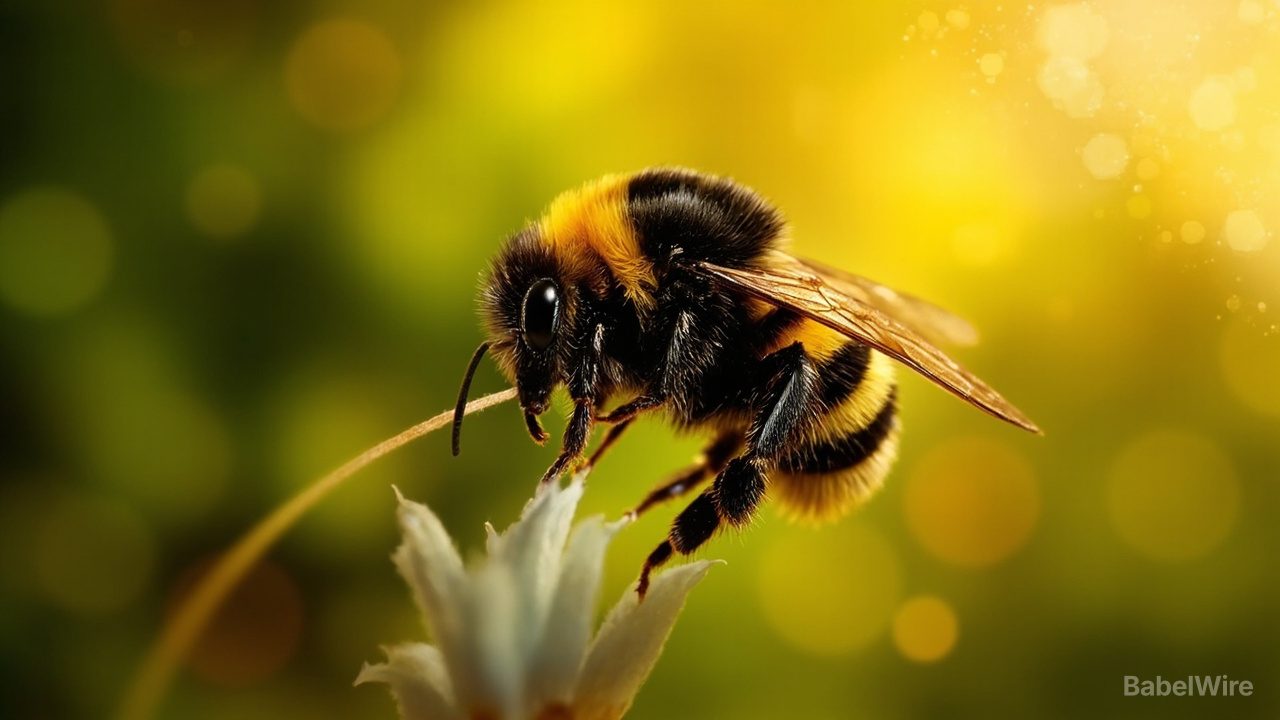
Bumble bees have astonished researchers by solving a classic cognitive test — the string-pulling puzzle — entirely on their own, inventing the solution without any prior training or demonstration.
The experiment, reported by scientists at Queen Mary University of London, presented bumble bees with a reward hidden at the end of a string that needed to be pulled to be accessed. While previous studies had shown that bees could be trained to pull strings, this was the first time they solved it spontaneously, without any teaching.
"We expected they might need some form of demonstration, but individual bees figured it out through their own trial and error," said one of the lead researchers. "This suggests a level of cognitive flexibility that we don't typically associate with insects."
The string-pulling test is a well-established benchmark for animal intelligence, used for decades to assess problem-solving in birds, primates, and other vertebrates. A subject must recognize that pulling the string brings the reward closer — a task requiring means-end understanding rather than simple trial-and-error learning.
What makes this discovery particularly striking is that the skill spread naturally through the colony. Bees that solved the puzzle were observed by others, and within days, the technique had propagated through the population. The behavior persisted over time, indicating social learning and cultural transmission — capacities once thought to be the exclusive domain of larger-brained animals.
The findings add to a growing revolution in our understanding of insect intelligence. Recent years have seen discoveries of bees capable of abstract concept learning, tool use, and even what appears to be basic numerical comprehension. Bumble bees have previously demonstrated the ability to learn complex flower-handling techniques from each other and to optimize foraging routes through something resembling a traveling salesman algorithm.
"Every time we design an experiment that we think will be too difficult for an insect, they find a way to prove us wrong," the researcher added. "We may need to fundamentally rethink what we mean by intelligence."
The study, published in the journal Biology Letters, opens new questions about the neural basis of complex behavior in insects, whose brains contain fewer than one million neurons — compared to the 86 billion in a human brain. How such sophisticated problem-solving emerges from such a tiny neural network remains one of neuroscience's most intriguing mysteries.
Sources
- sciencedaily.comScientists Stunned as Bumble Bees Solve a Classic Intelligence Test — ScienceDaily
- biorxiv.orgBumblebee String-Pulling Skill Spreads Between Colonies — BioRxiv
- chittkalab.sbcs.qmul.ac.ukBumblebees Attend to Both Properties of String and Target — Insect Science
- faunalytics.orgBumble Bees Spread String Pulling Through Social Learning — Faunalytics