Boston Dynamics has redesigned the hand at the end of Atlas's arm, and the trade-offs are unusually explicit. The new hand has 13 degrees of freedom across four fingers — up from seven on the previous generation — with a four-DOF opposable thumb, a single actuator type and direct actuation at every joint. No fragile cables cross the joints, the company says.
The hand is roughly the size of a large human hand and, per Boston Dynamics, similar in strength to the previous version: enough to carry a 100lb-plus loaded mini-fridge. Fingertips and palm carry dense pressure tactile sensors. The actuators are backdrivable and transparent to force, which the company describes as essential both for proprioception and for surviving impacts — hit something hard and the joint can move out of the way instead of wrecking a gearbox.
Much of the design work is aimed at simulation. Boston Dynamics says the hand was built for sim-to-real reinforcement learning, so control policies can be trained under domain randomisation and transferred to hardware using high-rate actuator proprioception rather than human demonstration alone. The company argues that wearable gloves and manipulation interfaces capture the right signals for pretraining but not the fast, closed-loop force regulation that dexterous manipulation needs.
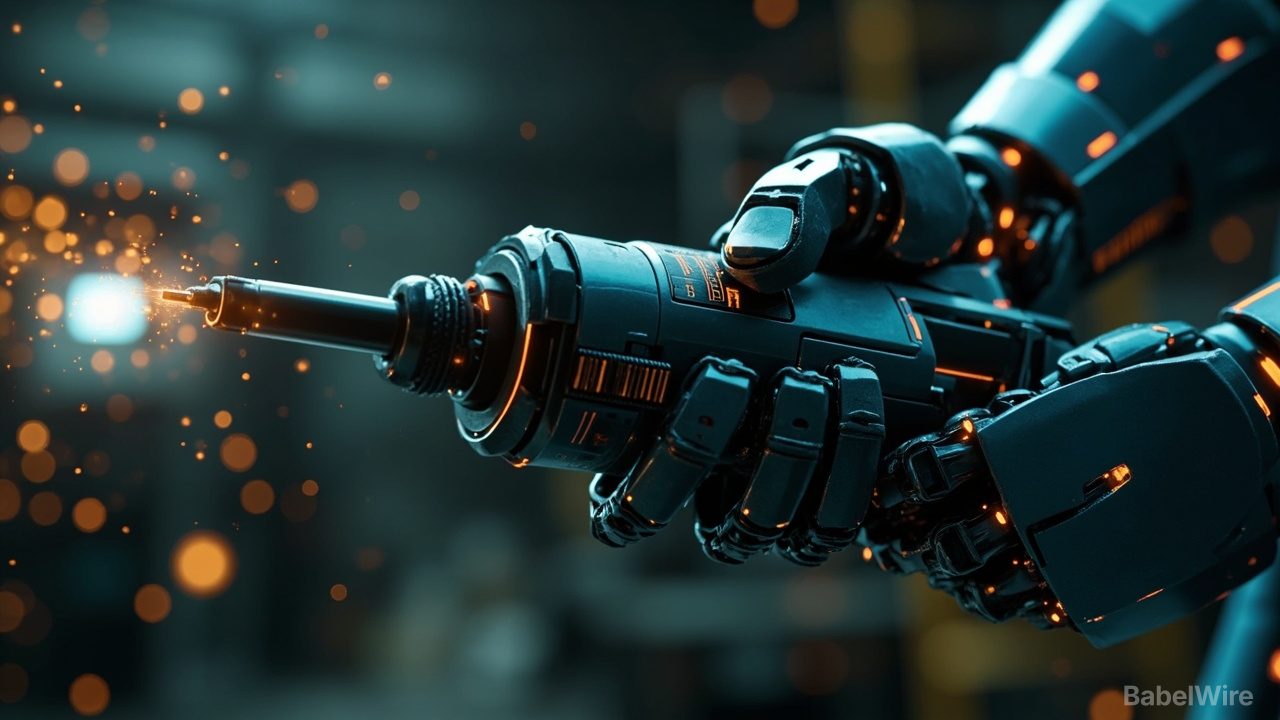
Capabilities include sliding the thumb along any other finger, dexterous pinch and tripodal grasps, and — most important for the commercial thesis — "triggered tool grasps" on drills, power torque drivers, grinders, nail guns and welding torches. A demo video shows Atlas inserting a drill bit into a drill, pulling its trigger and boring into wood.
The missing finger says the most about the philosophy. There is no pinky. Adding one would have been easy and more human-like, but it would also mean three more actuators, more cost, more volume and one more component to break. Chief technology officer Zack asked the team to tape their pinky to the ring finger for a day and report what they could no longer do; the answer was not enough to justify the complexity. Boston Dynamics' summary is blunt: "If you want to ship great products, the best part is no part."