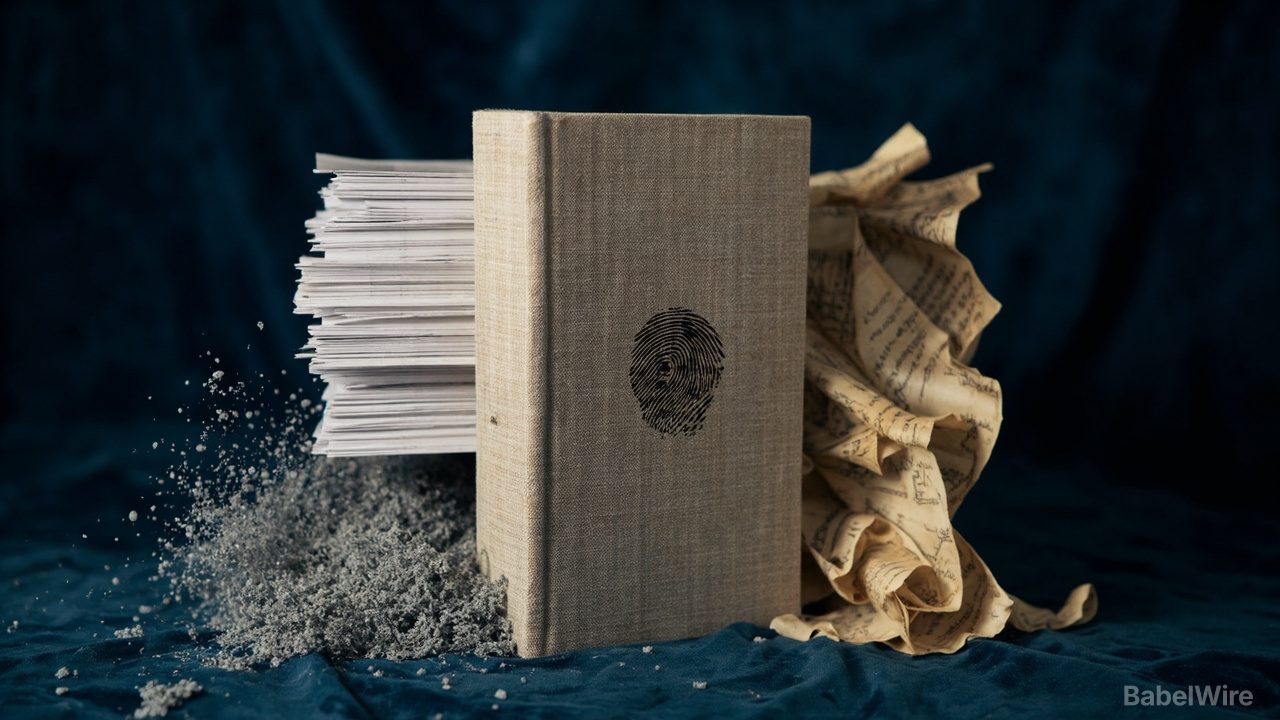
A British startup has won regulatory approval for a certification mark that tells readers a book was written by a human — the latest attempt to separate human writing from machine-generated text in a publishing industry shaken by AI scandals.
Books by People said on Wednesday that the UK's Intellectual Property Office had approved its mark, a thumbprint design publishers display on the cover. "If people are going to be writing AI books or seeking it out for their own enjoyment, that's their prerogative," cofounder Esme Dennys told WIRED. "But if you want to read something that's written by a person, you should be able to find that. We're just trying to create that choice."
Earlier labelling schemes such as Human Authored ran on an honesty system, with authors promising they had not used AI. Books by People tries to add weight: it requires an authorship declaration, runs each manuscript through proprietary software, and manually examines early drafts and research materials supplied by writer and editor for "indicators of humanity". Dennys says the company realised early that competing with ever-better generative models on detection alone would not be sustainable, which is why document and communication trails carry more of the burden. Where evidence is ambiguous, the company says it errs on the side of the author.
The business model is a flat membership fee for publishers plus a charge per submitted title. Five publishers have signed up, and the startup expects the mark to appear on its first book before the end of the year.
The backdrop is a year of publishing scandals: an agent cancelled a book deal reportedly worth $2 million, a publisher withdrew a novel from shelves, and readers alleged that a prize-winning short story had been generated with AI. Industry figures quoted by WIRED say the worry is less about being replaced than about eroding the default assumption that a shelved book was written by a person. "There's almost a feeling of revulsion about the idea of reading an AI text that purports to be human," said Sam Jordison of independent publisher Galley Beggar Press, which intends to adopt the mark.
Sci-fi author Ted Chiang, who called the certification "a statement of values", argues the knowledge of how something was created cannot be separated from the experience of reading it. Markus Dohle, former CEO of Penguin Random House, endorsed the effort in a statement.
The objection is that detection cuts both ways. New York startup Pangram claims 99.7% accuracy in spotting generated text, but authors have questioned a method that itself relies on AI. In September, debut author Jerry Falade — whose agent reportedly pulled the $2 million deal — alleged that detection software had misread his Nigerian dialect as evidence of AI use; Pangram's tool scored the book 97% AI-generated. "It takes months, even years to write a book," he wrote. "It takes AI-detection software two minutes to ruin your life's work." Tom West of the Publishers' Licensing Services warned of a "witch hunt" and argued the onus should instead fall on platforms and publishers to declare when media is AI-generated: "The default should be that a book is human-authored."