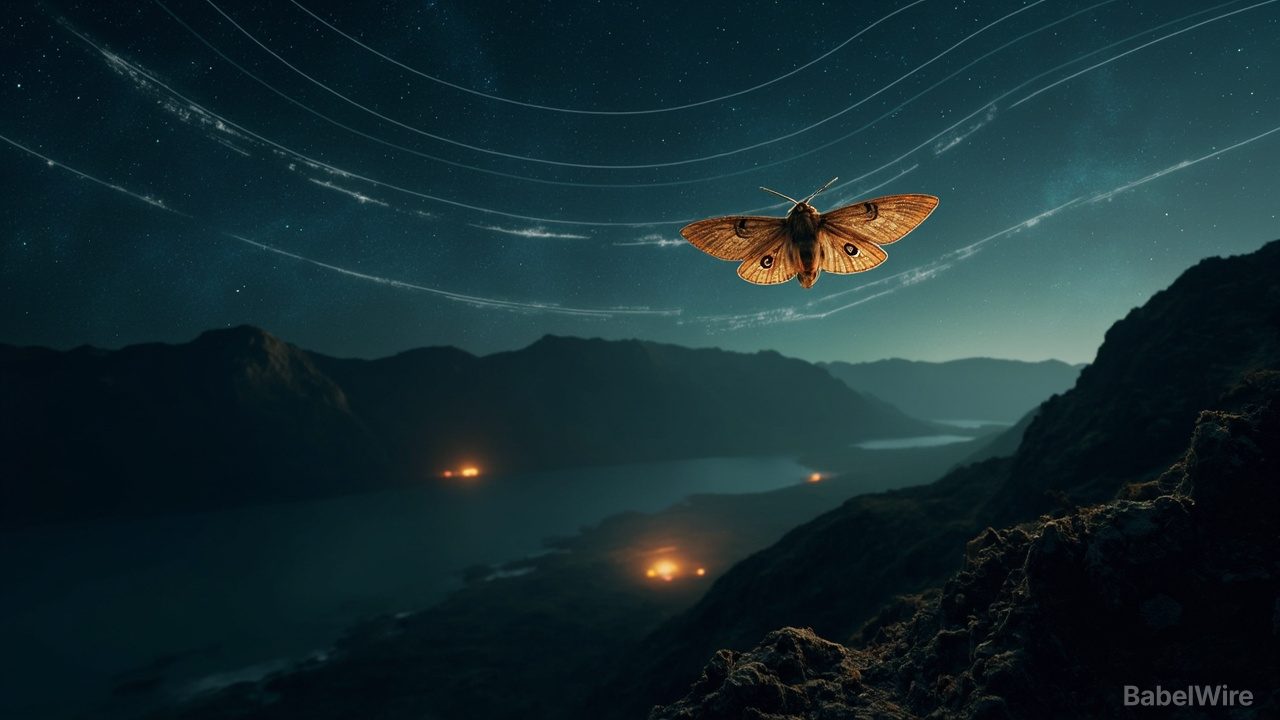
The Bogong moth is one of the great migrations most people have never heard of. Every spring, huge numbers of the dull brown insects leave the breeding plains of northern New South Wales and southern Queensland and fly south to the Australian Alps, where they spend the summer clustered in cool granite caves. The journey runs close to a thousand kilometres, at night, in a creature with a brain smaller than a grain of rice.
Getting there requires a compass, and the obvious candidates — the sun and the stars — are not always available. Cloud cover, moonlight and the low sun near dusk all degrade a visual heading. Experiments on Bogong moths in recent years had already shown that they can read the polarization of the sky and that they fall back on an internal sense of direction when the stars are hidden.
Physics World reports research that pins down the other half of that toolkit: the moths use Earth's magnetic field as a compass. Magnetic sense has been demonstrated across a spread of animals — sea turtles, migratory birds, certain insects — but confirming it in a moth that has to cross a continent, rather than a laboratory arena, is a different order of evidence.
The finding matters beyond entomology. Bogong moth populations have collapsed over recent decades through drought, heat and the 2019–20 bushfires, and the species is listed as threatened in Australia. Understanding how the migration works is part of understanding why it is failing: a route that depends on several redundant cues is robust, but only if each cue is still there to be used.
It also reframes how little it takes to navigate. The moth carries no map and needs none. A magnetic heading, a handful of stars and an internal clock are enough to put a thumb-sized insect in a cave on a mountainside a thousand kilometres from where it started.