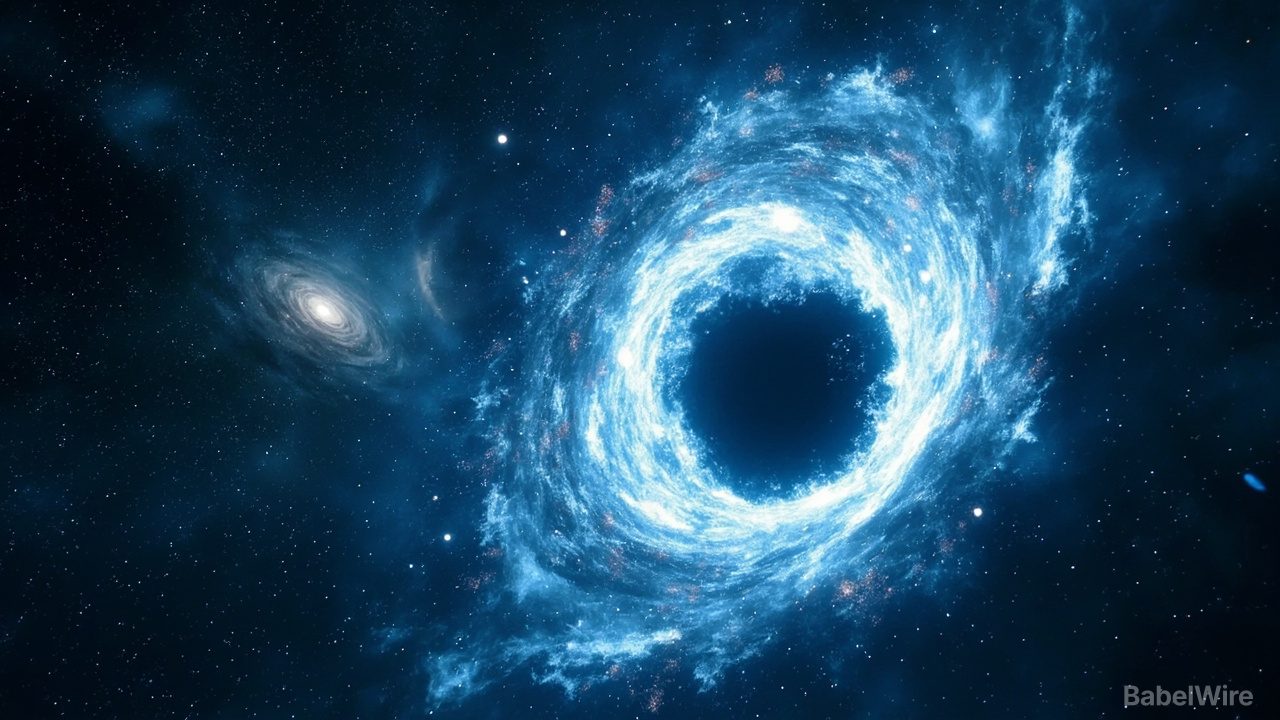
Astronomers have witnessed one of the most energetic cosmic explosions ever recorded: a black hole violently shredding a massive star in an event that briefly outshone the most powerful known supernovae.
The event, formally designated AT2024wpp and nicknamed 'the Whippet,' was detected by Anna Ho at Cornell University using the Zwicky Transient Facility at Palomar Observatory in California. It was presented at the American Astronomical Society conference in Phoenix, Arizona.
400 Billion Suns Worth of Energy
For a brief period, the energy released reached roughly 400 billion times the output of Earth's Sun. The destruction produced what researchers described as a Luminous Fast Blue Optical Transient (LFBOT) — a rare and poorly understood type of cosmic event.
"Even though we suspected what it was, it was still extraordinary," said lead author Daniel Perley of Liverpool John Moores University. "This was many times more energetic than any similar event and more than any known explosion powered by the collapse of a star."
A Shock Wave at One-Fifth the Speed of Light
The event generated a powerful shock wave that traveled outward through dense surrounding gas at one-fifth the speed of light. Material pulled from the star formed a disk around the black hole and became intensely hot as it spiraled inward, producing X-rays and a powerful wind of gas.
After about half a year, the shock wave appeared to 'fizzle out' after reaching the outer boundary of a bubble created by gas the doomed star had previously expelled.
A Mysterious Survivor
The most puzzling finding came months later. Observations from Keck Observatory, Magellan Observatory, and the Very Large Telescope showed no recognizable chemical signatures during the first month. But as the event faded, weak signatures of hydrogen and helium appeared.
The helium was traveling at more than 6,000 kilometers per second, suggesting that a densely bound structure may have survived the initial blast. Researchers speculate it could be a 'stream' of material released by the star's core during the black hole's destruction, or possibly material from a third member of the system being blasted by the black hole's particle wind.
"Not only do these events help us identify black holes, they provide a new way to identify where black holes occur and how they form and grow," Perley added.
The study was published in the Monthly Notices of the Royal Astronomical Society (DOI: 10.1093/mnras/stag678).
Sources
- sciencedaily.comA black hole shredded a 'super sun' — but something strange may have survived | ScienceDaily
- academic.oup.comAT2024wpp: an extremely luminous fast ultraviolet transient powered by accretion onto a black hole | MNRAS
- space.com'Super star' being shredded by black hole releases as much energy as 400 billion suns | Space.com