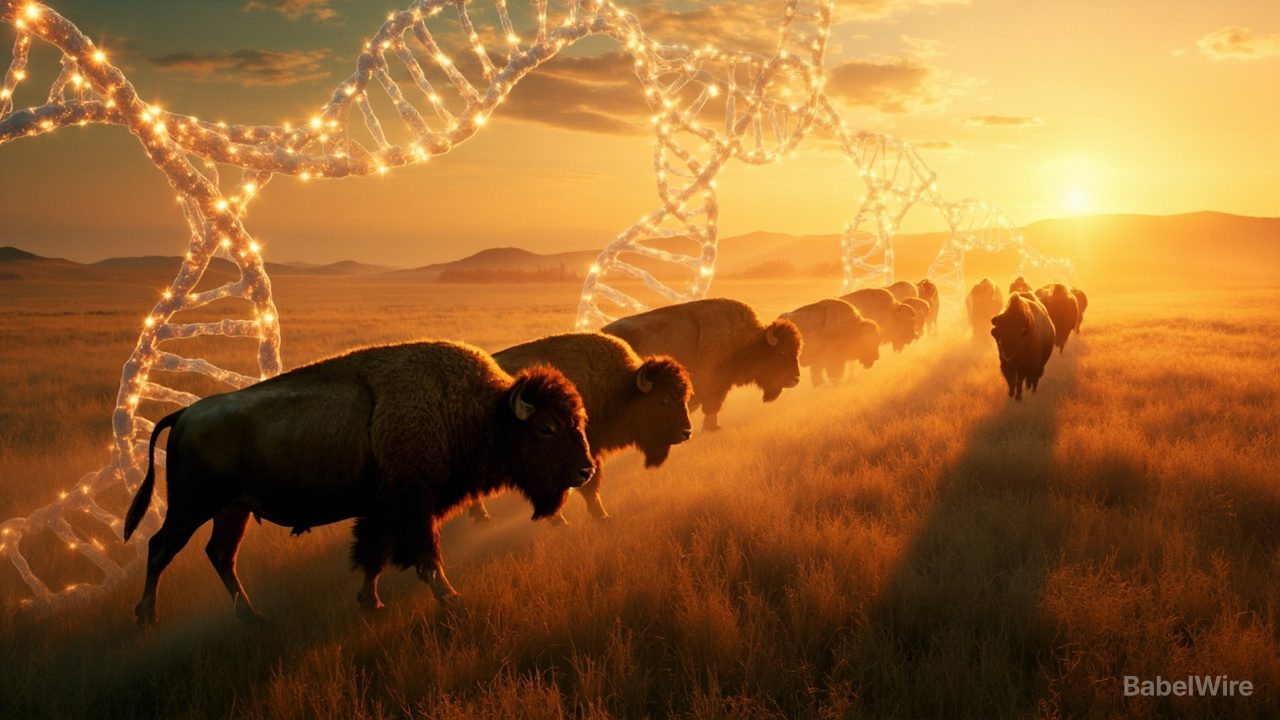
A team led by UC Santa Cruz paleogenomics researchers has built a genetic roadmap for restoring the North American bison — the continent's largest land mammal, driven to near-extinction by human activity a century ago. The study, featured on the cover of the August 6 issue of Science, uses ancient DNA to show what healthy bison diversity looked like before the 20th-century population collapse.
The researchers assembled the largest genomic dataset ever created for bison, spanning more than 20,000 years: they sequenced the genomes of 160 new bison — 115 that lived before the population crash and 45 from the last 100 years — and combined them with 52 published modern genomes. Led by Jonas Oppenheimer and senior author Beth Shapiro, the work partnered with Parks Canada, the University of Alberta and a large coalition of research institutions and land stewards.
Two findings stand out. First, the near-eradication of bison — from tens of millions of animals to just a few hundred — fragmented genetically connected herds into isolated pockets, but did not destroy the species' underlying diversity. Second, the persistent belief that most bison today carry cattle ancestry is largely a myth: using pre-cattle ancient genomes as a clean baseline, the team found cattle DNA in only about a third of modern bison, and where present it amounts to under 2% of the genome, traceable to hybridization roughly 20 generations ago.
The study also clarifies the complicated history of wood bison, which carry 7% to 64% plains bison ancestry depending on the herd — a legacy of Canada's translocation of roughly 7,000 plains bison into Wood Buffalo National Park in the 1920s. The authors argue wood and plains bison should continue to be managed separately, and that the genomic map offers a tool to reconnect isolated herds into a functioning metapopulation — the modern equivalent of the connectivity bison enjoyed for millennia. They also stress the species' sacred cultural role for Indigenous peoples, calling the relationship as important to restore as the headcount itself.
Sources
- news.ucsc.eduUC Santa Cruz News — Decoding the North American bison's genome to better inform conservation efforts
- science.orgScience — DNA reveals the hidden past of North America's bison—and keys to their future
- facebook.comScience Facebook — Paleogenomics research reveals the complex history of bison