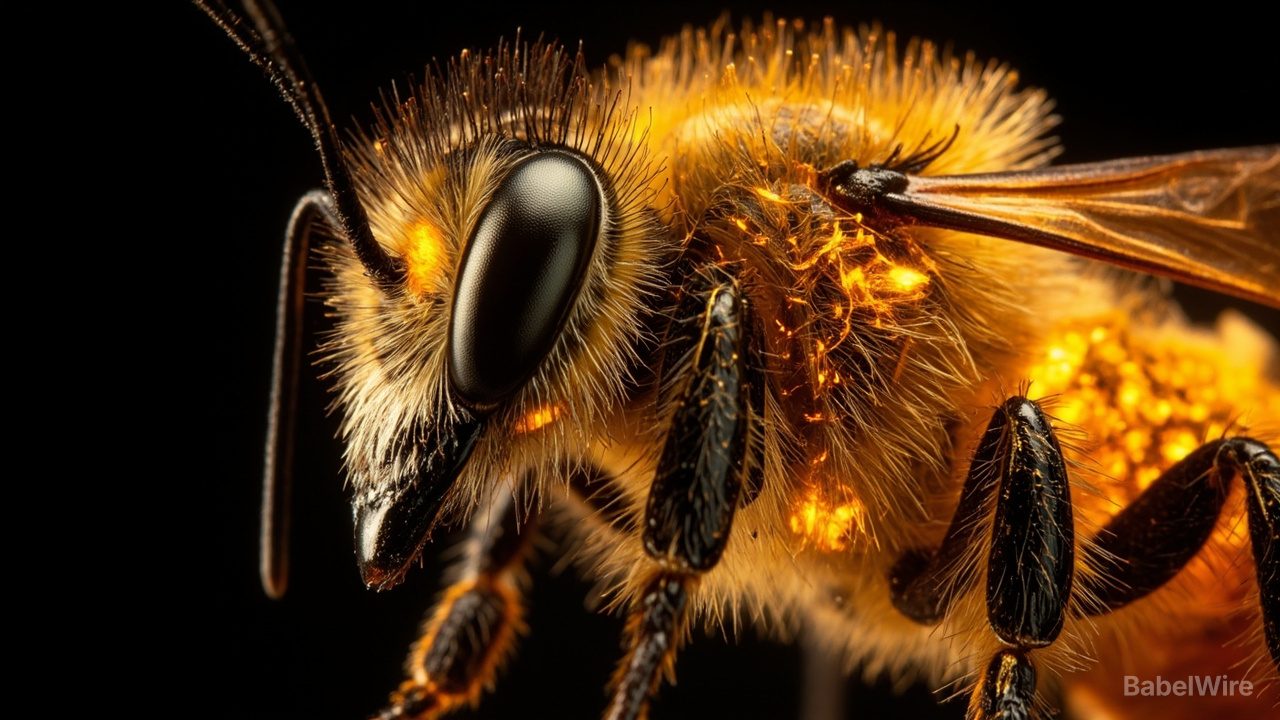
Biologists have discovered specific neural circuits in the honeybee brain that determine which jobs worker bees perform as they age — offering a new understanding of how a colony organizes its workforce without any central planner assigning tasks.
The study, led by Professor Dr. Martin Beye at Heinrich Heine University Düsseldorf (HHU) and published in Proceedings of the National Academy of Sciences (PNAS), reveals that a gene called doublesex controls age-dependent task allocation by acting on specific neural circuits.
The Age-Based Career of a Worker Bee
A worker bee's responsibilities change predictably as it grows older. Young workers care for the queen and developing larvae. In middle age, they build and maintain the hive and defend it against threats. Only in the final stage of their lives do they leave the colony to search for food.
These behavioral shifts are orchestrated by roughly one million neurons in the bee brain — but until now, scientists didn't understand how specific neural circuits produced this progression.
Silencing the Circuit, Changing the Job
The team's breakthrough came when they deactivated the doublesex gene in older worker bees. The bees immediately reverted to caring for the queen — a task normally performed only by younger bees. This suggested doublesex plays a key role in controlling age-related work behavior.
To investigate further, the researchers selectively silenced the specific neural circuits where doublesex operates. They used the gene to produce a protein that suppresses neural activity, then activated that protein by feeding the bees a particular substance — allowing them to reduce activity only in the targeted circuits.
The result was clear: once those circuits were inhibited, older workers returned to nursing the queen instead of carrying out their normal later-life duties.
"The older worker bees then resumed caring for the queen, which only younger bees would do otherwise," said Dr. Jana Seiler, lead author. "When the circuits were not inhibited, the bees exhibited their normal, age-dependent behavior. In this way, we were able to control which tasks the worker bees performed."
Neural Communication Organizes the Hive
The findings provide early evidence that communication between neural circuits — not external signals or a central planner — determines whether a worker bee nurses the queen, builds or guards the hive, or searches for food. When one circuit's activity is reduced, other circuits become active and trigger a different behavior.
"The ability to control the social behavior of bees offers us new opportunities to explore the fundamentals of innate behavioral diversity and social cooperation," said Professor Beye. "The solution to the secret of how bees and other animals cooperate so well without a blueprint for work is likely hidden in the brain's neural circuits."
The research opens new avenues for understanding how complex social systems emerge from simple neural mechanisms — in insects, and potentially in other social animals as well.