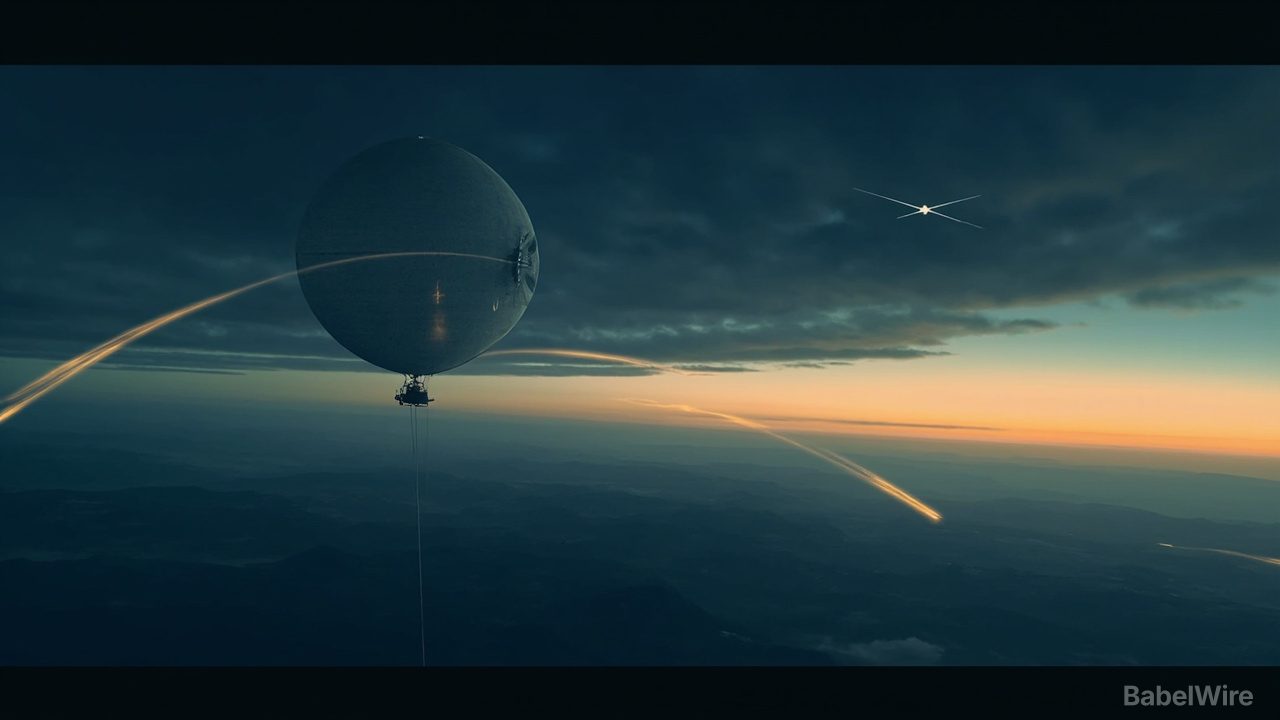
Military planners are looking upward — but not to satellites — for the next layer of airspace surveillance. A heise report describes efforts to carry radar on balloons, filling the space between ground stations that cannot see beyond the horizon and aircraft such as airborne early-warning platforms that are expensive to keep aloft around the clock.
The physics are the argument. A radar at altitude sees farther, and more importantly it looks down. That geometry suits the threats ground-based radar handles worst: drones, cruise missiles and terrain-hugging aircraft that are detected against ground clutter only at short range, if at all. A sensor above them has a cleaner line of sight and a longer warning window.
Balloons also offer persistence at a fraction of the operating cost of crewed or jet-powered platforms. A tethered or stratospheric balloon can stay on station for days or weeks, which shifts the economics from sortie-based to infrastructure-based: the cost is paid in station-keeping and logistics rather than in flight hours.
The trade-offs are equally clear. A balloon is slow, weather-sensitive and vulnerable, and it cannot reposition to chase a contact the way an aircraft can. Its value depends on how well its radar data can be fused into a common air picture alongside everything else, and on whether the balloon can hold a useful position rather than drifting with the wind.
The concept fits a broader turn toward layered, distributed sensing: many cheap persistent nodes feeding one picture, so that no single expensive platform is a single point of failure. Whether balloon-borne radar becomes a permanent layer or a stopgap will be decided by station-keeping performance and by the inglorious engineering work of data fusion.