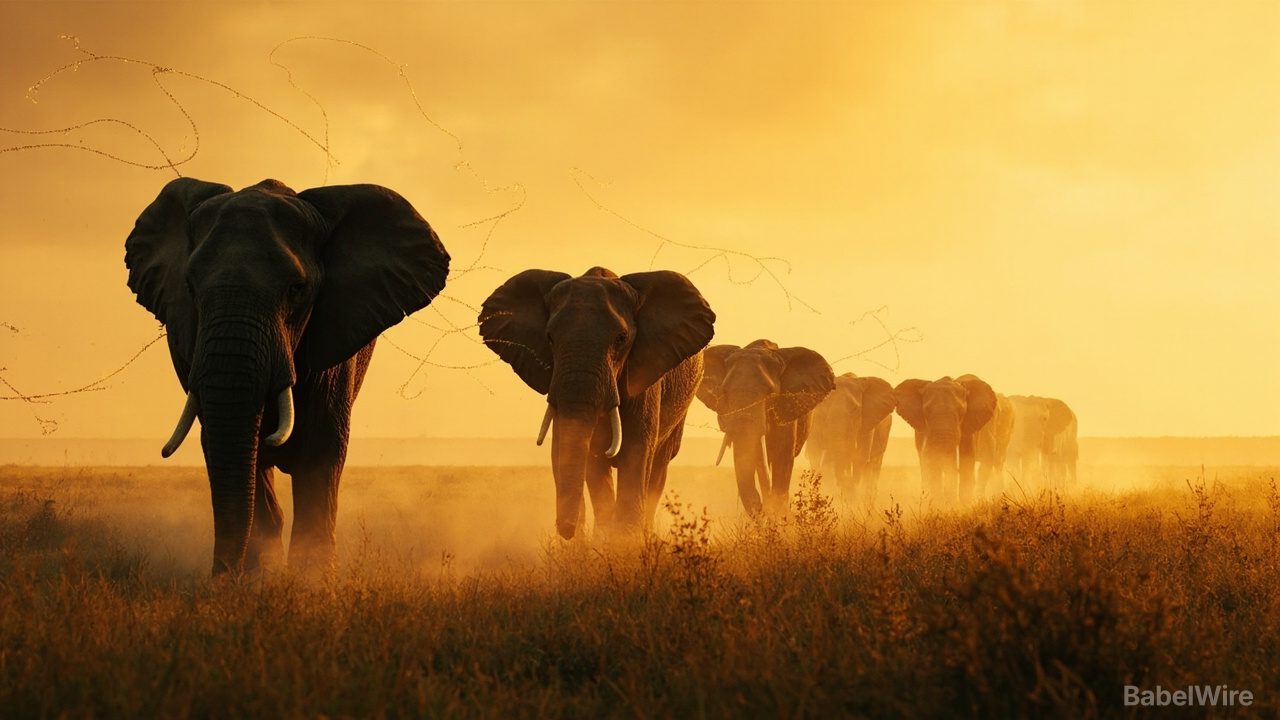
Researchers who spent twelve years following wild Asian elephants in Sri Lanka have documented a social tipping point: as the population gradually thinned, its tightly connected communities broke into smaller, more isolated groups, and the change looks hard to undo.
The study, led by postdoctoral researcher Anastasia Madsen in the lab of associate professor Shermin de Silva at UC San Diego, appears on the cover of the November 12 issue of Science. The team analysed the social dynamics of 443 wild female elephants at Udawalawe National Park, a roughly 119-square-mile reserve, tracking births, deaths, arrivals and departures alongside the animals' shifting relationships.
The pattern they describe is one of slow accumulation followed by sudden change. Losses from deaths, permanent emigrations and too few new individuals entering the population built up gradually. Then the society crossed a threshold: the same population moved from large, densely connected communities to smaller groupings with fewer links between them.
Crucially, the remaining elephants also changed how they related to one another, not simply how many relationships they had. Fewer individuals naturally means fewer connections; a reordered network means the survivors are not just rarer but differently integrated.
That matters because Asian elephants lean on their social groups to forage, share information and raise calves. "We see individual elephants leaving and possibly dying at accelerating rates, but new individuals are not coming into the population," Madsen said.
De Silva framed the finding in terms that reach beyond elephants. Social connectivity, she said, "is very much a matter of sharing space and building relationships throughout our lives." Resilient communities need to be able to replace the relationships they lose over time — and once a tipping point is passed, earlier states are much harder to recover.
Poaching and human-wildlife conflict already cut elephant numbers; disrupted habitat corridors and scarcer food add pressure. The study's authors argue that watching social structure — not just headcounts — is a practical early warning system for populations in trouble. The research was funded by U.S. Fish and Wildlife Asian Elephant Conservation Grants, the National Science Foundation, the University of Pennsylvania, UC San Diego and the nonprofit Trunks & Leaves.
Sources
- arstechnica.comArs Technica — In elephants, the resilience of communities has its limits
- science.orgScience — Increased demographic turnover and isolation precede social fragmentation (Madsen et al.)
- today.ucsd.eduUC San Diego — Elephants Found to be Increasingly Isolated, Leading to Fractured Social Networks
- eurasiareview.comEurasia Review — Population Losses Push Asian Elephants Past a Social Tipping Point