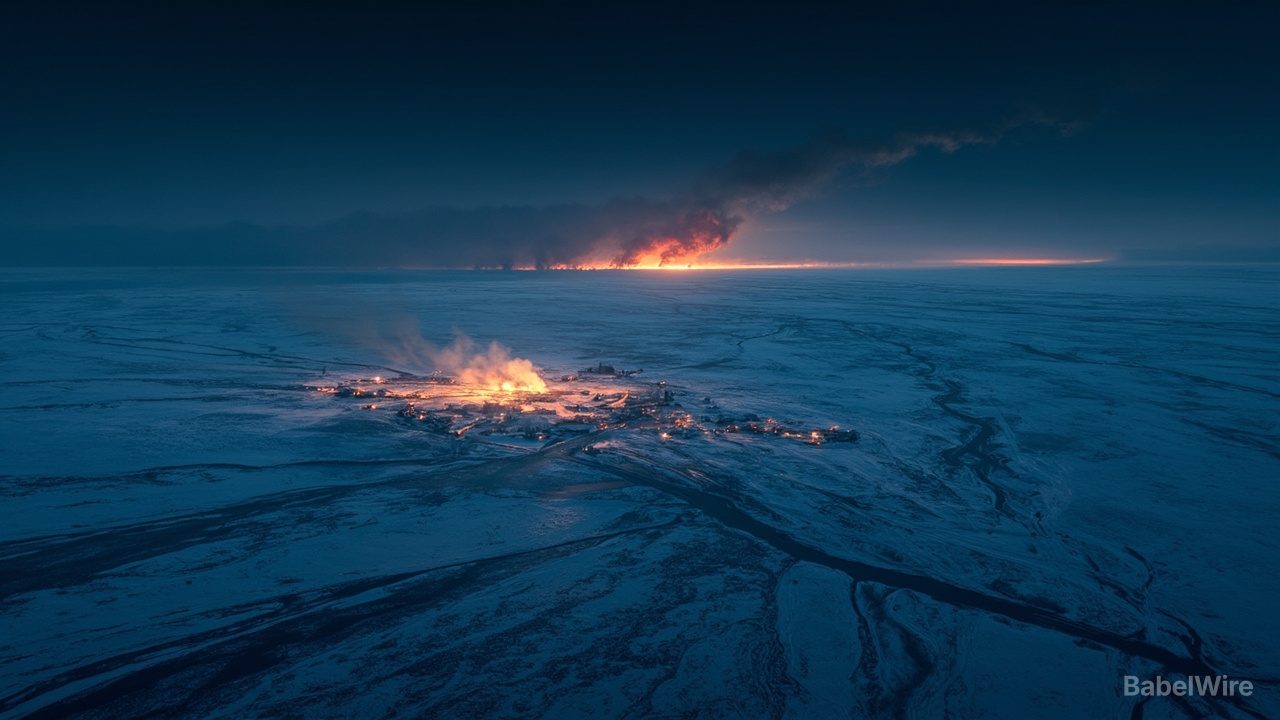
Arctic fires are driven not only by warming temperatures and drying landscapes, but also by human activity — and the human contribution is larger than previously appreciated, according to a new study in Communications Earth & Environment.
An international team led by the University of Zurich used artificial light at night as a satellite-based indicator of human presence across the Arctic between 2001 and 2013, since direct, consistent data on human activity in the region are hard to obtain. The results were striking: fires occurred 2.5 times more often in areas illuminated by nighttime light than in climatically similar unlit areas, and fire occurrence was higher closer to lit areas.
'This does not mean that human activity is the only driver of fires in the Arctic, as changing temperature, moisture, and drought conditions remain major factors,' said first author Cengiz Akandil, a postdoctoral researcher at UZH. 'The findings nevertheless show that human activity also plays an important role.'
The pattern also showed large regional differences in fire occurrence near lit areas, which the researchers say points to the influence of fire management, prevention measures and firefighting capacity. 'Better fire prevention and management around settlements, industrial sites, roads, and other lit areas could therefore help reduce ignition risks and limit fire damage,' Akandil said.
The stakes extend far beyond the Arctic. Smoke from major Canadian fires reached Europe last summer, and Arctic fires accelerate permafrost thaw and release carbon stored in frozen ground, feeding back into global climate change. The team, which included researchers from NASA's Goddard Space Flight Center and the University of Münster, argues that integrating fire prevention into land-use planning, industrial operations and community protection will become increasingly important as Arctic development continues.
'As Arctic development continues and climatological conditions become more fire-prone, integrating fire prevention into land-use planning, industrial operations, and community protection strategies will become increasingly important,' said senior author Gabriela Schaepman-Strub of UZH.