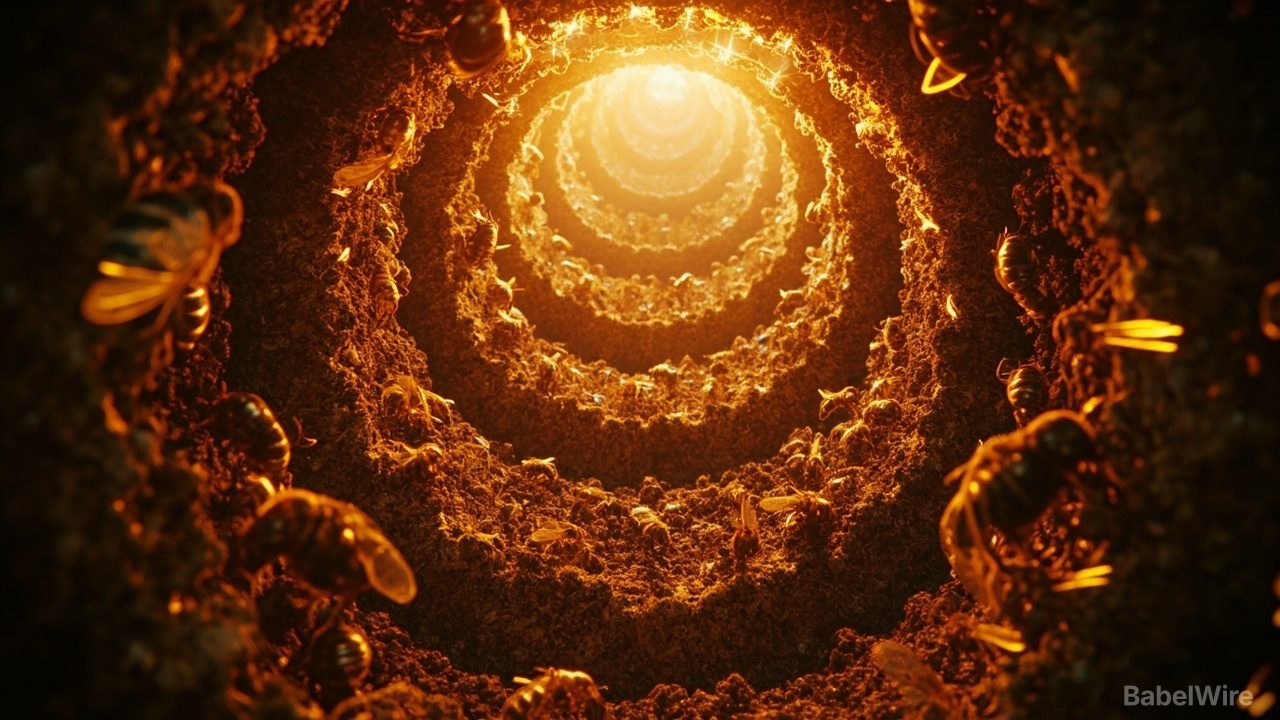
A 60-year-old pillar of evolutionary biology is wobbling. New research from Arizona State University suggests that haplodiploidy — the unusual genetic system shared by ants, bees and wasps, in which females develop from fertilized eggs and males from unfertilized ones — is not, on its own, what drove these insects to evolve eusociality, the most sophisticated form of social organization in the natural world.
For six decades, textbooks have taught that haplodiploidy made sisters more closely related to each other than to their own offspring, so females could gain a greater evolutionary advantage by helping raise siblings rather than reproducing. The hypothesis, rooted in W.D. Hamilton's inclusive fitness theory, seemed to explain why eusociality — colonies with queens, workers and overlapping generations — arose so often in ants, bees and wasps, yet only rarely in termites, aphids, thrips and a few beetles.
The new study, published in Current Biology by PhD student Sachin Suresh and senior author Timothy A. Linksvayer, put the idea to the largest empirical test yet. The researchers assembled data on social behavior and genetics from nearly 69,000 insect species, mapped them onto two of the largest species-level insect family trees available, and used phylogenetic comparative methods to estimate how often eusociality evolved under different genetic systems.
At first glance the classic story held: eusociality did seem to emerge more often among haplodiploid insects. But a deeper analysis revealed that nearly the entire statistical signal came from a single branch of the insect family tree — the aculeate Hymenoptera, which includes stinging wasps, bees and ants. Once that lineage's unusual evolutionary history was accounted for, haplodiploid insects elsewhere evolved eusociality at rates similar to those seen in diploid insects.
"When we formally tested it, we found there is no real association between the genetic determination system and eusociality," Suresh said. "It has more to do with environmental factors and the life-history traits of insects."
The real drivers, the authors argue, may be biological traits unique to these insects — stingers, specialized nesting behaviors and other life-history features — that made cooperation advantageous again and again. The finding reframes one of biology's most influential ideas and demonstrates the power of large comparative datasets to revisit theories that have gone largely unchallenged for decades.
Sources
- sciencedaily.comScienceDaily: A 60-year-old theory about ants, bees and wasps may be wrong
- phys.orgPhys.org: Decades-old theory for how insect societies evolve challenged
- cell.comCurrent Biology: Haplodiploidy alone does not predict the evolution of eusociality
- scitechdaily.comSciTechDaily: New Research Questions a Textbook Theory of How Insect Societies Evolve